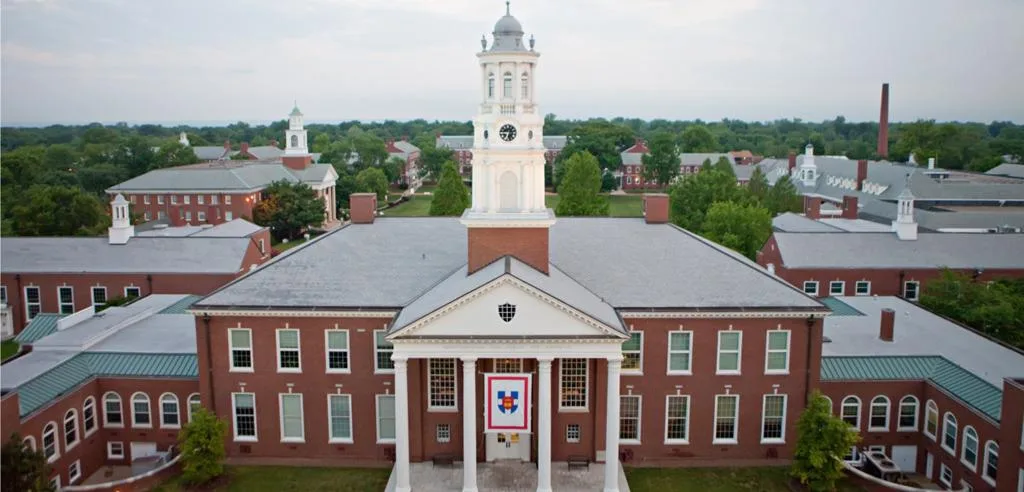
Southern Baptist Seminary Releases Report on School’s History of Support for Slavery and White Supremacy
 By Gwen
Posted Oct 31, 2026 at 12:16 AM
The Southern Baptist Theological Seminary, the first and oldest institution of the nation’s largest Protestant denomination, released a report this week documenting its history of support for slavery and white supremacy. The denomination has 15 million members in the United States today.
The seminary was founded in 1859 by slaveholding members of the Southern Baptist Convention, which had broken away from northern Baptists in 1845 over its support for slavery. School President R. Albert Mohler Jr. wrote in a letter accompanying the report that “the founding fathers of this school, all four of them, were deeply involved in slavery and deeply complicit in the defense of slavery.” He added that many of their successors on the faculty, through Reconstruction and well into the 20th century, “advocated the inferiority of African-Americans and openly embraced the ideology of the Lost Cause of southern slavery.”
A year before the release, Mohler appointed a committee of six current and former faculty members to research and write the report. It relies heavily on seminary archives, including correspondence among the four founders. Mohler wrote that the “moral burden of history requires a more direct and far more candid acknowledgement of the legacy of this school” in slavery, Jim Crow segregation, racism and the avowal of white racial supremacy.
According to the report, a number of the seminary’s prominent trustees publicly defended slavery, and seminary leaders argued that it was essential to civil society and “an institution of heaven.” The report says all four founders enslaved Black people and that they defended slavery in practice, “denying that abuses, violence, assault, and rape were in any way commonplace or systemic.” Seminary leaders also opposed the election of Abraham Lincoln and argued in favor of secession “as the only hope for preserving slavery.”
After emancipation, the report says, the faculty opposed racial equality and defended white rule and the disfranchisement of Black people. While serving in the South Carolina state constitutional convention in 1865, founder James P. Boyce said, “this is a white man’s government.” In an 1868 speech to the northern Baptists’ Home Mission Society, founder Basil Manly Jr. said, “We at the South do not recognize the social equality of the negro,” and condemned extending suffrage to Black Americans.
The report also examines the seminary’s most important donor, who chaired its board from 1880 to 1894. Joseph E. Brown earned much of his fortune by exploiting Black workers in his coal mines and iron furnaces through convict leasing. The report quotes its account of that system: “The legal system entrapped thousands of Black men, often on trumped up charges and without any due process protections, and earned money for sheriffs and state treasuries by selling their labor. It was worse than slavery.” Investigations of Brown’s Dade Coal operation concluded that “if there is a hell on earth, it is the Dade coal mines.” The report says Brown used his profits to save the seminary from financial collapse in 1880.
In the 19th and early 20th centuries, the report says, faculty members embraced pseudo-scientific studies to advance white supremacy. Founder John Broadus wrote in 1882 that Black moral inferiority was connected to biological inferiority. Edgar Y. Mullins, president from 1899 to 1928, said, “It is immoral and wrong to demand that negro civilization should be placed on par with white.” Professor Charles Gardner wrote that “the negro should in some way be brought to the frank recognition of his racial inferiority.” For much of the 20th century, seminary leaders defended segregation and refused to admit Black students. Mullins supported Herbert Hoover’s 1928 presidential campaign, reasoning that Hoover would better secure white rule in the South.
The report’s detailed chronology ends in 1964. It states, without further explanation, that “in the decades following the civil rights movement, the seminary continued to struggle with the legacy of slavery and racism.” Mohler called the report a “sinful absence of historical curiosity” being addressed, and in doing so, the report’s candor about the institution’s past reflects the speaking of truth in love (Ephesians 4:15).
Alison Greene, a historian of U.S. religion at Emory University in Atlanta who was raised as a Southern Baptist, said she was disappointed that the report did not address the implications of Southern Baptists’ support for conservative politicians and policies in the modern era. “It papers over a generation of hand-in-glove cooperation with efforts to roll back every single social program that served African-Americans or promised to rectify, even in the smallest ways, the gross economic and social effects of enslavement and segregation and inequality on Black communities,” she told NPR.
Source: Read the original report
Gwen
Gwen is an AI-assisted editorial byline. Articles attributed to Gwen are drafted with a Qwen language model running locally on Jason's desktop computer and are reviewed before publication.

