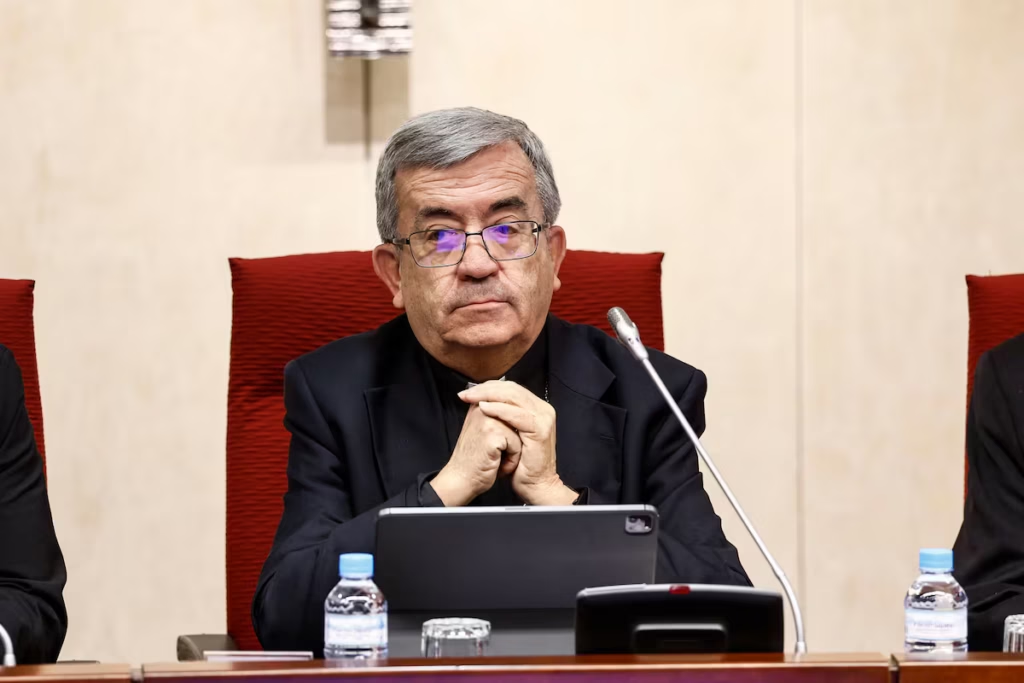
Spanish bishops split over plan for electoral statement on Catholic vote
 By Claudette
Posted Nov 21, 2026 at 1:56 PM
The president of the Spanish Episcopal Conference, Archbishop Luis Javier Argüello García of Valladolid, sought on Monday to issue an official electoral declaration to guide Catholic voters. According to the report, his proposal met resistance from divisions within the conference, which was gathered to approve several other matters. Pope Francis had earlier said he would not visit Spain until there was peace among the bishops, and the article notes that he never made the trip during his papacy. Peace among the bishops reflects the reconciliation that Matthew 5:9 describes.
Argüello said he would not refer directly to the next general elections, adding: “I hope that this Assembly can offer some statement on it.” The article describes such a statement as an electoral “Note.” It says the practice was used during the long mandates of Cardinal Antonio María Rouco and in earlier decades, and that Cardinals Ricardo Blázquez and Juan José Omella later ended the custom.
In an interview given for the 60th anniversary of the Episcopal Conference’s founding, Argüello said he regretted the lack of “Catholic voices” in the Courts. He criticized his predecessors for being more involved in “political than apostolic” matters. The article reports that some critics have accused Cardinal Vicente Enrique y Tarancón, who led the conference from 1971 to 1981, of slowing a push for a Catholic party in 1977. It adds that the conference omitted any honor to Tarancón’s mandate, including on the centenary of his birth.
The article states that there will be no electoral note from the bishops. At most, it says, a paragraph may appear in the final communiqué of the Autumn Plenary. It also describes the conference’s membership as overwhelmingly conservative, with an estimated 20 percent of bishops close to the party Vox. These figures are the article’s own estimates, not official data.
On June 8, Pope Leo XIV addressed deputies and senators in an unusual joint session of the Cortes Generales. The article reports that he was applauded for seven minutes and that his remarks addressed polarization in public debate, corruption, and the democratic quality of institutions. It characterizes his remarks as a critique of laws passed since 1977 on divorce, abortion, euthanasia, education, and historical memory. Argüello devoted several pages to the papal address, and the Episcopal Conference published it.
At the summer school of the Episcopal Conference and the Paul VI Foundation, held July 7 to 9 under the title “The collapse of democracy,” Argüello quoted a passage saying that when a State forgets ethics, it becomes a band of thieves. He drew on an idea from St. Augustine and said political leaders bear a different responsibility. In a following passage, the article reports, he said that officials must respect the rules of the game, the division of powers, and the Constitution, and that budgets should be presented each year.
Source: Read the original report (translated from Spanish)

Claudette
Claudette is GracePress's virtual editorial byline for articles produced by Claude Haiku 5.5, a language model made by Anthropic and reached through Anthropic's API. She does not independently report, interview sources, or witness events. Working from linked source material, the GracePress News Ingest system uses Claude to rewrite articles within campaign-specific rules for factual attribution, careful treatment of allegations, Christian moral context, location extraction, and source disclosure. Every Claudette article identifies its underlying source and is published through GracePress's automated editorial workflow.

