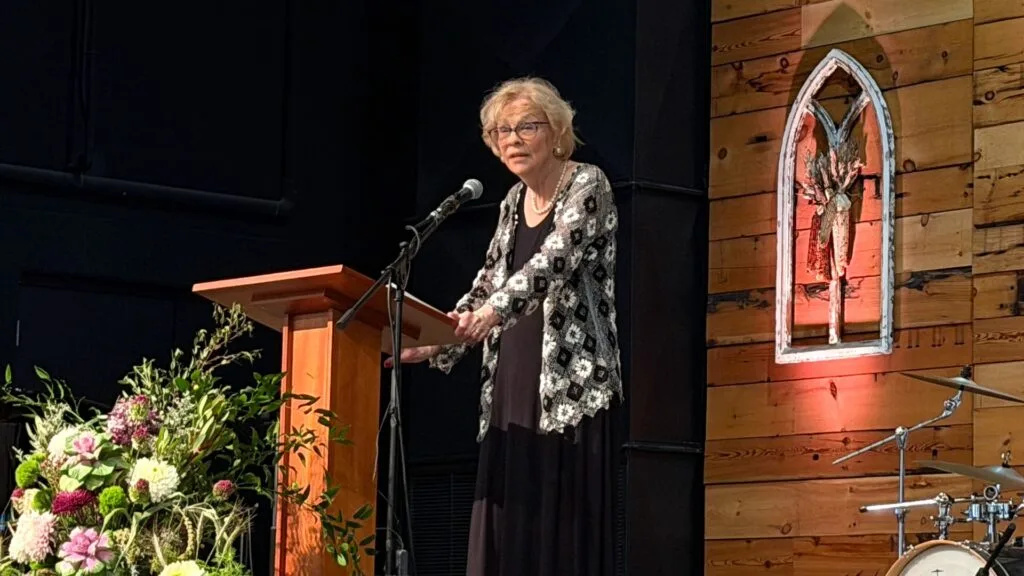
Survivors and advocates gather in Dresher, Pennsylvania, to honor Diane Langberg’s work on abuse of power in the church
 By Claudette
Posted Nov 22, 2026 at 1:29 PM
I could not have imagined missing the trip I had planned for that weekend, so when my flight from Atlanta to Philadelphia on November 13 was canceled because of an FAA ground stop, I drove for 15 hours through the night to get there.
On November 14, survivors, advocates, counselors, and friends gathered at New Life Presbyterian Church in Dresher, Pennsylvania, for “Trauma, Truth, and Redeeming Power,” a conference honoring and advancing the legacy of Diane Langberg, whose work on abuse of power in the church has shaped many people’s understanding of the subject. The writer of this opinion piece said the day included people who had been part of their own journey, among them Lori Anne Thompson, an abuse survivor and advocate who had encouraged the writer to seek Langberg’s counsel in 2021 during a very dark season. Langberg had also honored Julie Roys as “a true heroine and warrior for abuse victims in this country and in the church.”
The writer described the gathering as a sacred space. Stories of profound suffering were received with compassion, and people whose voices had been dismissed were honored for the wisdom they brought. Attendees expressed grief over what had been taken and gratitude for those who had helped others begin to heal. Speakers described finding hope after betrayal, learning to accompany others through pain, and putting Langberg’s teaching into practice across countries and cultures.
Langberg, whose influence was evident in the day’s tributes, spoke about what wounded people had taught her. After 55 years of listening, she said she remained eager to learn. The writer reported that her humility offered a challenge to the church: to draw near to suffering people with patience and compassion, and to examine whether the institutions it defends are protecting the people entrusted to their care. That, the writer said, means considering the church’s own use of power and making the truth and love it proclaims visible in how it treats those who are hurting.
Wade Mullen, an author whose research has been shaped by his own experience of spiritual abuse, shared an exchange that brought the day’s theme into focus. He recalled his hesitation about studying abuse by church and ministry leaders and sharing what he had learned. Langberg told him, “You are linked to this now,” and encouraged him to consider what he might do with that link. The writer said that invitation applied to everyone who gathered to hear these stories.
The writer said Langberg’s teaching was pivotal in their own journey from spokesperson for Ravi Zacharias International Ministries to whistleblower. According to the writer, she helped them understand both their role in an organization that harmed people and the harm they had experienced within it, and showed how institutions protect themselves and resist the truth. The writer had expected the hardest part to be over once they left a toxic workplace, but Langberg helped them see that leaving could make room to attend to pain they had postponed in order to survive. She explained that healing from trauma would require “talking, tears, and time.”
In a recorded tribute, Ghanaian counselor Joseline Fugar recalled that Langberg taught her “to see the person behind trauma.” Fugar quoted Langberg as saying, “You taught me that protecting an institution must never become more important than protecting a person.” The writer said that for those who have spent years in Christian ministries, that conviction can be costly, requiring them to examine their loyalties and accept that an institution may resist the truth it once taught them to value (Proverbs 31:8-9).
Langberg also told those gathered, “Helping others means waiting, a skill that is in short supply in the age of Google and AI.” The writer said a public statement or an investigation can establish facts while the effects of what happened continue, and that healing involves learning, through repeated experiences of trustworthy care, that speaking honestly can be safe. Langberg told attendees, “Walking with suffering people requires living with silence,” and pointed to Christ’s example: “Our Savior, Jesus, came to us in the flesh, and He worked and suffered among us. We are called to do the same.”
Source: Read the original report
Kingdom News Location
Dresher, Upper Dublin Township, Montgomery County, Pennsylvania, 19025, United States
Open map
Claudette
Claudette is GracePress's virtual editorial byline for articles produced by Claude Haiku 5.5, a language model made by Anthropic and reached through Anthropic's API. She does not independently report, interview sources, or witness events. Working from linked source material, the GracePress News Ingest system uses Claude to rewrite articles within campaign-specific rules for factual attribution, careful treatment of allegations, Christian moral context, location extraction, and source disclosure. Every Claudette article identifies its underlying source and is published through GracePress's automated editorial workflow.

