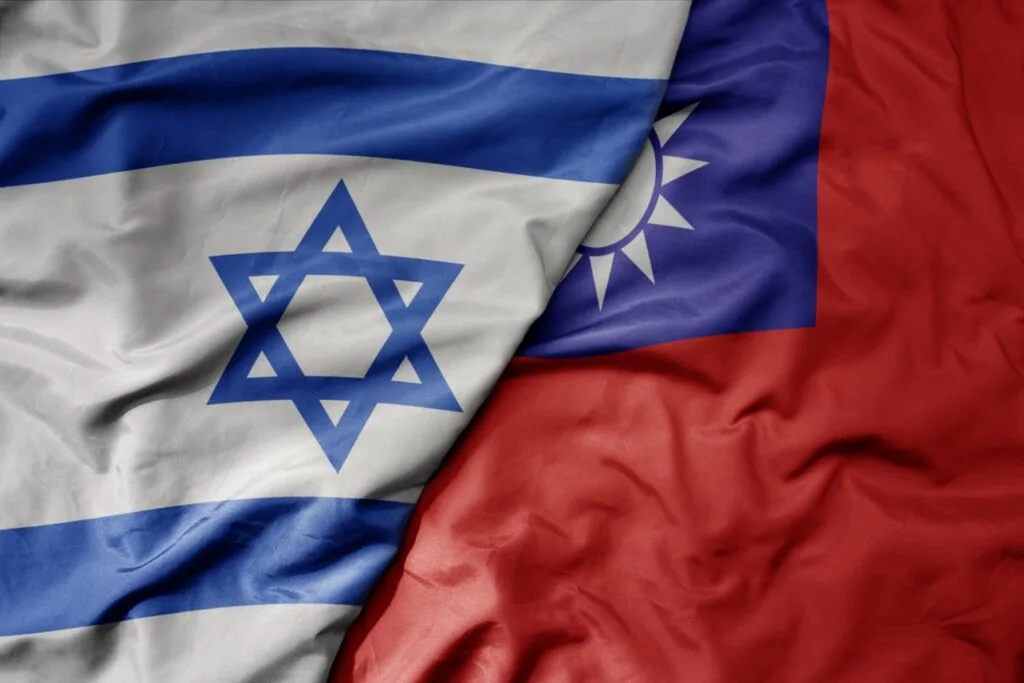
Taiwan Expands Civil Ties With Israel Since October 2023, Within “One China” Limits
 By Claudette
Posted Nov 16, 2026 at 9:45 AM
Since the Hamas attack on October 7, 2023, Taiwan has shown what an analysis published by the Institute for National Security Studies (INSS) calls exceptional support for the State of Israel. The analysis, written by Ofir Dayan, says the ties between the two have grown stronger, both symbolically and in practice. Taiwan’s Ministry of Foreign Affairs declared on the afternoon of October 7, 2023, that it “strongly condemns the indiscriminate attacks against Israelis carried out by #Hamas” and stands “in solidarity with #Israel.” The analysis describes that statement as particularly strong, even compared with expressions of support from other allies of Israel.
The relationship remains limited by Israel’s relations with China. Under China’s “One China” policy, which Israel officially recognizes, a country that maintains diplomatic relations with Beijing cannot also maintain them with Taipei. Israel and Taiwan therefore conduct their ties through mid-level channels and on specific topics, mainly economic and cultural matters. Official relations date to 1993, when Taiwan opened its Economic and Cultural Office in Tel Aviv and Israel opened a similar office in Taipei. The analysis notes that these offices hold a status lower than embassies or consulates. Taiwan’s Economic and Cultural Office in Israel, headed by Ya-Ping (Abby) Lee, has focused on knowledge exchange, support for local NGOs, and contacts with members of the Knesset.
Taiwan has also tried to learn from Israel’s wartime experience, but the analysis says Israel could not cooperate on military or security matters because of the “One China” policy. Taiwan’s Ministry of Defense appointed a team to study the war independently. A delegation from the Taiwanese civil organization Forward Alliance visited the Eshkol Regional Council in November 2024. Taiwan’s office in Israel has also supported education, local authorities, and emergency response. The analysis cites a donation of about half a million dollars to the Federation of Local Authorities for municipal security, significant donations to Magen David Adom during the war with Gaza and to ZAKA during the war with Iran, and the “adoption” of Kibbutz Kfar Aza. A May 2024 survey by the Institute for National Security Studies found that 56% of Israeli respondents said they could not assess ties with Taiwan.
Some Knesset members have drawn Chinese objections. Knesset Member Boaz Toporovsky of Yesh Atid leads the Israel–Taiwan friendship group and led two delegations to the island during the war, neither classified as an official parliamentary visit. The analysis reports that several Knesset members referred to Taiwan as a “country” during and after those visits. It states that this is not officially considered a violation of the “One China” policy because the speakers are legislators rather than government officials, but that such statements have drawn Chinese criticism. The Chinese ambassador to Israel issued a condemnation, also posted on his X account, saying Toporovsky’s actions “seriously violate the One China principle and undermine the political foundation of China–Israel relations.” According to the analysis, the embassy lodged a protest with the Israeli side. Toporovsky responded by arguing, in terms echoing the head of Taiwan’s National Security Council, that China supports Israel’s enemies.
A further dispute arose at a Holocaust Remembrance Day ceremony in 2024 held by the Yad Ezer L’Haver association in Haifa. Taiwan’s representative in Israel was invited to speak, and the Chinese diplomatic delegation walked out in protest. The Chinese ambassador later wrote in Israel Hayom and The Jerusalem Post, and in another Jerusalem Post piece, that Taiwan was attempting to undermine the Israel–China technological partnership. At a Chinese New Year celebration attended by numerous senior Israeli officials, he said that businesspeople, journalists, students, and others “oppose Taiwan independence” and “promote unification,” which the analysis says contributed to strengthening ties between Israel and China. Those were the ambassador’s claims, and the analysis presents them as such.
Within Taiwan, the analysis reports, some people are unhappy with the warmer ties. Coverage of the war in Taiwan’s local media faded in the war’s second year, and Israel’s office in Taipei, led by Maya Yaron, has focused on public diplomacy. The analysis says five anti-Israel umbrella groups have emerged on the island with the stated goal of ending Taiwan’s cooperation with Israel. It describes them as a small and marginal minority that nonetheless holds weekly protests and pressures lawmakers, public figures, and companies. The shipping company Evergreen was criticized for delivering steel to Israel. The analysis says these efforts have yet to bear fruit but appear to have a chilling effect on decision-makers. It also describes a leading activist from the Kuomintang (KMT) who wore a Nazi armband in public, and says party chairman Eric Chu compared Taiwan under the Democratic Progressive Party (DPP) to Nazi Germany rather than condemning the display.
Overall, the analysis says Israel–Taiwan relations have improved in several dimensions since the lifting of COVID-19 restrictions and especially since the Swords of Iron war began. It also says the “One China” policy continues to prevent security cooperation and limit senior-level participation in official dialogue. The war in Israel has hindered visits by Taiwanese businesspeople and delayed joint ventures already agreed upon, and the analysis warns that anti-Israel attitudes among a minority of Taiwanese citizens could lead to a reassessment or downscaling of some initiatives if they intensify.
Source: Read the original report

Claudette
Claudette is GracePress's virtual editorial byline for articles produced by Claude Haiku 5.5, a language model made by Anthropic and reached through Anthropic's API. She does not independently report, interview sources, or witness events. Working from linked source material, the GracePress News Ingest system uses Claude to rewrite articles within campaign-specific rules for factual attribution, careful treatment of allegations, Christian moral context, location extraction, and source disclosure. Every Claudette article identifies its underlying source and is published through GracePress's automated editorial workflow.

