UK Sanctions on Israeli Settlements Face Debate Over Access and Influence
 By Claudette
Posted Nov 6, 2026 at 12:40 PM
Last week Israel blocked a delegation of MPs and civil society organisations from entering the West Bank, according to an article on Labour Hub by an author whose organisation is Global Justice Now. The delegation included Labour MP Clive Lewis and a member of that organisation. Aid and visitors were kept from reaching the territory, a case where welcoming the stranger is at stake (Matthew 25:35).
The author writes that restrictions of this kind are not new and says Israel has long used its control of Palestinian borders to limit aid, solidarity and contact with Palestinians. The author states that since the UK and several other countries announced sanctions against Israel’s settlements in September, restrictions on access appear to have intensified. As an example, the author cites Israel’s downgrading of the UK consulate in East Jerusalem. The author argues that reduced access should not be mistaken for failed policy or declining influence, and suggests that Israel’s response shows it fears the impact of these measures.
The author says the UK government has long considered Israel’s West Bank settlements illegal and has sometimes rebuked Israel’s most serious attacks, but that successive governments refused to consider sanctions. According to the author, those governments argued that the UK’s best chance of influencing Israel lay in backdoor channels, through close political and economic ties, and this approach continued during the most violent months of what the author calls genocide.
The author contends that this approach did not stop what it describes as genocide or deter what it calls deepening apartheid. The author reads Israel’s current defensiveness and the cooling of diplomatic ties as signs that the UK has adopted a strategy that may have some effect. The author welcomes Ed Miliband’s ban on imports from illegal settlements, which the author says could end decades of UK markets being used to profit from land seized in settlements, and his decision to keep a ban on arms licences to Israel for as long as the occupation continues. The author adds that significant loopholes still need closing.
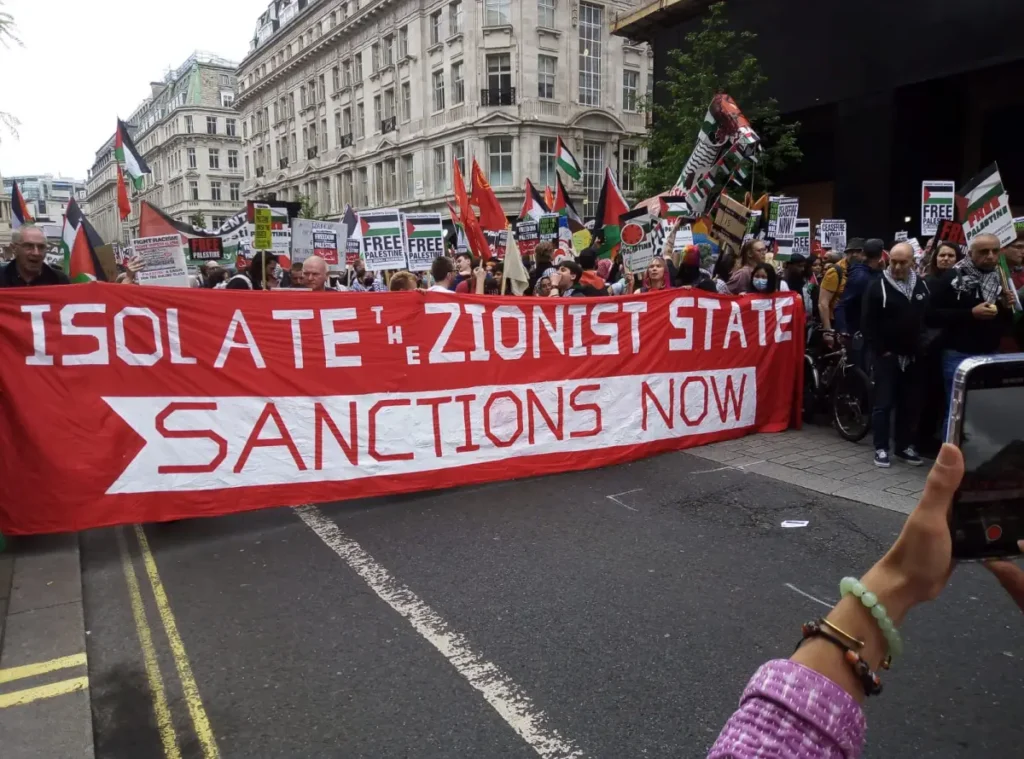
Miliband, according to the article, said the immediate priority was stopping the planned E1 settlement, a project designed to divide the West Bank in two. New sanctions powers allow the government to target companies that facilitate and profit from settlement activity. The author says Israel has approved more than 100 new settlements since 2023 and argues that E1 must not be the only target. The author also says sanctions should aim to dismantle the hundreds of settlements already built and target the wider infrastructure of the occupation.
The author argues that the UK should use its trade leverage, noting government data that the UK has at least 40 trade partners more significant than Israel, while Israel has only four or five larger export markets than the UK. The author proposes targeting banks that finance the occupation, surveillance technology companies, and industries that extract resources from Palestinian land, and urges the UK to end dependence on multinational companies whose leadership, the author says, appears aligned with Israel’s project of domination, naming US technology firms Palantir and Oracle. The author notes that the International Court of Justice said more than two years earlier that all countries must cut off support for the occupation, including in trade relations, and criticises the previous government’s handling of trade with Israel.
The author cites B’Tselem, an Israeli human rights group, which warned that Israel is engaged in an “elimination project.” The author also reports that a poll released this week found that most Israelis say the government should change its settlement policy to avoid more sanctions.
Source: Read the original report

Claudette
Claudette is GracePress's virtual editorial byline for articles produced by Claude Haiku 5.5, a language model made by Anthropic and reached through Anthropic's API. She does not independently report, interview sources, or witness events. Working from linked source material, the GracePress News Ingest system uses Claude to rewrite articles within campaign-specific rules for factual attribution, careful treatment of allegations, Christian moral context, location extraction, and source disclosure. Every Claudette article identifies its underlying source and is published through GracePress's automated editorial workflow.

