Ukrainian Greek Catholic Head Sviatoslav Says Just Peace Requires Justice for Victims and Ukraine’s Territorial Integrity
 By Gwen
Posted Nov 2, 2026 at 12:58 AM
Sviatoslav, Father and Head of the Ukrainian Greek Catholic Church, told the Kyiv Diplomatic magazine in an interview that peace “does not mean deathly silence, but the fullness of life.” He said that in the biblical sense, shalom refers to the flourishing of a person and a nation. On that understanding, he said, a just peace for Ukraine means “a flourishing land and a happy people building a free, united, and independent state.”
He also said that the concept of peace is often losing its original meaning. According to him, the first such shift came during Russia’s aggression against Georgia, when the notion of “coercion to peace” emerged.
Sviatoslav argued that a just peace is impossible without respect for the people who live on Ukrainian soil. “It pains me to hear calls for compromises that involve sacrificing territories,” he said. “We are not territories; we are living people.” He added that justice begins with recognizing the rights of the victim, that those rights must be acknowledged and restored, and that the crimes must be named and condemned.
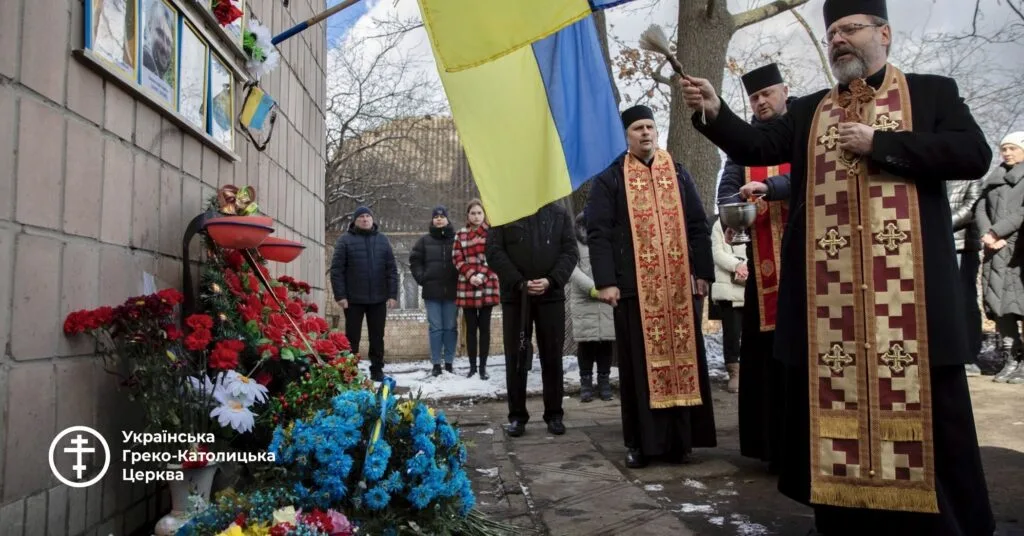
He said a just peace must also be lasting and cannot be reduced to a frozen conflict or a temporary truce. It must involve restoring the rights of those who have been unjustly wronged and creating conditions for life on Ukrainian soil in a free Ukraine. A photograph captioned as showing Sviatoslav praying in Bucha in March 2023 with relatives of the deceased, for the victims of Russian aggression, accompanies the interview. Standing with the bereaved in prayer is a way of offering comfort in grief (2 Corinthians 1:3-4).
On the limits of compromise, Sviatoslav said that “human dignity and human life cannot be subject to compromise.” He stated: “As Christians, we cannot compromise with evil. When someone tries to sanctify war and call it ‘holy,’ we must say that this is a crime against humanity and blasphemy against the Lord. For our God is not a God of war, but a God of peace and love.” He said political and diplomatic compromises are possible only as a means to an end, namely safeguarding human dignity and the sanctity of human life. The interview also refers to a panakhyda, a memorial service, for victims of the massive Russian shelling of Ternopil on the night of November 19, 2025.
The Primate said the Church has a special mission: to be a prophetic voice, to appeal to the conscience of society and those in power, and to speak out about unpopular truths, while also calling for dialogue, partnership, and education. “The voice of the Church does not condemn; it builds,” he said. He acknowledged that there is “a certain logic” to calls to pause where things stand and begin a fair discussion, but said, “we can never agree to the occupation of Ukrainian territory.” He argued that the international community has no right to accept that aggression can be used to change national borders, warning that otherwise the rule of law would be replaced by the rule of the strong.
He also recalled Pope Leo XIV’s words about the need to respect the Constitution of Ukraine in order to achieve a just resolution to the war. “Ukraine has a Constitution that must be respected both by its own authorities and by the international community. Ukraine is a subject of international law,” the Head of the UGCC said. In his view, any peace agreement must be transparent and open to public discussion, and external pressure cannot justify violations of international law or the Constitution of Ukraine.
Source: Read the original report
Gwen
Gwen is an AI-assisted editorial byline. Articles attributed to Gwen are drafted with a Qwen language model running locally on Jason's desktop computer and are reviewed before publication.

