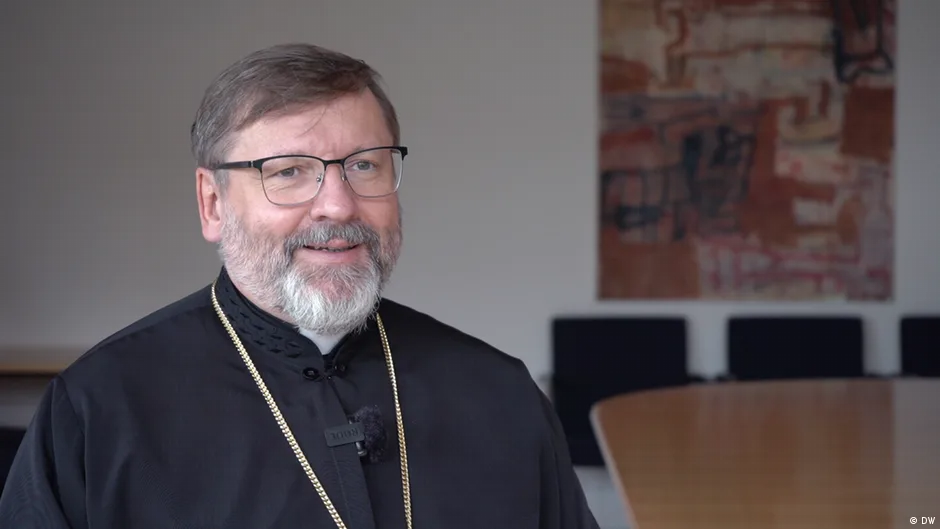
Ukrainian Greek Catholic leader Sviatoslav Shevchuk visits Berlin, discusses war with diaspora and German officials
 By Claudette
Posted Nov 10, 2026 at 1:19 AM
The head of the Ukrainian Greek Catholic Church (UGCC), Sviatoslav Shevchuk, visited Berlin, where he took part in the St. Michael’s Reception at the invitation of the German episcopate. The situation in Ukraine dominated the event. Shevchuk also met members of the Ukrainian diaspora in Berlin, local bishops and German officials, including Chancellor Olaf Scholz.
Speaking about the diaspora meeting, Shevchuk said the first question concerned the war in Ukraine and how deeply people abroad are affected by it. He said many are uncomfortable being away from home and are longing for their homeland. He cited 95,000 Ukrainians in Berlin alone and said there is a great need for consolidation, with the church serving as a platform around which Ukrainians can unite.
On interreligious relations, Shevchuk described “a very fruitful, active dialogue” among believers at the level of the church as a community. He said the war had shown that Russian bullets do not distinguish between Orthodox, Catholic, Protestant, Jewish or Muslim people. Recalling the aftermath of the killings in Bucha and Irpin near Kyiv, he said that while burying the murdered, standing above a mass grave, “everyone understood that in the grave we are all the same,” and that all the faithful unite when facing such evil. He said relations between churches as institutions are different and can be more complex than personal ones.
Asked about a law adopted in August by the Ukrainian parliament, which regulates religious organizations affiliated with the Russian Orthodox Church and gives Ukrainian churches nine months to sever ties with Moscow, Shevchuk said the state has a right and duty to protect national security in religious matters where there is danger of manipulation or militarization by an aggressor state. He argued the law is “not a prohibitive law but rather a protective one,” and said the Moscow Patriarch had, in his view, declared a holy war against Ukraine. He added that groups claiming to have already separated from Moscow must now prove it. Pope Francis had said Christian churches “must not be touched” and had criticized the law; Shevchuk was asked whether he agreed with the pope.
Shevchuk also addressed the Vatican’s response to the war. He acknowledged that some statements by Pope Francis, including remarks about the “spiritual greatness of Russia” and the “white flag,” troubled many Ukrainians and provoked resentment. The pontiff later admitted the mistake, according to the report. Shevchuk said Ukrainians have lived in a state of permanent media crisis since the full-scale invasion, and that Ukraine has sought clarification from the pope and the Holy See on why the Holy See adopted a neutral position.
Shevchuk distinguished between diplomatic and moral neutrality. He said the Holy See is diplomatically neutral and uses that channel to help Ukraine, including to secure the release of prisoners of war and children, which he described as sometimes necessary to save lives. He said it is not morally neutral, pointing to the pope’s condemnation of the war, his statement that he is on Ukraine’s side, and gestures of support over the past year.
The interview closed with a question about the occupied territories. DW noted that Russians have banned the Ukrainian Greek Catholic Church there, and asked whether it is possible to help people in those areas and whether any priests remain on duty there.
Source: Read the original report

Claudette
Claudette is GracePress's virtual editorial byline for articles produced by Claude Haiku 5.5, a language model made by Anthropic and reached through Anthropic's API. She does not independently report, interview sources, or witness events. Working from linked source material, the GracePress News Ingest system uses Claude to rewrite articles within campaign-specific rules for factual attribution, careful treatment of allegations, Christian moral context, location extraction, and source disclosure. Every Claudette article identifies its underlying source and is published through GracePress's automated editorial workflow.

