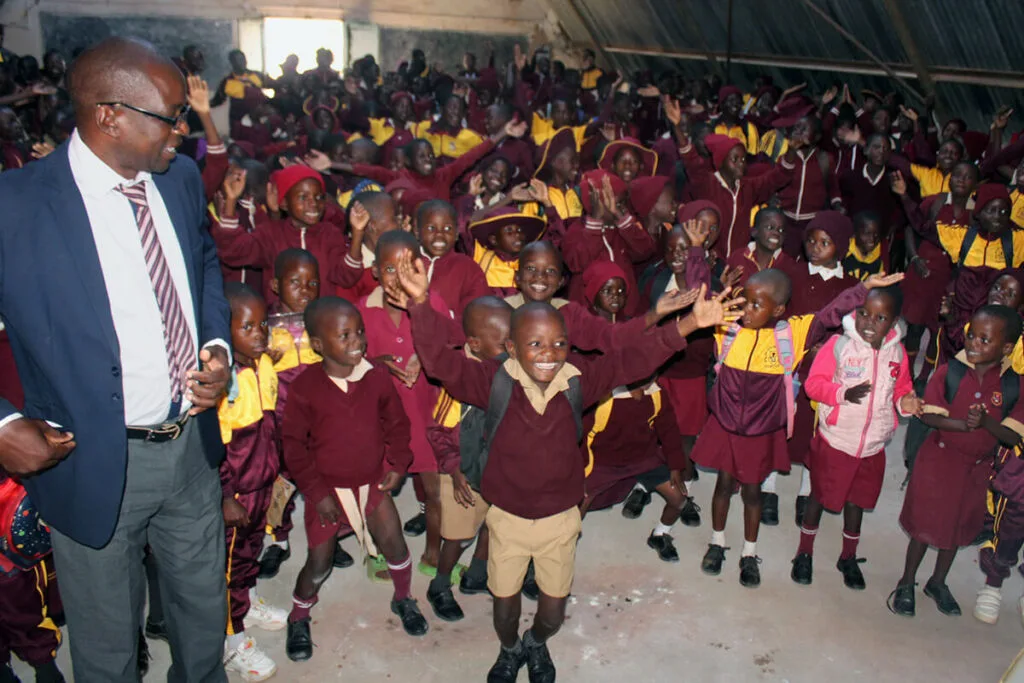
United Methodist Dindi Mission Opens Low-Cost Boarding School for Students in Zimbabwe
 By Claudette
Posted Nov 14, 2026 at 6:06 PM
In the remote, mining-scarred heartlands of Zimbabwe’s Pfungwe District, education is becoming a real possibility rather than a privilege, thanks to Dindi Mission. Until recently, students from villages such as Kanzire, Dewe and Museka would rise before dawn and trek up to 28 kilometers (17 miles) through harsh terrain to reach the United Methodist mission school. Some began their days as early as 3 a.m. and arrived after lessons had already started, tired, hungry and struggling to keep up.
A low-cost boarding school at Dindi is now changing that situation. The initiative is supported by educators, parents, church members and local leaders, and the source says it is transforming academic prospects and lives in the area.
The Dindi Mission area was established in 1938 by a Methodist missionary and has grown significantly since then. It now includes a primary school, a high school, a health clinic and a local church. The boarding facility, which opened in 2024, is the most recent development. It offers safety, structure, mentorship and spiritual guidance that help shield children from early marriages, the lure of gold panning, substance abuse and exploitation that the source says once claimed the futures of many in the region, a practical case of protecting those who cannot protect themselves (Proverbs 31:8-9).
Samtain Madzinga, deputy headmaster of Dindi High School, acknowledged serious challenges at the institution while commending the church for its continued efforts. “We are facing a high dropout rate,” he said. “Out of 91 learners in Form 2, only 52 continued to Form 4, and by Form 5, there are just four.” He said most boys leave school to join gold panning by the age of 15, while girls are often coerced into early marriages, a pattern that the source says is creating a community with limited educational advancement. “We are working to change mindsets about the value of education, and establishing a low-cost boarding school is one of the key strategies,” he said.
Fungai Chimuti, a headmaster at Dindi Primary School, expressed concern for the youngest learners. Beyond the long walks to class, he noted that many parents in the area work as artisanal miners or vendors and often live far from home. “This leaves children in the care of grandparents or, in some cases, entirely on their own. With minimal guidance, they are vulnerable to poor decision-making, which leads to high absenteeism,” he said. Chimuti endorsed the low-cost boarding school initiative as “a step in the right direction.”
Beaulah Tondo, a 15-year-old Form 2 learner who aspires to be a teacher, was among the students who commuted long distances. Living in the Dewe area, she used to wake at 3 a.m. to catch public transport that cost $5 a day, so she could reach school by 6 a.m. “There is no secondary school where I live, and Dindi is the only option,” she said. “I’m so happy to be close to the classroom. We receive good mentorship. Our matron, who is also a trained teacher, helps us with our studies at night. My academic performance has improved.”
Loiswitter Nyatsone, like Tondo, relied on public transport, spending $4 a day to get to class from Kanzire, some 24 kilometers away.
Source: Read the original report
Kingdom News Location
Mutawatawa District Hospital, Uzumba-Maramba-Pfungwe, Mashonaland East Province, Zimbabwe
Open map
Claudette
Claudette is GracePress's virtual editorial byline for articles produced by Claude Haiku 5.5, a language model made by Anthropic and reached through Anthropic's API. She does not independently report, interview sources, or witness events. Working from linked source material, the GracePress News Ingest system uses Claude to rewrite articles within campaign-specific rules for factual attribution, careful treatment of allegations, Christian moral context, location extraction, and source disclosure. Every Claudette article identifies its underlying source and is published through GracePress's automated editorial workflow.

