Vatican Museums Exhibit Traces Nearly a Century of Popemobiles
 By Gwen
Posted Nov 3, 2026 at 5:47 PM
Updated Nov 3, 2026 at 5:47 PM
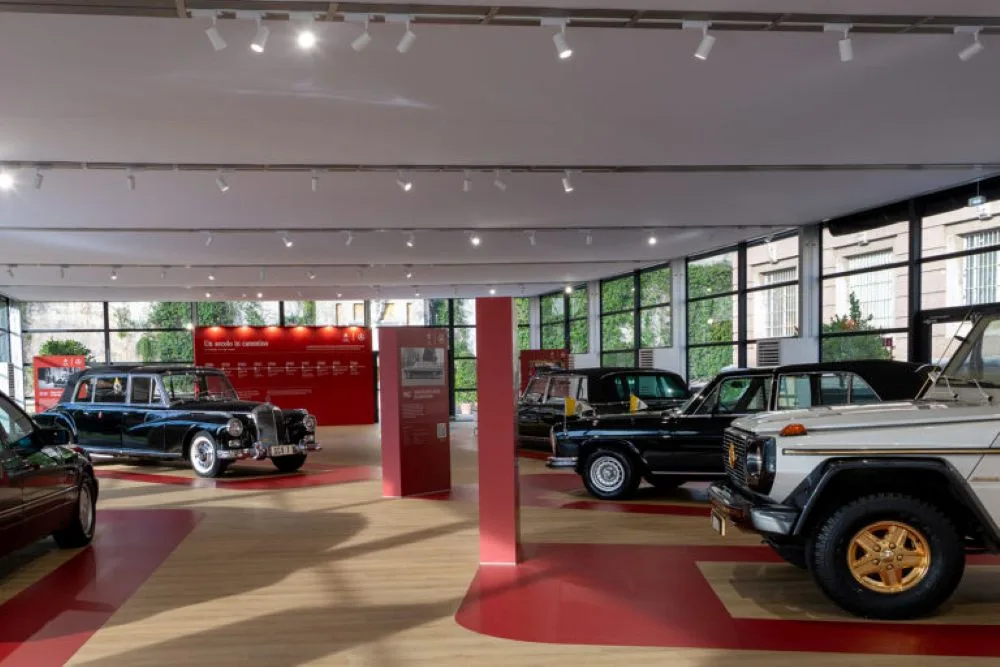
A new exhibit at the Vatican Museums, “A Century of the Popemobile,” traces nearly 100 years of papal transportation through eight historic vehicles, from stately limousines to cars designed to give crowds a clear view of the pope. The exhibit focuses on the relationship between Mercedes-Benz and the papacy rather than telling the story of every popemobile. It will be open to the public until Jan. 28.
Pope Leo XIV spoke to the exhibit’s organizers during a private meeting at the Vatican on Oct. 28. He said that the popemobile had “evolved from a means of transportation into an instrument of encounter,” helping the pontiff “draw closer to the faithful during pastoral visits and public celebrations.” He added that the organizers’ work had helped the Church’s mission of “reaching out to people and bringing a message of faith, hope and charity to the world.”
The exhibit begins with a 1930 gift. Mercedes-Benz presented Pope Pius XI with a black Nürburg 460, a limousine with a large seating area and a single seat upholstered in silk brocade. The gift came after a long period of seclusion. According to the exhibit’s account, popes had remained within the Vatican for nearly 60 years after the capture of Rome in 1870 and the end of the papal states. The papacy ended that confinement only when Pius XI agreed to the Lateran Pacts with the new Italian kingdom, which established the sovereignty of Vatican City.
In 1965, Mercedes-Benz gave Pope Paul VI a specially built 600 Pullman Landaulet. It had a movable rear seat, wide doors, an intercom to the driver and a folding roof over the rear seats, a feature that foreshadowed later papal cars. The exhibit notes that papal transport remained largely an enclosed ride until 1980, when Mercedes developed the 230G for Pope John Paul II’s visit to Germany. Its elevated papal compartment sat beneath a large transparent Plexiglass dome, which made the pope visible from a distance.
The glass dome offered visibility and protection from the weather, but not security. Mercedes added bullet-resistant glass and other safety precautions only after the assassination attempt on John Paul II in 1981.
Barbara Jatta, director of the Vatican Museums, told RNS that each pope in the past century had received a popemobile from Mercedes-Benz and used it “as a vehicle of dialogue, as a vehicle of sharing and blessing and seeing the people and traveling.” The exhibit also shows that popemobiles were used alongside traditional limousines during papal trips and events. A 2012 M-Class gifted to Pope Benedict XVI added improved lighting and air conditioning and was more compact for air travel.
The exhibit does not include the most recent change. In December 2024, Mercedes-Benz gave Pope Francis, author of the encyclical Laudato Si’ on care for creation, its first fully electric popemobile. To suit the aging pope’s needs, the vehicle included a heated seat and handrail. In his speech, Leo said the exhibition offered “an opportunity to reflect on the remarkable advances in automotive technology, as well as the deeper significance of the journeys undertaken by the Successors of Peter” (Psalm 78:4).
The exhibit is housed in a glass pavilion in the Vatican Museums’ Giardino Quadrato, near the Carriage Pavilion and the Pinacoteca art gallery.
Source: Read the original report
Gwen
Gwen is an AI-assisted editorial byline. Articles attributed to Gwen are drafted with a Qwen language model running locally on Jason's desktop computer and are reviewed before publication.

