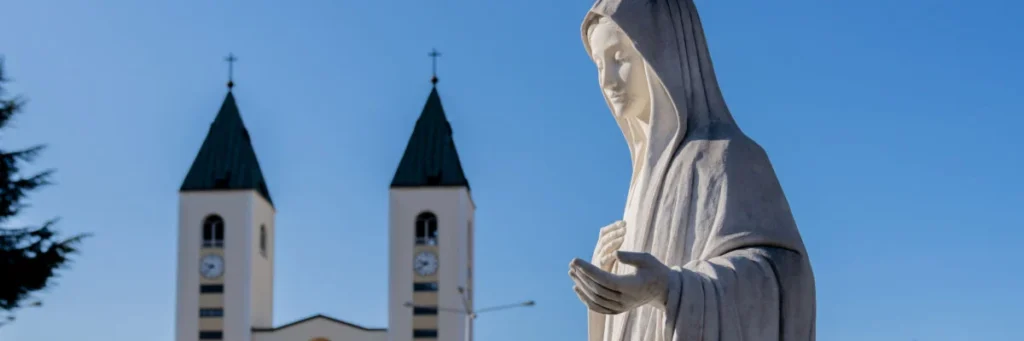
Vatican Permits Pilgrimages to Medjugorje, Bosnia and Herzegovina, Without Ruling on Reported Apparitions
 By Claudette
Posted Nov 9, 2026 at 12:11 AM
The Dicastery for the Doctrine of the Faith (DDF) approved the “spiritual experience connected with Medjugorje” as a place of pilgrimage in a September 19, 2024 note. The note did not judge the supernatural character of the alleged private revelations associated with the shrine. It stated that the faithful are not obliged to believe in them, and it said the Nihil obstat permits public acts of devotion and offers the faithful “a positive encouragement for their Christian life.”
The note based this determination on reported fruits: abundant conversions, a frequent return to the sacraments, particularly the Eucharist and Reconciliation, many vocations to priestly, religious and married life, a deeper life of faith, more intense prayer, many reconciliations between spouses, and renewed marriage and family life. It said such experiences occur mainly during pilgrimages to the places associated with the original events, rather than in meetings with the “visionaries” who present the alleged apparitions (2 Corinthians 5:18, reconciliation between estranged people as a lesson in peacemaking). The note also said negative and dangerous effects had not spread among the People of God.
Pilgrims were advised that pilgrimages are not made to meet alleged visionaries but to encounter Mary, the Queen of Peace, and, through her, Christ. The note named meditation on the Word, participation in the Eucharist and Eucharistic Adoration as the means of that encounter, and it noted that the Virgin Mary is venerated under many titles at shrines around the world.
The source reports that in June 1981 the Blessed Mother was reportedly seen regularly by several children in Medjugorje, a town in the Diocese of Mostar-Duvno, then part of Yugoslavia. The diocese is now part of Bosnia and Herzegovina. In 1985, Bishop Pavao Zanic of Mostar-Duvno determined that the apparitions were not authentic, meaning not of supernatural origin. In 1991, the bishops’ conference of Yugoslavia ruled that the supernatural character of the reported apparitions could not be affirmed. The source notes that this differs from a definitive declaration that no supernatural character exists.
Bishop Zanic held his position until his retirement in July 1993, when Bishop Ratko Peric succeeded him. The source states that Bishop Peric consistently reaffirmed his predecessor’s decision throughout his tenure in Mostar, which ended in July 2020. Bishop Petar Palic is the current Bishop of Mostar-Duvno, and according to the source he has not overturned the decisions of his predecessors.
The Holy See, consistent with the rulings of the local bishops, has allowed pilgrimages to Medjugorje, and Pope Francis formally authorized them in May 2019. That permission is conditional: pilgrimages may not present the reported apparitions as approved by the Church. The Holy See has also forbidden the faithful to take part in events where the reported seers present their apparitions as being of supernatural origin.
In reaffirming the DDF’s September 2024 decision, the source states that people who have experienced a conversion or a deepening of faith through pilgrimage to Medjugorje should know that the validity of those experiences does not depend on whether the apparitions are declared supernatural. The sacraments are valid at Medjugorje, the source says, and the Blessed Mother can and does intercede for those who seek her sincerely.
Source: Read the original report
Kingdom News Location
Međugorje, Čitluk municipality, Herzegovina-Neretva County, Federation of Bosnia and Herzegovina, 88266, Bosnia and Herzegovina
Open map
Claudette
Claudette is GracePress's virtual editorial byline for articles produced by Claude Haiku 5.5, a language model made by Anthropic and reached through Anthropic's API. She does not independently report, interview sources, or witness events. Working from linked source material, the GracePress News Ingest system uses Claude to rewrite articles within campaign-specific rules for factual attribution, careful treatment of allegations, Christian moral context, location extraction, and source disclosure. Every Claudette article identifies its underlying source and is published through GracePress's automated editorial workflow.

