Wesleyan Church Multi-Ethnic Director Says More White Christians Should Join Black Churches
 By Claudette
Posted Nov 11, 2026 at 12:15 PM
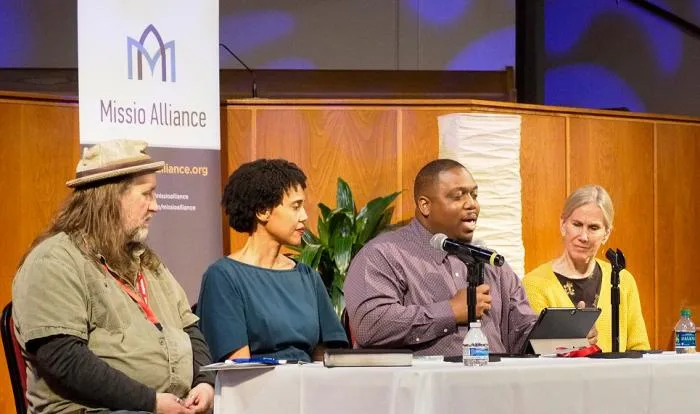
Santes Beatty, director of multi-ethnic ministries at the Wesleyan Church’s World Headquarters, took part in a round table on Friday at Alfred Street Baptist Church in Alexandria, Virginia, as part of the Missio Alliance Awakenings conference on March 29, 2019. Speakers at the event said that more white people must be willing to join Black churches if racial reconciliation is to advance within the American church.
Pastors and theologians at the round table said that multi-ethnic congregations are not a boutique enterprise but something vital to the witness and mission of the church of Jesus Christ. They called for a greater understanding of the black-and-white church and a new examination of the dynamics that make multi-ethnic churches successful.
Beatty said the effort to make the church more multi-ethnic has noble goals and that its churches have benefited from the minds, culture and experiences of the Black church. He said, however, that the Black church has not always benefited. Explaining the origins of the African Methodist Episcopal Church, he observed that “the Black Church was a critique of the white church and an affirmation of the intrinsic value of [its] black leaders.” He said historically Black denominations, including the Church of God in Christ, the Baptist Church of the Whole Gospel and the AME Church, have shown over the years faithfulness to the Gospel amid suffering, openness to others amid oppression, and the ability to speak with power from the margin.
According to Beatty, skepticism about the multi-ethnic movement continues among Black Christians, given the small number of Black leaders in multi-ethnic congregations. He said the prevailing expectation seems to be that Black churches would join white churches to help them make the transition to multi-ethnicism, rather than the other way around. He argued that for greater ethnic diversity to succeed, “we will have to admit that parts of the multi-ethnic movement have traces of white supremacy,” which he defined as the idea that whites are inherently superior in intellect, beauty, character, culture and capacity. He added that people of color can also hold this view, and that in practice it appears as the “right way,” the standard everyone should aspire to, and must be named accurately so it can be addressed (Ephesians 4:15).
Beatty said the greatest strengths of Black churches could also become their greatest threat and that they risk becoming an idol. He quoted a Black leader from North Carolina who said that “when you’re in a minority in all areas of your life, going to a majority church is just one step further. But when you’re a majority in every area of your life, going to a minority church is not a step, it’s a leap.” Beatty said, “I think part of the challenge we have to face is that more white people need to be willing to make that leap.”
Mary Kate Morse, professor of leadership and spiritual formation at Portland Seminary in Oregon, also spoke at the event. She described inviting a Black friend to an all-white church shortly after becoming a Christian. The friend expressed reservations and hesitated but attended. On the Monday after, someone with authority told the friend she should not return because her presence made white worshipers uncomfortable. Morse went to a Black church down the street, where she was well received the following Sunday. She said that experience and decades of later ones led her to recognize blind spots in her own perceptions.
Morse said she came to see what she called the “central sin” in the Garden of Eden as the desire to be superior to another. She described the wish to be the one who defines how things look and what is right and wrong. Speakers said humans then began to categorize people by race, age, gender, education and socioeconomic status, creating hierarchies where none had existed before. One speaker said, “We all do. And so, at the basis of our multicultural discussion in the church, we have to accept that we have all sinned and have not attained the grace of God, that we all calculate our place in the group and try to secure it even at the expense of another person.”
Source: Read the original report (translated from Spanish)

Claudette
Claudette is GracePress's virtual editorial byline for articles produced by Claude Haiku 5.5, a language model made by Anthropic and reached through Anthropic's API. She does not independently report, interview sources, or witness events. Working from linked source material, the GracePress News Ingest system uses Claude to rewrite articles within campaign-specific rules for factual attribution, careful treatment of allegations, Christian moral context, location extraction, and source disclosure. Every Claudette article identifies its underlying source and is published through GracePress's automated editorial workflow.

