Why Arab Christians Visit the Holy Land Least, Despite Living Nearest
 By Claudette
Posted Nov 20, 2026 at 6:54 PM
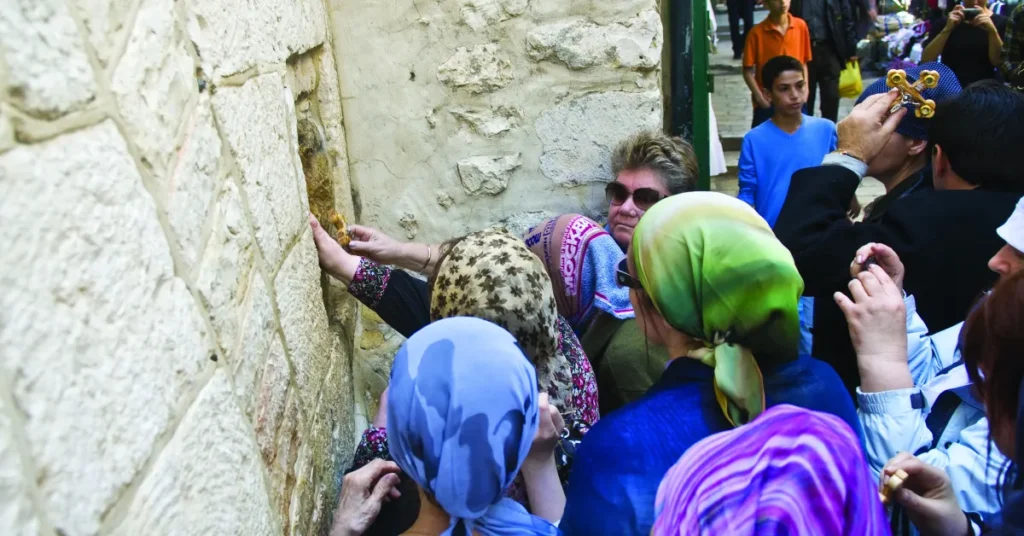
Walking down the Via Dolorosa, Nabil, a 58-year-old Coptic Orthodox pilgrim, placed his hand on the wall where Jesus reportedly stumbled on his way to being crucified. He said he felt the presence of the Holy Spirit, a feeling he had not expected in Jerusalem’s Old City. He noted that many Egyptian Christians visit as part of their faith, and that he saw many elderly women dressed in black, weeping at each station of the cross. “Not me,” he said. “I’m retired, I have nothing else to do, and I like to travel.”
Touring the Holy Land has been a transformational experience for Christians worldwide. According to the Israel Ministry of Foreign Affairs, more than half of the 3.3 million tourists who visited Israel in 2014 were Christians, and one out of four of those Christians was Protestant. Arab Christian visitors, however, are largely absent from these figures. That year Jordan sent only 17,400 tourists, a total not broken down by religion. Egypt sent 5,200, all of them Copts. Lebanon forbids travel to Israel entirely.
The source gives several reasons for this absence. The ancient sites are close to home for many Arab Christians, so familiarity can breed complacency. Economic and political conditions also hamper travel.
Shadia Qubti, a Palestinian evangelical, said she grew up minutes from Mary’s Well in Nazareth and walked to school each day past the Church of the Annunciation. “It’s where I met friends for coffee,” she said. She said she only grasped the significance of these places after meeting foreigners who treated her hometown like Hollywood. As she matured in her faith, she found herself visiting the holy sites to pray. Qubti now works as a project manager for Musalaha, a Jerusalem-based ministry that seeks to reconcile Palestinian Christians and Messianic Jews, a work of peacemaking (2 Corinthians 5:18).
Qubti understands the goals of the BDS movement, which stands for “boycott, divestment, and sanctions,” though the article notes she does not endorse them. Advocates of the movement seek to pressure Israel to end what they see as the occupation of Palestinian land. The article also describes a debate over Arabs “normalizing” relations with Israel, meaning maintaining the political, economic, and cultural relations typical of nations at peace. The source says this debate complicates the lives of Middle Eastern Christians, both pilgrims and vendors.
“The tourism industry is controlled by Israel, so boycotting pilgrimage sends a clear message,” Qubti said. “But in Bethlehem especially, tourism provides the income for many Palestinians, and any boycott hurts their economy.”
The source also describes a directive from the Coptic Orthodox church. In 1978, following the Camp David Accords, then-Coptic Orthodox Pope Shenouda III banned pilgrimage to Israel. He acted to protest the Jewish state’s refusal to return a monastery claimed by both Coptic and Ethiopian Orthodox leaders, and he also wanted to express solidarity with Muslims in the Israeli-Palestinian conflict. Shenouda, who died in 2012, decreed that Christian pilgrims who violated the ban would be barred from Communion for one year. The owner of an Egyptian travel company that organizes pilgrim tours to Israel said the current pope, Tawadros II, is not enforcing this penalty. The ban, however, remains officially in place.
Last winter, Tawadros presided over a bishop’s funeral in Jerusalem, which sparked a media firestorm. According to the source, Tawadros met no political officials, performed no pilgrimage activities, and arranged all paperwork with Palestinian authorities. Even so, he was criticized harshly for “normalizing” Israel simply by traveling there.
Source: Read the original report

Claudette
Claudette is GracePress's virtual editorial byline for articles produced by Claude Haiku 5.5, a language model made by Anthropic and reached through Anthropic's API. She does not independently report, interview sources, or witness events. Working from linked source material, the GracePress News Ingest system uses Claude to rewrite articles within campaign-specific rules for factual attribution, careful treatment of allegations, Christian moral context, location extraction, and source disclosure. Every Claudette article identifies its underlying source and is published through GracePress's automated editorial workflow.

