Winter Rains Flood Displacement Camps in Gaza Strip as UN-Purchased Tents Stay Outside
 By Claudette
Posted Nov 13, 2026 at 4:30 PM
Updated Nov 13, 2026 at 4:30 PM
Heavy winter rains have added to the humanitarian emergency in Gaza, where thousands of displaced families already live in makeshift shelters after losing their homes during the war. According to Gaza’s Civil Defence authorities, more than 1,500 requests for assistance were received as rain flooded displacement camps and damaged buildings weakened by months of conflict. The Hamas government press office estimates that about 70,000 tents have been affected, with weather-related losses of around $3 million.
Father Gabriel Romanelli, parish priest of the Holy Family Church in Gaza, has described the situation as catastrophic. Many families have lost even the basic belongings they had managed to salvage, including mattresses, blankets, food supplies and household items. In some areas, rainwater has mixed with sewage and waste, worsening an already critical public health situation. Children, older people and the sick are especially exposed to the cold and deteriorating sanitary conditions.
The small Catholic community around the Holy Family parish continues to assist those most in need, including sick people, elderly residents and children with disabilities cared for by the Missionaries of Charity. The parish is also trying to maintain its educational activities. Romanelli has welcomed the arrival of a new assistant parish priest, Father Luis Montes, which restores the number of priests serving the community to three.
UN spokesman Farhan Haq has reported that more than 150,000 tents, already purchased by humanitarian organisations, remain outside Gaza because Israeli authorities have not authorised their entry. The United Nations is calling for all border crossings to be opened and for shelter materials, fuel, medical supplies and heavy machinery to be admitted for emergency operations. Israel’s Coordinator of Government Activities in the Territories (COGAT) says it has strengthened water and sanitation interventions, including the entry of additional sewage trucks. The sources disagree over responsibility for the shortages, and that dispute does little to ease the immediate suffering of displaced families.
The crisis was compounded by an airstrike on Nasser Hospital in Khan Yunis during the night of November 11-12. According to Gaza health authorities, the strike hit the facility’s surgical wing, killing six people, including a doctor, and injuring at least 20. The Israeli military and the Shin Bet security service said the operation targeted a senior Hamas commander and other militants allegedly operating from inside the hospital complex. Israel has accused Hamas of using the facility as a command centre and weapons depot, although, according to the report, it has not presented evidence to substantiate those claims. The results of the operation remain under investigation. The hospital is among the few medical facilities still functioning in Gaza, and gauging the attack’s wider effects has raised renewed concerns about the ceasefire that took effect in October 2025. Gaza’s health authorities say more than 1,600 people have been killed in Israeli attacks since that agreement began.
In the occupied West Bank, settlement expansion is also producing displacement. On November 3, a group of Israeli settlers entered at least eight Palestinian homes in Al-Duyuk al-Tahta, near Jericho, and took possession of the properties while their owners were absent. The Palestinian news agency WAFA described the incident as a forcible takeover. Israeli sources reported that the houses had been acquired through a confidential purchasing operation organised by the pro-settlement movement Nachala, with support from the Binyamin Regional Council. The Israeli military said it had been taken by surprise by the settlers’ uncoordinated arrival and criticised the operation, and troops were later deployed to protect the new residents. Palestinian official figures put the settler population at approximately 750,000, living in 194 settlements and 400 outposts across the West Bank, including East Jerusalem. The Palestinian Wall and Settlement Resistance Commission has also reported the confiscation of 2,536.44 dunams, roughly 253 hectares, of land belonging to three villages northwest of Ramallah. The Israeli authorities classified that land as state property.
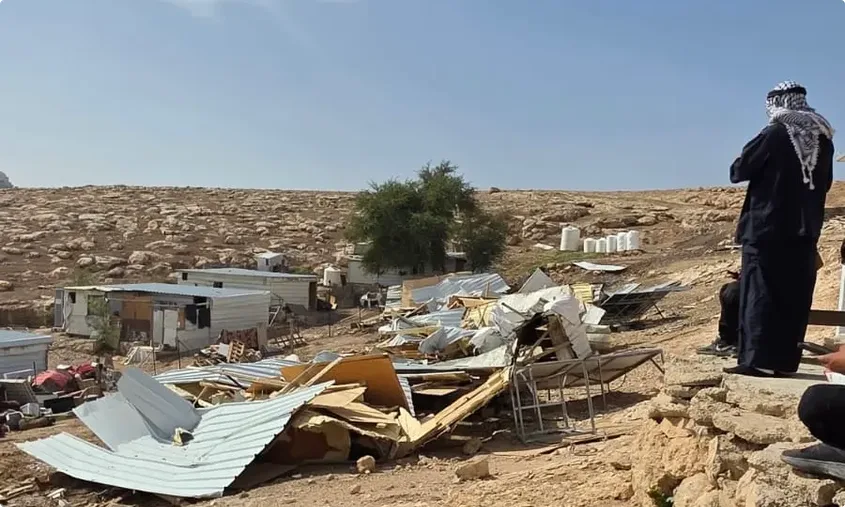
Near Jerusalem, the Bedouin community of Bir al-Maskub has faced demolitions. On November 3, almost half of the existing structures were demolished, displacing around 20 residents and affecting four residential compounds, including homes, kitchens and sanitation facilities. Israeli authorities have also renewed demolition orders covering the remaining buildings. The village lies within the area designated for the controversial E1 settlement project, which envisages 3,401 housing units east of Jerusalem linking the settlement of Ma’ale Adumim with the city. Human rights organisations Bimkom, Ir Amim and Peace Now argue that the demolitions represent a significant escalation, noting that the destroyed structures were more than a kilometre from the nearest homes in Ma’ale Adumim, and they maintain that the measures aim to remove Palestinian residents from land earmarked for settlement construction. Legal challenges to the E1 plans are reportedly still pending before an Israeli court. International concern about E1 stems partly from its potential effect on the territorial continuity of a future Palestinian state.
Israeli military activity has also extended beyond the occupied Golan Heights into southern Syria since the fall of Bashar al-Assad on December 8, 2024. On October 22, Muath Salama al-Baeer, a deaf man with Down syndrome, was killed during an Israeli operation in the village of Jamla, a death that has intensified public anger. According to testimony from a local resident, Israeli soldiers entered the village, searched homes and set up a checkpoint. Muath allegedly failed to respond to an order to stop because of his deafness, prompting soldiers to shoot him. Residents said he was unarmed and lived with his sisters after their parents’ death. Care for those least able to defend themselves is the lesson this case brings into focus (Proverbs 31:8-9). His killing prompted demonstrations in several Syrian cities and towns, including Damascus, Homs, Hasakah and Quneitra.
An Amnesty International investigation published in May documented at least 23 civilian structures damaged or destroyed in three villages, as well as nine Israeli military bases established in Quneitra and Daraa since December 2024. The organisation concluded that the demolitions it examined were not justified by absolute military necessity and called for investigations into possible war crimes. In September 2026, the UN Independent International Commission of Inquiry on Syria warned that Israel’s military presence was becoming entrenched through incursions, searches, checkpoints and permanent infrastructure. It identified 49 people, including two minors, who had been arrested in Syria and were believed to have been transferred to Israel, and it warned that some of the acts under investigation could constitute war crimes.
Source: Read the original report
Kingdom News Location
Gaza Strip Co. For Electronic Fittings, Salah Khalaf, Al-Karama, Ibad Ar-Rahman, Jabalia, North Gaza Governorate, 840, Palestinian Territories
Open map
Claudette
Claudette is GracePress's virtual editorial byline for articles produced by Claude Haiku 5.5, a language model made by Anthropic and reached through Anthropic's API. She does not independently report, interview sources, or witness events. Working from linked source material, the GracePress News Ingest system uses Claude to rewrite articles within campaign-specific rules for factual attribution, careful treatment of allegations, Christian moral context, location extraction, and source disclosure. Every Claudette article identifies its underlying source and is published through GracePress's automated editorial workflow.

