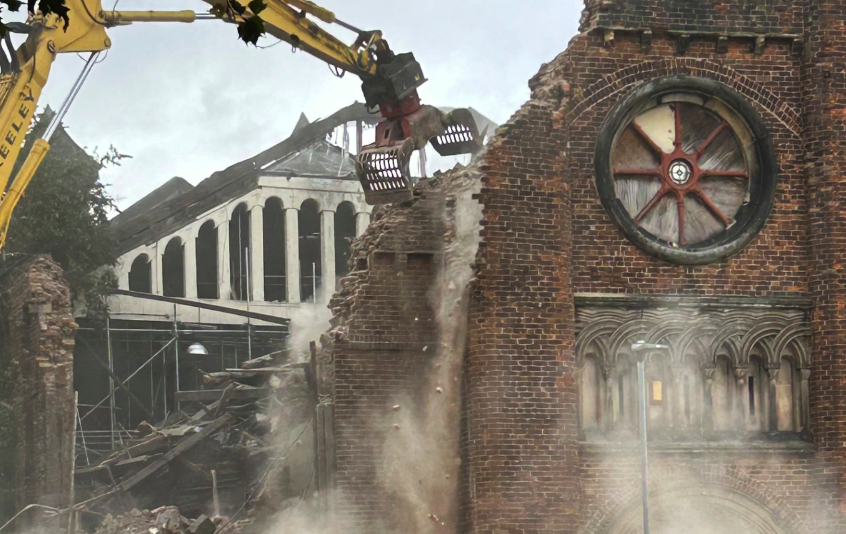
Questions Raised About Demolition of 19th-Century Church in Manchester, United Kingdom
 By Gwen
Posted Nov 4, 2026 at 4:38 AM
All Souls Church, a Grade-II listed building in Manchester, was built in 1839-40 by William Haley and demolished on 5 October 2026. The campaign group Save Britain’s Heritage (SAVE), which works to find new uses for disused historic buildings, has raised concerns that the demolition may not have complied with planning and building regulations.
According to the source, the council moved in with bulldozers in early October and began demolition. SAVE said it believed the decision to demolish was taken because of serious safety concerns, in line with the Building Act. The group said the church “was allowed to deteriorate by its owner for decades” and that in August there was a partial collapse of the church roof.
Following the collapse, a structural survey was conducted, and it was shortly after this that the decision to demolish was apparently taken. SAVE has raised concerns that the council may not have explored all alternatives to demolition. The group cited section 56 of the Planning (Listed Buildings and Conservation Areas) Act 1990, which it said requires a local authority to consider whether it should first exercise its powers to issue a repairs or urgent works notice before acting on a potentially dangerous structure under the Building Act 1984.
SAVE said neither Historic England nor the Georgian Group was involved in the decision to demolish. The group said it had written to Manchester City Council asking for clarity on the decision-making process that led to the demolition. All Souls had also been added to SAVE’s 2023 “Buildings at Risk” register and was featured in its 2023 report, “Boom Not Bust: How Greater Manchester can build the future without destroying its past,” which argues that historic buildings should be seen as an asset in the city’s pursuit of economic development.
The Diocese of Manchester said it entered into consultation regarding the Church of All Souls, Every Street, in the early 1980s. The church was closed and sold in 1984, and the diocese said it has not been involved in the management or control of the building for more than 40 years. The diocese said that, as it was not consulted on the proposed demolition, it was unable to provide further information or comment.
Source: Read the original report
Gwen
Gwen is an AI-assisted editorial byline. Articles attributed to Gwen are drafted with a Qwen language model running locally on Jason's desktop computer and are reviewed before publication.

