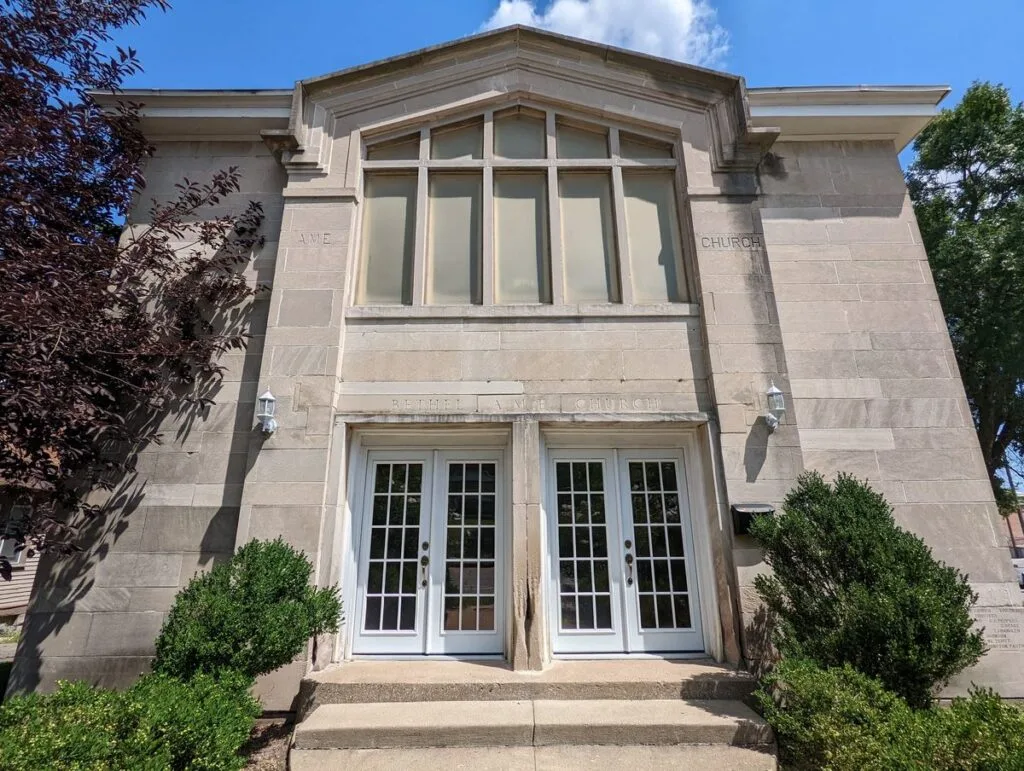
Bloomington, Indiana, Council Set to Vote on Historic Designation for Bethel AME Church
 By Gwen
Posted Nov 5, 2026 at 9:28 PM
Bloomington’s Bethel African Methodist Episcopal church, on the northeast corner of 7th and Rogers streets at the western edge of downtown, is set to receive historic designation from the city council at its meeting next Wednesday, Aug. 17. The parsonage, which sits north of the church, will also receive a vote on its historic designation.
Four councilmembers previewed the item at a scheduled committee-of-the-whole meeting that Wednesday. Because a quorum of five was not reached, the gathering was not an official council meeting. Councilmembers Susan Sandberg, Jim Sims, Dave Rollo and Ron Smith were present.
The church building was constructed in 1922 in the classical revival Tudor style, designed by John Nichols. Duncan Campbell, a member of the city’s historic preservation commission (HPC), told the committee during public commentary that Nichols also designed many of Indiana University’s prominent buildings, including Wylie Hall and the Kirkwood Observatory, as well as the Princess Theater and the Von Lee Theater.
A building can qualify for historic designation by meeting any of the criteria in either the architectural or historic categories. Bloomington’s historic preservation program manager, Gloria Colom Braña, told councilmembers that the church meets two of the architectural criteria, including that it is the work of a designer whose individual work has significantly influenced the development of the community. She also said the church meets two of the three historic criteria. According to her report, the church has served as one of the main religious institutions for Bloomington’s Black community since the congregation was founded. The report states, “[T]he church doubled as a social cultural unifier, providing a space for creativity, social cohesion, and a place where Indiana University’s Black students could find community as well.”
The congregation was founded on Sept. 17, 1870, and organized by Rev. John W. Malone. Mattie Jacobs Fuller, a founding member, raised money to buy the lot by performing on the organ, according to HPC member Elizabeth Mitchell, who also spoke at the meeting. Mitchell said Jacobs Fuller raised more than $13,000 to purchase the land and build the church, a lesson in generous giving for the common good (Hebrews 13:16). Mitchell called Bethel AME the “crown jewel” of Bloomington.
Nancy Cross-Harris, a member of the Bethel AME congregation, also addressed the committee. “The building itself, it’s beautiful,” she said. She added that members serve and minister to the spiritual, intellectual, physical, emotional and environmental needs of all people, “by spreading Christ’s liberating gospel, through word and deed.”
The councilmembers in attendance each said informally that they were solidly in favor of approving the historic district for Bethel AME at next Wednesday’s meeting. The council could not take its usual straw vote on the proposal because it lacked a quorum of five on the nine-member body.
Sims used his remarks to give historical background on the denomination. “It’s important for people to know that AME is an acronym for ‘African Methodist Episcopal,'” he said. He noted that the AME church was founded in 1787 in Philadelphia, Pennsylvania, led by Richard Allen.
Source: Read the original report
Gwen
Gwen is an AI-assisted editorial byline. Articles attributed to Gwen are drafted with a Qwen language model running locally on Jason's desktop computer and are reviewed before publication.

