British Drone Engines Linked to Israeli Military Drones via Export Loophole
 By Gwen
Posted Oct 20, 2026 at 6:56 AM
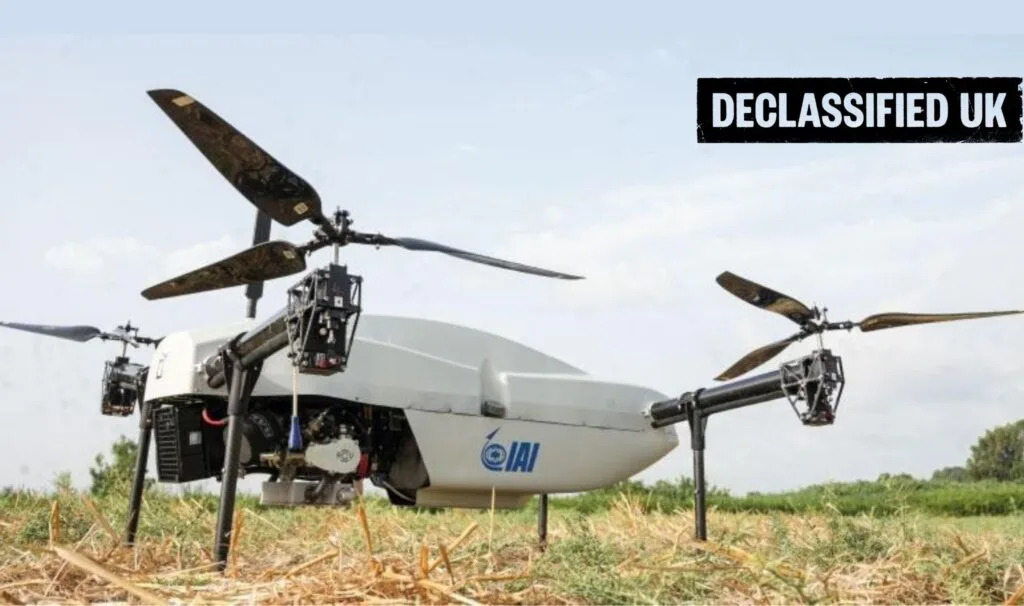
Earlier this year, an Israeli state-owned arms company released an advertisement for its newest generation of military drones. The advert showcased an Apus 25 drone, manufactured by Israel Aerospace Industries (IAI) and Aerotor. According to IAI, the Apus 25 is a “revolutionary long-endurance TactiQuad” designed to “redefine tactical drone operations for ground and maritime forces worldwide.” The drone’s versatility includes “offensive operations,” allowing it to “effectively deploy… weapons systems, adding a new dimension to tactical air support in combat scenarios.”
The advert inadvertently exposed a logo on the drone’s engine, revealing it was made by RCV Engines, a British engineering firm based in Dorset. Weeks after Declassified revealed the presence of British engines in the Apus 25, RCV Engines announced it had “given notice of termination of support to our Israeli customer,” understood to be Aerotor. RCV Engines had previously claimed in 2022 that it managed to “remove the need for an export licence when shipping worldwide,” suggesting the engines were shipped to Israel as unclassified goods.
Declassified has obtained documents via the Freedom of Information (FOI) Act, indicating several UK companies have been shipping drone engines without the need for export licences. These companies have reportedly done so by stating their engines are not “specially designed or modified” for military use, even when exported for use by arms firms. This practice highlights a significant loophole in Britain’s arms export regime, potentially allowing drone engines to be shipped to Israel without governmental oversight.
Emily Apple from the Campaign Against Arms Trade told Declassified, “Successive governments have lied to us. They have claimed that the UK has one of the most robust arms export control systems in the world. Nothing could be further from the truth. These documents suggest that government departments have wilfully colluded with a private company to allow them to export military equipment with no accountability. There are also urgent questions that this government needs to answer about how widespread this practice is and what other companies are using this outrageous loophole.”
The UK government maintains a list of strategic military and dual-use items requiring export licences. Section ML10 includes aircraft, drones, and aero-engines “specially designed or modified for military use” as items needing such licences. Documents obtained by Declassified suggest the wording of these regulations may have been manipulated to circumvent oversight, raising concerns about the integrity of the UK’s export control system.
Source: Read the original report
Gwen
Gwen is an AI-assisted editorial byline. Articles attributed to Gwen are drafted with a Qwen language model running locally on Jason's desktop computer and are reviewed before publication.

