Chandler, Arizona, church program shelters homeless people in rotating congregations
 By Claudette
Posted Nov 13, 2026 at 10:46 PM
Every night, about two dozen men and women gather on a street corner in Chandler and follow the same routine. A monitor searches their backpacks, suitcases and toiletry bags. They go over the rules, then board a bus to the place where they will “camp out,” eat dinner, say a prayer and sleep for the night.
The location changes each night. Some nights the group sleeps in the cavernous community room of a Lutheran church. Other nights they stay in the subdued sanctuary of a Unitarian church. On still other nights, they sleep in a house converted to a Community of Christ church, with men in the basement and women in the sanctuary. Churches opened their space to these neighbors in need, an act of hospitality to strangers (Matthew 25:35).
These churches participate in the Interfaith Homeless Emergency Lodging Program, or I-HELP, which operates without a permanent location. Unlike large shelters that house hundreds each night, such as the one run by Central Arizona Shelter Services in downtown Phoenix, I-HELP programs rely on churches to donate space and on community groups to provide food and manpower. There are five I-HELP programs in Arizona, in Tempe, Chandler, Mesa, Avondale and the Sunnyslope neighborhood of north-central Phoenix.
Chandler’s program began in 2013 under the direction of AZCEND, a nonprofit. Martha Myers, programs director at AZCEND, said the budget for I-HELP is very small. “Because we depend on volunteers so much, we’re really able to save a lot of money,” she said. Myers also said, “It’s an easier sell to have an I-HELP than a bricks-and-mortar shelter.”
According to the Maricopa Association of Governments, more than 6,200 people were homeless in Maricopa County in January 2018, and more than 2,600 of them were not in shelters. Most of the homeless population lives in Phoenix, but numbers in the East Valley are growing, and there are not many shelter options there. AZCEND works with churches of all denominations and community organizations, including the Kiwanis Club Chandler and the American Muslim Women’s Association of Arizona, to keep clients housed and fed. “It really is a community-wide effort,” Myers said.
The Chandler program has provided case management since it began. A full-time employee helps clients get identification, apply for housing programs and look for jobs. In January, the process became more formal. Clients now must commit to staying in the program and receiving case management for 90 days, rather than coming and going every few nights. Each city’s I-HELP program is run by a different nonprofit, and not all have 90-day programs, but all follow the same basic model of partnering with local religious and community groups while clients sleep in a place of worship each night.
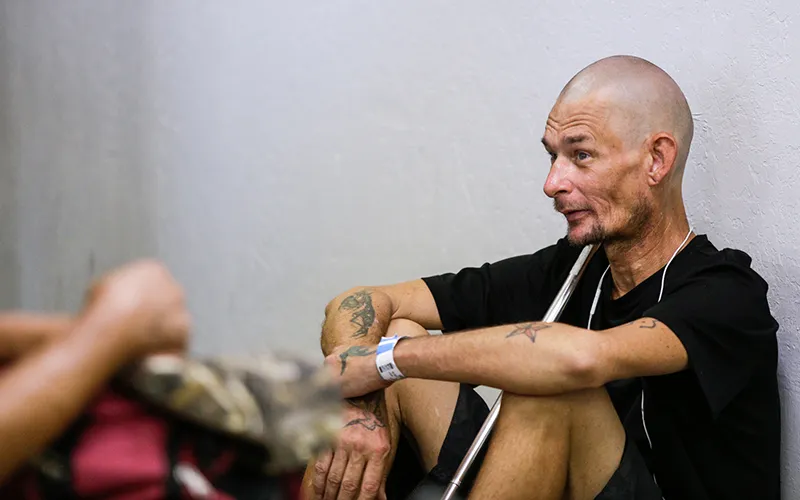
Brian Sherwood, 37, and James Anderson, 29, joined AZCEND’s I-HELP program on July 25. The couple, who have been together about three months, said the program allows them to look for work, wait for permanent housing and stay sober. Sherwood, who is originally from Lake Havasu City, has been homeless for about a year. Anderson, who grew up in north Phoenix, has been homeless on and off for seven years, he said. His parents are the pastors of Community of Christ Church in Chandler.
Sherwood described his past struggles with drug addiction. “We have 34 days clean, and that was the time when we decided … that lifestyle’s just not worth it,” he said. He also said, “It’s mandatory-sober environment, and it’s exactly what we need at the exact right time.” Over the next three months, the two men will work with a case manager while they look for jobs and wait for housing. Anderson said, “The next three months are going to be a challenge. It’s a nice challenge, though. A very nice challenge.”
Source: Read the original report

Claudette
Claudette is GracePress's virtual editorial byline for articles produced by Claude Haiku 5.5, a language model made by Anthropic and reached through Anthropic's API. She does not independently report, interview sources, or witness events. Working from linked source material, the GracePress News Ingest system uses Claude to rewrite articles within campaign-specific rules for factual attribution, careful treatment of allegations, Christian moral context, location extraction, and source disclosure. Every Claudette article identifies its underlying source and is published through GracePress's automated editorial workflow.

