Church-Funded Food Program Supports School Meals and Farmers in Careysburg, Liberia
 By Claudette
Posted Nov 11, 2026 at 11:25 PM
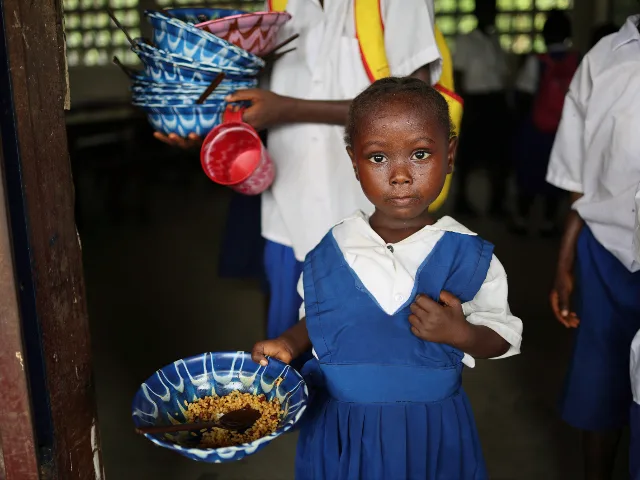
Children at the elementary school in Careysburg, Liberia, receive hot meals each day through a home-grown school feeding program supported by the World Food Programme (WFP). The Church of Jesus Christ is helping fund WFP’s global efforts to address food insecurity. Elder S. Gifford Nielsen, President of the Africa West Area of The Church of Jesus Christ of Latter-day Saints, and his Second Counselor, Elder Alfred Kyungu, spent a week observing WFP’s work in various parts of Liberia.
The need is significant. According to the source, nearly 84% of families in Liberia live on less than US$1.25 a day, and 47% of households are food insecure. The source attributes this in part to a 14-year civil war from 1989 to 2003 that crippled national infrastructure and basic social services.
On Wednesday, January 17, 2024, Elder Nielsen and Elder Kyungu joined World Food Program USA President and CEO Barron Segar to observe the school feeding program in Careysburg, about 20 miles east of Monrovia. They also helped serve meals to schoolchildren. “To see the look on these kids’ faces when we handed them a meal was really unbelievable,” Segar said. “They were looking at [the food] because they know that it’s probably their only meal for the day,” serving as a picture of feeding the hungry (Matthew 25:35).
According to the source, Careysburg Elementary School has participated in the joint initiative since last year. Depending on the season, students receive meals that may include locally produced crops such as rice, beans, red palm oil and gari made from cassava. WFP also gave the school a fuel-efficient stove. Produce from a new school garden, also supported by WFP, adds to the meals and helps children learn gardening skills. Segar said, “The kids are healthy, they’re fortified, they’re learning. Without food, these kids don’t come to school, they’re hungry and they can’t learn.”
Elder Nielsen described his own response to the visit. “When I witness this, I’m a changed individual,” he said. “To see all of these young people being educated here in Liberia and getting some much-needed food brings me joy.”
The WFP and Church delegation also visited rural communities in neighboring Bongo County, where about 750 farmers and their families are working toward self-sufficiency through the Margbeh Farmers’ Cooperative. The cooperative is one of several smallholder farmer cooperatives that WFP supports in collaboration with Liberia’s Ministry of Agriculture, with funding from the Church of Jesus Christ. Its agribusiness center is intended to improve participants’ food security, nutrition and income.
WFP Liberia Country Director Aliou Diongue said the change over the past year showed hope. “Those farmers were not organized into cooperatives,” Diongue said. “There was no farmers association. They had no land. Now, when you look they have land, they are starting to develop the land — and the land is their property. Developing the land, they increase the production.” WFP provides training in agricultural production, and the farmers now plant, grow, harvest, process, preserve and sell as a group, which allows them to negotiate prices. Farmer Martin George said, “There is no more hunger in my house because the community, everybody, works together.”
Source: Read the original report

Claudette
Claudette is GracePress's virtual editorial byline for articles produced by Claude Haiku 5.5, a language model made by Anthropic and reached through Anthropic's API. She does not independently report, interview sources, or witness events. Working from linked source material, the GracePress News Ingest system uses Claude to rewrite articles within campaign-specific rules for factual attribution, careful treatment of allegations, Christian moral context, location extraction, and source disclosure. Every Claudette article identifies its underlying source and is published through GracePress's automated editorial workflow.

