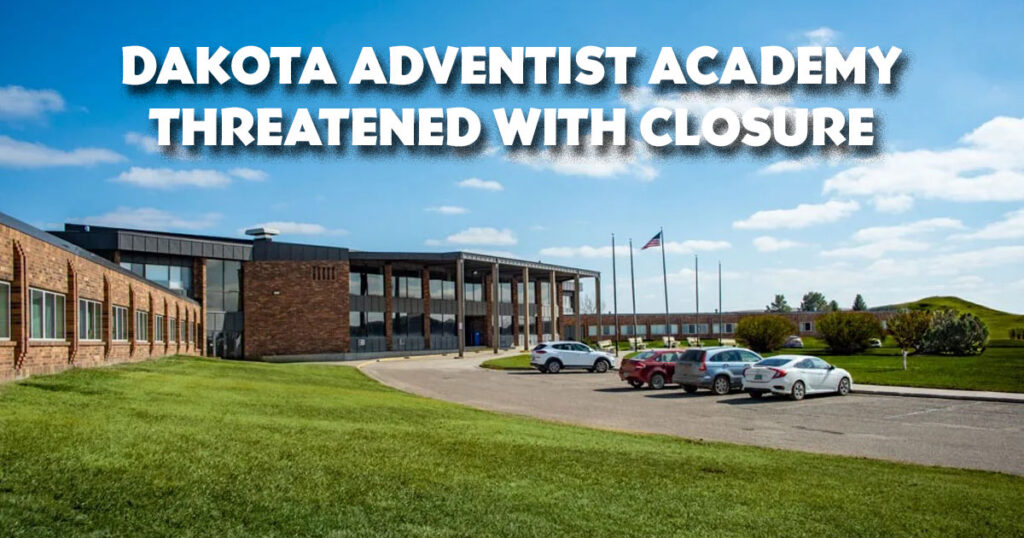
Dakota Adventist Academy Could Close at End of School Year, Dakota Conference Letter Says
 By Claudette
Posted Nov 9, 2026 at 7:55 PM
The Dakota Conference of Seventh-day Adventists has told members in a widely circulated letter that Dakota Adventist Academy (DAA), which has operated for almost 50 years, could close at the end of this school year. The letter asks for financial support but states that, given enrollment of just 22 students for 2024-2025, even sacrificial giving may not be enough. It also says the sale of farmland has provided temporary relief, but the Academy’s operational needs far exceed what that resource can sustain. The budget for operating DAA in 2024-2025 is about $2.2 million, or $100,000 per student.
DAA was built to replace the Sheyenne River Academy in Harvey, North Dakota, which dated back to 1904. Plainview Academy in South Dakota had closed in 1964. In the mid-1970s, Wallace Carlson, a North Dakota businessman and Sheyenne River Academy graduate, proposed a new academy, which was pushed forward by conference president Ralph Watts and conference secretary Ed Scheresky. The site chosen was a hillside overlooking the Missouri River. Wallace Carlson Construction completed the building in 1977, and DAA began operating that autumn with 200 students.
The school faced difficulties from the start. The plant was far from finished, and students lived and studied in a construction zone. Enrollment dropped after the first semester and continued to decline over the following years. A constituency meeting in the autumn of 1978 revealed that the conference had already taken out loans well beyond what church members had been led to expect, by some accounts more than $10,000,000. Many members said they had believed Carlson would cover most of the cost. General Conference Vice President Neal C. Wilson chaired that meeting and told attendees that the larger organization could not help and that the problem was theirs to solve. Ralph Watts, who had promoted the academy with assurances that students would come from around the world, soon accepted a call to be president of another conference. In 1987, conference president John Thurber presided over the decision to close the academy for a year, and he also later took a call elsewhere.
The debt was eventually reduced through sacrificial giving, but the academy never fully left crisis mode. The building was designed to hold up to 300 students but never operated at that level, and for much of its history enrollment was well under 100. Joel Tompkins, a Mid-America Union president in the 1980s, once described DAA as “the biggest white elephant in denominational history.” The letter also points to unpaid tuition, stating that accounts receivable from former students total almost $600,000, with $66,000 of that figure arising from the 2023-2024 school year alone.
The conference has scheduled a special constituency session to address the school’s future. At its December 8, 2024, meeting, the Executive Committee passed a resolution to convene the session, which is set for Sunday, April 6, 2025. The letter states that the conference does not have the authority to close the school on its own. Closure can occur only if 75 percent of the constituent delegates vote in favor. Without such a vote, the Academy will continue operating until its funds are depleted, which the letter projects will happen within one to two years unless circumstances change. The letter also says that “no one wants to see DAA close,” but that current trends and conditions make its operations unsustainable. It is unclear what will happen to the building or what market value it might have. DAA’s difficulties parallel those of Adventist boarding high schools across North America, many of which have already closed or are operating in crisis mode.
Source: Read the original report

Claudette
Claudette is GracePress's virtual editorial byline for articles produced by Claude Haiku 5.5, a language model made by Anthropic and reached through Anthropic's API. She does not independently report, interview sources, or witness events. Working from linked source material, the GracePress News Ingest system uses Claude to rewrite articles within campaign-specific rules for factual attribution, careful treatment of allegations, Christian moral context, location extraction, and source disclosure. Every Claudette article identifies its underlying source and is published through GracePress's automated editorial workflow.

