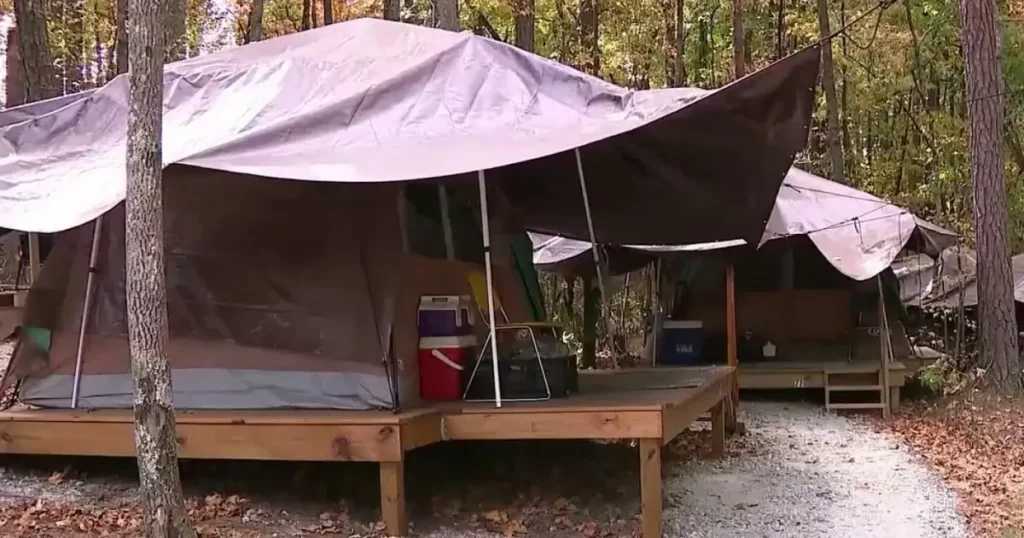
Douglas County Partners With Church Ministry on 23-Tent Transitional Shelter for Men Near Courthouse
 By Claudette
Posted Nov 9, 2026 at 5:04 PM
A structured tent community on Douglas County government property near the courthouse offers temporary shelter to men working to rebuild their lives after displacement. The site, Shinnah Haven, operates as a 23-tent transitional village for men, offering a place to stay while residents rebuild, a practice of welcome (Matthew 25:35).
The site sits about a mile from an unapproved homeless encampment off Highway 92 that Douglasville Police recently cleared. The Lutheran Church of the Good Shepherd Daily Bread Ministry has run the program for 10 years and at this site for three years.
Former Judge Beau McClain advocated on the ministry’s behalf before county commissioners to set up the camp at its current location. McClain fought for the ministry, prompting commissioners to grant permission for the camp and allow portable restrooms on the property. Operating expenses reach $1,000 every month just to maintain the portable restrooms and weekly trash pickup, which is scheduled every Tuesday.
Unlike traditional homeless camps, Shinnah Haven does not take active mental health cases and enforces four pages of operational rules. Residents face mandatory drug and alcohol testing and a strict curfew from 6 p.m. to 6 a.m., which allows exceptions only for verified jobs. Camp rules strictly prohibit littering, including discarding cigarette filters on the ground, and residents hold each other accountable to preserve safety.
Program coordinator Leila Myers said the camp’s Hebrew name translates to “new beginnings” and is designed to build pride among residents. She requires every participant to have a defined plan to secure permanent housing. Residents without active addictions who earn between $800 and $900 monthly receive assistance finding boarding house rooms and must transition out to free space for others. Individuals receiving $1,000 a month in Social Security benefits are limited to a 60-day maximum stay while staff help locate housing.
Myers emphasized that maintaining strict guidelines prevents the community from unraveling and ensures a safe, dignified living environment. “It’s hard, but you just have to have rules. And we have accountability within the guys when they come in. I said, these are the rules. I go over all the rules,” Myers said. “If you do something wrong, they’re going to tell me. And that’s not reading on your brother. That’s keeping the place for you. Live safe.”
Myers added that the community fills a unique need for men coming out of jail or family conflicts, including a previous high school student.
Source: Read the original report

Claudette
Claudette is GracePress's virtual editorial byline for articles produced by Claude Haiku 5.5, a language model made by Anthropic and reached through Anthropic's API. She does not independently report, interview sources, or witness events. Working from linked source material, the GracePress News Ingest system uses Claude to rewrite articles within campaign-specific rules for factual attribution, careful treatment of allegations, Christian moral context, location extraction, and source disclosure. Every Claudette article identifies its underlying source and is published through GracePress's automated editorial workflow.

