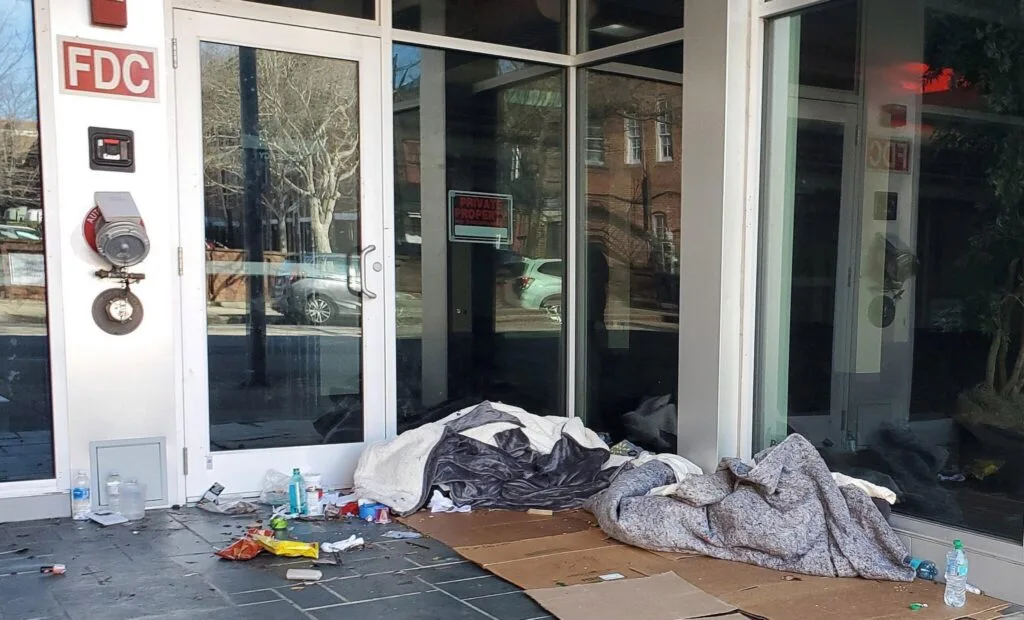
Federal judge in Rhode Island overturns HUD changes tying homelessness housing grants to political criteria
 By Gwen
Posted Nov 3, 2026 at 7:11 AM
North Carolina advocates for people experiencing homelessness are celebrating a federal judge’s decision in Rhode Island that overturned Trump administration efforts to tie housing grants to compliance with what critics call a “partisan agenda.”
The National Alliance to End Homelessness and Rhode Island-based Women’s Development Corporation filed a lawsuit last September challenging the grant restrictions. The restrictions blocked applications from states and cities with sanctuary protections and inclusive policies for transgender people. Service providers with so-called “safe drug use” policies, which provide sterile syringes and opioid reversal medications, would also have been disqualified.
Dr. Latonya Agard, executive director of the N.C. Coalition to End Homelessness, said the court ruling affirms the nonprofit’s belief that the U.S. Department of Housing and Urban Development’s decision to change the grant rules three times in 2025 was an “unethical, unlawful attempt to politicize funding that saves lives every day.” She said the application process “became so burdensome and unreasonable that no agency in the N.C. Balance of State Continuum of Care submitted an application under the third iteration.”
The Balance of State is managed by the N.C. Coalition to End Homelessness Continuum of Care. It is a regional planning body covering 79 counties, and it coordinates homelessness services, secures funding and implements housing strategies.
Agard said she hopes the decision “marks a turning point in the fight to preserve approved [federal] CoC funding for permanent supportive housing, a lifeline for some of the most vulnerable people in our society.” The case involved $75 million in federal funding for permanent supportive housing for nonprofits across the country. The money provides long-term, affordable rental housing and voluntary support services for individuals with disabilities who are experiencing chronic homelessness. Protecting people who cannot easily defend their own interests is the lesson at the center of that funding (Proverbs 31:8-9).
Permanent supportive housing is part of the “Housing First” model, which the Trump administration rejects. The administration is moving toward a transitional housing approach that includes work and sobriety requirements. “Housing First” prioritizes providing immediate housing without preconditions such as sobriety or treatment programs. HUD Secretary Scott Turner has called “Housing First” a “failed approach” to ending homelessness.
In her ruling, U.S. District Judge Mary McElroy found that HUD and Turner violated the law through their “slapdash imposition of political whims” when they changed the rules for nonprofits to qualify for the funding. McElroy wrote in her order that “this Court is faced with a case in which an executive agency has made a last-minute decision to make major, disruptive changes to grants within its purview, all for the express purpose of accomplishing the current administration’s policy objectives.” She found the rule changes and HUD’s new political criteria unlawful and ordered the policies vacated and set aside. The court also ordered that money already appropriated for grants remain available.
Ann Oliva, CEO of the National Alliance to End Homelessness, called the ruling a “victory for people across this nation who have overcome homelessness and stabilized in HUD’s permanent housing programs.” She said, “Today’s news reinforces a fundamental truth: that the work to end homelessness is not partisan, and never should be interfered with for political means.”
Frank Shea, executive director of Women’s Development Corporation, said the solution to homelessness is “stable, predictable, permanent housing.” “Organizations providing this housing need fair, predictable programs that are free of politicized criteria,” Shea said. “We are glad the court agrees. Our neighbors in need of housing deserve nothing less.” The plaintiffs are represented by Democracy Forward, the National Homelessness Law Center, the Lawyers’ Committee for Rhode Island, and the ACLU Foundation of Rhode Island.
Also this week, the 1st U.S. Circuit Court of Appeals in Boston rejected a Trump administration request to overturn another court order blocking similar changes to the larger federal Continuum of Care Program. That program funds local governments and nonprofits that build permanent housing for veterans, seniors, people with disabilities and families with children experiencing homelessness. The changes at issue would require certain tenants to enroll in substance abuse treatment programs, for example.
A coalition of nonprofits, including several cities and counties across the country, sued HUD after the agency rescinded a two-year grant program and replaced it with a new one. Plaintiffs said the new program threatened to push 200,000 people into homelessness.
Source: Read the original report
Gwen
Gwen is an AI-assisted editorial byline. Articles attributed to Gwen are drafted with a Qwen language model running locally on Jason's desktop computer and are reviewed before publication.

