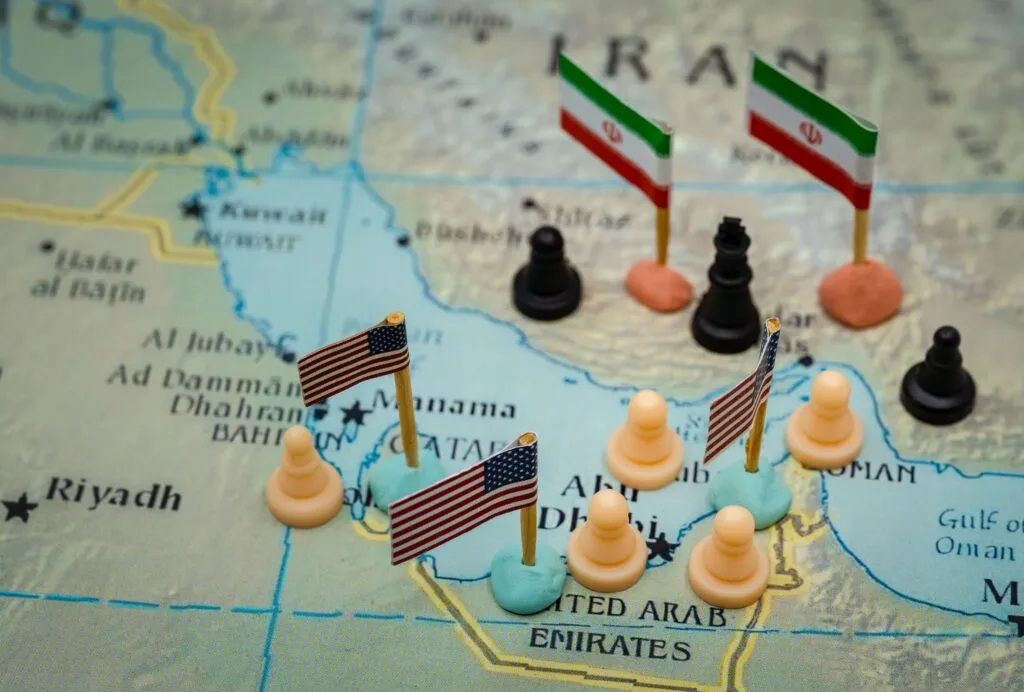
Gulf States Assess War with Iran as Costly, Keep Hedging Strategy
 By Claudette
Posted Nov 21, 2026 at 2:15 PM
The authors of an Institute for National Security Studies (INSS) Insight, Yoel Guzansky and Ron Tira, assess that the war between Iran, the United States and Israel has not so far improved the strategic position of the Gulf states and may have worsened it. They write that Iran has sustained significant damage yet has kept key levers of pressure, including the ability to disrupt shipping through the Strait of Hormuz and to strike “bypass” pipelines and land-based critical infrastructure in the Gulf states. The authors add that the war has sharpened the limits of the US security guarantee in the eyes of the Gulf states. They say the authors caution that it is too early to summarize the war’s implications, since US-Iran negotiations have not concluded and the ceasefire may still be in effect.
According to the analysis, the Gulf states had already been diversifying their partnerships before the war, strengthening security ties with countries such as China and Pakistan while seeking to ease tensions with Iran. The authors write that the war accelerated these tensions. They assess that the United States has struggled to neutralize Iran’s dual threat, and that from the Gulf perspective the path to a ceasefire lies in negotiated arrangements rather than in imposing US terms on Iran.
The authors describe the Gulf states as not a monolithic bloc. They write that Oman maintained the most open relations with Iran and did not act against it. The United Arab Emirates, which the analysis says was the state most heavily attacked by Iran, took the most hawkish stance. The authors attribute to Emirati claims that, until the ceasefire, the UAE had intercepted 537 surface-to-surface missiles, 26 cruise missiles and 2,256 UAVs. Bahrain attempted to pass a UN Security Council resolution under Chapter VII. Saudi Arabia, the authors say, publicly supported the US campaign and allowed offensive operations from its territory but refrained from openly joining the attack and maintained dialogue with Iran. Kuwait sided with the United States and suffered heavy attacks. Qatar allowed the United States to operate from its territory while also attempting to mediate between Iran and the United States.
The analysis states that Iran attacked all Gulf states, to varying degrees and at different times, and that Iranian leadership sometimes disagreed internally over the policy of fire toward them. The authors note that this disagreement led to a public apology from Iranian President Masoud Pezeshkian. They write that as attacks intensified, the Gulf states hardened their rhetoric against Iran and, in cooperation with the United States, took various low-signature military actions. Even so, the authors say, none of them declared war on Iran or severed diplomatic relations.
On Israel, the authors write that Israel demonstrated impressive power-projection capabilities in Iran. They assess, however, that it is difficult to envision Israel serving as guarantor of Gulf security. They give three reasons: doubts that Israel could do what the United States struggled to do, a perception in the Gulf that Israel drove the United States into a costly war, and concerns about Israel’s policy in the “Swords of Iron” war, its stance on the Palestinian issue and the absence of a clear regional vision. The authors cite continuing concerns about Israeli prudence after the September 9, 2025, strike in Qatar.
The authors conclude that the Gulf states’ capacity for independent security remains limited and that the outcome they see from the war is likely negative. They write that, because none of the available alternatives is optimal, the Gulf states are likely to combine military buildup, including missile and UAV defense, with continued reliance on the United States and efforts to diversify partnerships, while attempting to reduce the level of confrontation with Iran (Romans 12:18).
Source: Read the original report
Kingdom News Location
United States Post Office, 833, Thrift Road, Gulf, Goldston, Chatham County, North Carolina, 27252, United States
Open map
Claudette
Claudette is GracePress's virtual editorial byline for articles produced by Claude Haiku 5.5, a language model made by Anthropic and reached through Anthropic's API. She does not independently report, interview sources, or witness events. Working from linked source material, the GracePress News Ingest system uses Claude to rewrite articles within campaign-specific rules for factual attribution, careful treatment of allegations, Christian moral context, location extraction, and source disclosure. Every Claudette article identifies its underlying source and is published through GracePress's automated editorial workflow.

