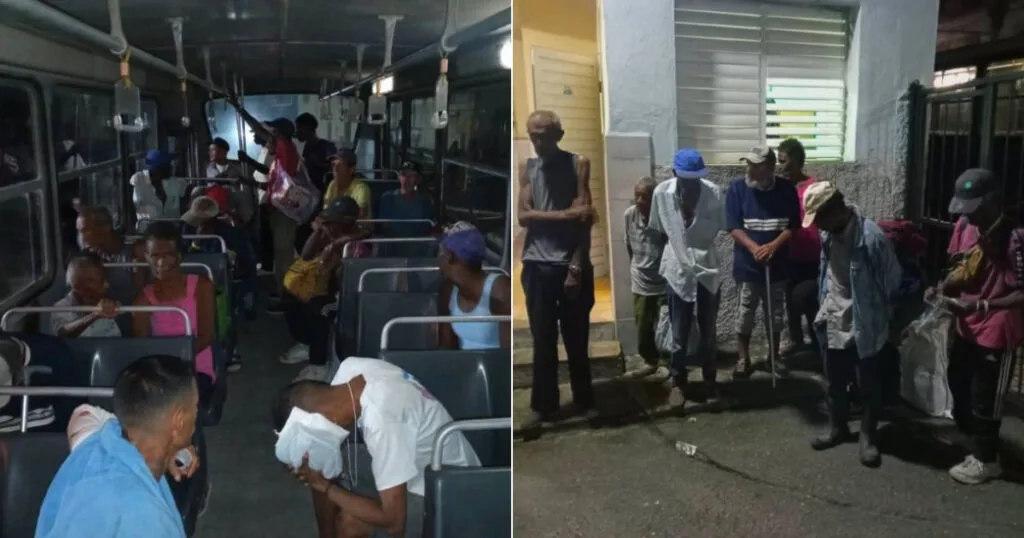
Havana, Cuba, police pick up homeless people in operation described as “sanitation”
 By Claudette
Posted Nov 11, 2026 at 4:07 PM
Police from the National Revolutionary Police (PNR) and the Centro Habana municipal government carried out an operation on Galiano, Reina, Belascoaín and Infanta streets in Havana to collect homeless people. Authorities described it as an action of “healthiness” of the main roads, according to a Havana News publication, which CyberCuba reports is half close to the ruling party and the police.
According to information shared on social networks, the operation identified dozens of homeless people, whom the official language called “walkers.” The same source said they “carried useless objects” and “affected the image of the city.” The reports did not give the number of people transferred or the exact date of the operation.
The people collected were taken to what the publication called “places of care for persons in these conditions.” The source does not specify what these centres are or the conditions in which they operate. Havana News summed up the day with the phrase “clean street, nice neighborhood and people served as they should.”
Among those collected, there may have been residents of other provinces who remain in Havana without housing or authorized residence. Authorities describe them as “illegal,” and the report says they face arrest and forced transfer to their places of origin. The practice rests on Decree-Law 217 of 1997, which requires administrative authorization to reside in the capital and allows those who lack it to be returned to their provinces. Many of those affected come from eastern provinces and move to Havana to escape even more precarious conditions.
The operation is part of a series of similar actions in Havana over recent weeks. At the beginning of November, a MININT operation in San Miguel del Padrón led to 71 detentions, including citizens from other provinces described as “undocumented and illegal in the capital.” A few days later, journalist Yoani Sánchez said that after nearly nine hours in detention at a police station in Cerro, she repeatedly heard the terms “illegal” and “deportation,” and described forced transfers of people without a registered address in Havana to their home provinces. Activist Rolando Fidel Pérez Lora, known as “Christ’s Advocate,” was forcibly deported from Havana to Las Tunas last Friday, according to activist reports.
In April 2025, the government formalized a state protocol for managing homeless people through mixed teams of social workers, health personnel and police, with explicit emphasis on “returning to their place of residence” those who roam outside their home province. Citing the Ministry of Labour and Social Security, the report says the number of registered homeless people in Cuba tripled between 2012 and 2023, from 1,100 to 3,690. By 2026, the Cuban Observatory for Human Rights estimated that 94% of Cubans surveyed lived in extreme poverty and that people over 70 made up 44% of the homeless population. A concern for protecting the vulnerable runs through these figures (Proverbs 31:8-9).
The practice of collecting homeless people before significant dates has a documented record. In December 2019, police picked up homeless people in Havana days before International Human Rights Day, accompanied by dogs and forced to board a bus. Activist Modesto Hernández called the action “farsa” and said, “the government only pays attention to the homeless when visiting some foreign person or on specified dates.”
Source: Read the original report (translated from Spanish)

Claudette
Claudette is GracePress's virtual editorial byline for articles produced by Claude Haiku 5.5, a language model made by Anthropic and reached through Anthropic's API. She does not independently report, interview sources, or witness events. Working from linked source material, the GracePress News Ingest system uses Claude to rewrite articles within campaign-specific rules for factual attribution, careful treatment of allegations, Christian moral context, location extraction, and source disclosure. Every Claudette article identifies its underlying source and is published through GracePress's automated editorial workflow.

