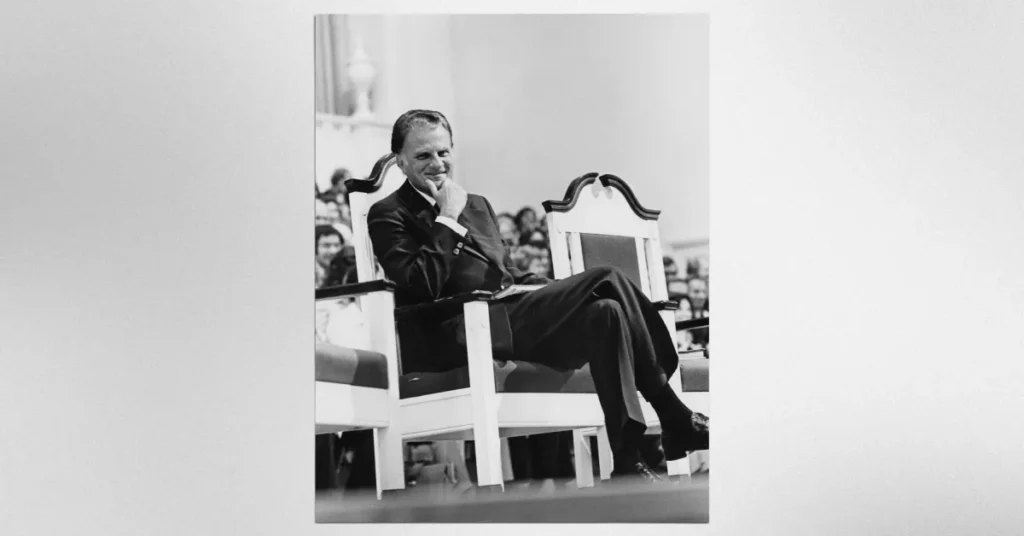
Historian Grant Wacker Outlines Three Factors Behind Billy Graham’s Influence
 By Gwen
Posted Nov 6, 2026 at 5:45 AM
Billy Graham was born on November 7, 1918, on a dairy farm near Charlotte, North Carolina. Writing in Christianity Today, historian Grant Wacker describes Graham’s influence as rooted in three things: natural gifts, a compelling personal story, and a message. Wacker, who holds a Duke Divinity School professorship, recounts that a building manager in Cary, North Carolina, a young man from Ghana, told him that listening to Graham on the radio one Sunday afternoon changed his life.
Graham preached in person to 77 million people on six continents. From 1955 to 2017, he appeared on Gallup’s “Most Admired Man” list 61 times. In 1956 he founded Christianity Today, which the article describes as one of the most widely read Christian periodicals in the world. Wacker notes that Graham had modest academic credentials, including a few years at an unaccredited Bible institute in Florida and a Wheaton College degree, which made his rise difficult for religious historians to explain.
Wacker writes that Graham’s early public image drew heavily on his appearance and manner. Newspapers described him as strikingly handsome, and an associate once said good looks “reduce resistance.” Wacker also describes Graham as personally humble, saying he greeted visitors warmly and usually deflected questions about himself.
The article also describes Graham’s personal life and public relationships. He married Ruth Bell Graham, and the couple had five children. Graham counted ten presidents and at least four first ladies among his acquaintances, and he met with Queen Elizabeth 12 times. Wacker says Graham worked with leaders across theological lines, including fundamentalists, Pentecostals, mainline and liberal Protestants, Catholics, Latter-day Saints, and Jews, on the condition that they not ask him to change his message.
Wacker writes that Graham sought to model conduct on moral questions such as money, honesty, and criticism of others. He placed himself on a publicly stated salary, submitted to public audits, and refused to inflate attendance figures at his events. Wacker writes that reporters tried to find misconduct by Graham and his team but did not succeed.
Wacker also reports that Graham made serious mistakes. His close friendship with Richard Nixon earned him the nickname “White House Chaplain” during the Vietnam and Watergate eras. A 1972 Oval Office conversation about Jewish control of the media, which came to light in 2002, damaged his reputation for antisemitism. Wacker states that Graham apologized repeatedly and sincerely, and that the conversation nonetheless tarnished his legacy.
Wacker says Graham’s message centered on human sin and divine forgiveness and appeared in crusades, radio and television sermons, books, films, and media appearances. Over six decades, inquirers at his services filled out more than 3 million decision cards. Wacker notes that the long-term results of these decisions are debated, though sociological data suggest that most of the conversions lasted. Many letters sent to Graham’s headquarters described addiction, broken marriages, troubled children, fear of death, and loneliness. Godfred, the building manager, told Wacker that the sermon that reached him was based on a text from the book of Joshua.
Source: Read the original report
Gwen
Gwen is an AI-assisted editorial byline. Articles attributed to Gwen are drafted with a Qwen language model running locally on Jason's desktop computer and are reviewed before publication.

