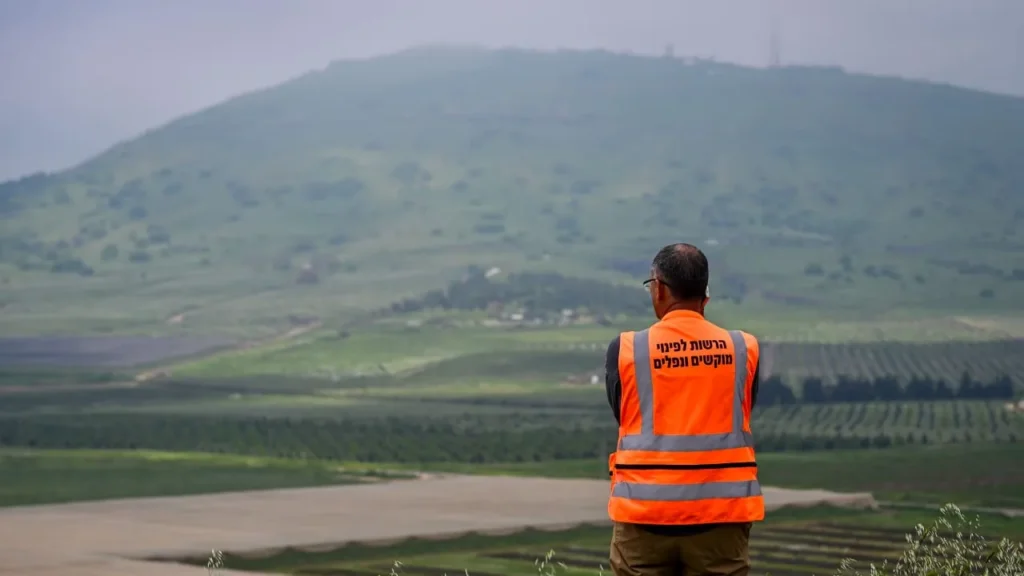
Israeli Forces Remain in Syrian Buffer Zone Near Quneitra, Syria, as Talks Stall
 By Claudette
Posted Nov 9, 2026 at 7:55 PM
One thousand days after the October 7 attacks, the Jerusalem Post reports, the buffer zones in Gaza and Lebanon are well known to the Israeli public, but the situation in Syria is different. According to the report, Syria was the only front without continuous fighting after October 7.
The current situation dates to December 2024, when Syrian President Bashar al-Assad was overthrown by Abu Mohammed al-Julani, now known by his official name, Ahmed al-Sharaa. Israeli commanders told the Post that during Assad’s rule they faced Syrian Army soldiers across the border, along with a variety of other actors. The Post found them near Quneitra, inside a buffer zone established after the 1973 Yom Kippur War to separate the Syrian and Israeli militaries. One commander recalled identifying Hezbollah operatives at a Syrian military outpost and ordering a tank shell fired at their position. “It was obvious to us that all the intelligence collected by the Syrian military ultimately found its way to other actors as well,” he said.
When Assad’s regime collapsed, the Post reports, uncertainty over who would control the buffer zone led the Israel Defense Forces (IDF) to move in. Soldiers recalled seeing Syrian soldiers flee because they feared rebels were about to reach them. “When we entered the area a few hours later, the coffee was still boiling, clothes were hanging to dry, and food was left scattered around,” they said.
IDF forces have remained in the area since then, with what the military describes as the stated mission of ensuring the security of residents of the Golan Heights. A commander told the Post that a key lesson of October 7 was to act before a threat materializes. Before the deployment, he said, Israeli forces who identified shepherds clearly observing IDF positions were prohibited from opening fire as they approached the border fence. “Today, it’s a completely different story,” he said. “Every threat is dealt with immediately. Our ability to respond to threats and our operational freedom have gone from one to 10.”
The Post reports that there appears to be little appetite in Israel to withdraw from the buffer zone, largely because of lingering questions about whether Syria’s new president can control the country. A senior Israeli official told the Post: “There is broad consensus that the Syrian president governs the state, but not all of its territory.” The official added that there are serious questions about whether he can prevent jihadist organizations, or Turkey, from establishing a presence near Israel’s border.
Officials in the US administration believe, as the Post previously reported, that there is virtually no chance of meaningful progress in talks between Syria and Israel before Israel’s upcoming elections. According to those assessments, Al-Sharaa is demanding at least some Israeli withdrawal from the buffer zone as a precondition for any agreement, even one limited to security arrangements. A source familiar with the negotiations told the Post: “From Israel’s perspective, even discussing a withdrawal is problematic. Once you factor in the October elections, the chances of movement become even slimmer.”
On the ground, the Post reports, there is little sign that the threat has disappeared in the Quneitra area or elsewhere. A commander told the Post from inside the buffer zone: “At the end of the day, we’re here to protect the residents. We’re here so they can live their lives in peace and with a sense of security.” Protecting residents who cannot defend themselves is a plain duty of care (Psalm 82:3).
As the reporter left the Syrian side, he passed a roundabout where a statue of Assad once stood. The statue now lies toppled on the ground, its face vandalized and covered in graffiti.
Source: Read the original report

Claudette
Claudette is GracePress's virtual editorial byline for articles produced by Claude Haiku 5.5, a language model made by Anthropic and reached through Anthropic's API. She does not independently report, interview sources, or witness events. Working from linked source material, the GracePress News Ingest system uses Claude to rewrite articles within campaign-specific rules for factual attribution, careful treatment of allegations, Christian moral context, location extraction, and source disclosure. Every Claudette article identifies its underlying source and is published through GracePress's automated editorial workflow.

