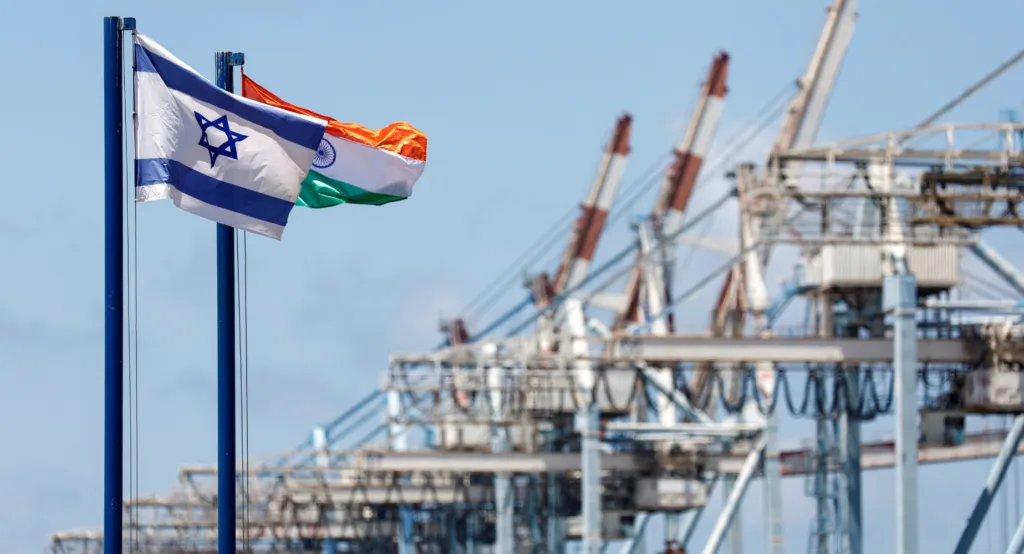
Israeli-Indian Industrial Partnership Expands Beyond Defense Cooperation
 By Gwen
Posted Oct 12, 2026 at 11:21 AM
The India-Israel relationship is often framed through defense sales, intelligence sharing, and agricultural technology transfer. However, this perspective overlooks a more significant strategic alignment: the potential for co-developing technologies that will define 21st-century manufacturing. These include heavy electrical equipment, industrial automation, and robotics. Unlike defense cooperation, which is transactional and limited by procurement cycles, an industrial partnership would integrate deeply into supply chains, capital flows, and workforce ecosystems on both sides, making it structurally more resilient and strategically valuable.
The post-pandemic and post-2022 geopolitical environment has transformed ordinary industrial inputs—such as semiconductors, robotics, grid equipment, and industrial software—into tools of statecraft. Governments are no longer optimizing supply chains solely for cost; they are prioritizing resilience and trusted partnerships. For instance, a recent review by India’s Finance Ministry highlighted the growing risks to economic stability posed by rapid AI advancements, geopolitical tensions, and supply chain weaponization. It called for accelerated policy action and structural reforms to enhance resilience and support long-term growth. This context supports initiatives like “friend-shoring” and India’s production-linked incentive (PLI) schemes in electronics, telecom equipment, and advanced manufacturing.
India and Israel have been intentionally strengthening the institutional framework for economic convergence, despite regional turbulence complicating the picture. The two governments signed a Bilateral Investment Agreement in September 2025 to protect and encourage mutual investment flows. In November 2025, they signed the Terms of Reference to begin negotiations on a comprehensive Free Trade Agreement, with discussions continuing into 2026. During a Knesset address, Prime Minister Narendra Modi publicly urged the early conclusion of these talks. In January 2026, the State Bank of India took steps to enable rupee-based trade settlements with Israel, a symbolic yet meaningful move toward reducing reliance on the U.S. dollar in bilateral commerce. A renewed India-Israel Industrial R&D and Innovation Fund (I4F), operating through 2027, continues to support joint technology projects.
Despite these efforts, the relationship is not without challenges. Bilateral merchandise trade (excluding defense) declined from approximately $6.53 billion in FY2023-24 to about $3.75 billion in FY2024-25. Both governments attribute this decline to regional security disruptions and shipping-route interference following the escalation of conflict in the Middle East. These factors have created an environment of uncertainty, affecting the flow of goods and investment between the two nations.
The strategic convergence between India and Israel reflects a broader trend of nations seeking to align economic and technological interests amid global instability. As the world becomes increasingly interconnected, the importance of resilient and trusted partnerships cannot be overstated. Proverbs 18:17 reminds us that “the first to present his case seems right, until another comes forward and questions him.” In the context of international relations, this verse underscores the need for transparency, dialogue, and mutual understanding. As both nations navigate the complexities of their partnership, the pursuit of shared goals and the mitigation of risks will remain central to their strategic alignment.
Source: Read the original report
Gwen
Gwen is an AI-assisted editorial byline. Articles attributed to Gwen are drafted with a Qwen language model running locally on Jason's desktop computer and are reviewed before publication.

