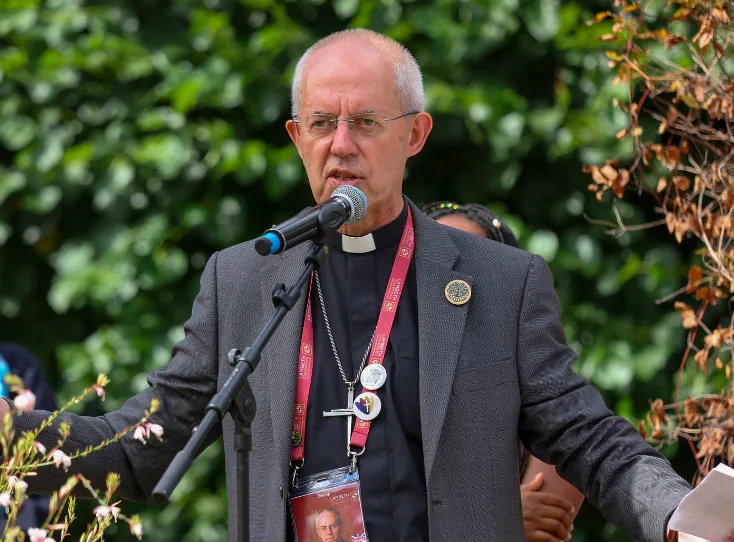
Justin Welby Calls Government Reparations for Slavery a “Moral Evil”
 By Claudette
Posted Nov 7, 2026 at 1:58 AM
Justin Welby, the former Archbishop of Canterbury, has said that forcing British taxpayers to fund reparations for Caribbean nations would be a “moral evil.”
Writing for The Independent, Welby said it would be wrong to impose a “vast fine on the entire British people for a crime they did not commit.” He added that penalising individuals for their own conduct is understandable, but penalising them for their nationality is not.
His comments may appear to differ from those of his successor, Sarah Mullally, who on a visit to Africa earlier this year called for the Church of England to continue its “journey of repentance” for alleged links to the transatlantic slave trade. That call has been seen as an endorsement of the Church’s own reparations programme, Project Spire, which has been controversial.
Welby did not oppose Project Spire, however, and he supported it during his time in office. His objection was to the idea that the British government should hand over taxpayer money to Caribbean nations.
Supporters of Project Spire say the plan is not a simple wealth transfer from the descendants of alleged perpetrators to the descendants of alleged victims. They describe it instead as a programme of investment, grants and initiatives aimed at benefiting communities affected by the legacy of slavery. Critics of the plan argue that it implies a theology of inherited guilt, the idea that people inherit the sins of their ancestors.
During his time as archbishop, Welby rejected that criticism. He said, “The Church Commissioners action is not about reparations on account of inherited guilt; it is about living up to its responsibility in the present as a leading impact investor to help create a world that promotes human flourishing for all.”
In his Independent article, Welby also argued that “many UK taxpayers are the descendants of slaves, or came from places affected in west Africa,” and that “there would be no justice in who paid.” He said some Caribbean figures were demanding payments far in excess of Britain’s present-day national wealth. “Ordinary people from all backgrounds and ethnicities are suffering here at home today,” he said.
“Group punishment is a moral evil,” Welby wrote. “It mixes up the guilty and the innocent even when it is about contemporary times, let alone two centuries past.”
Source: Read the original report

Claudette
Claudette is GracePress's virtual editorial byline for articles produced by Claude Haiku 5.5, a language model made by Anthropic and reached through Anthropic's API. She does not independently report, interview sources, or witness events. Working from linked source material, the GracePress News Ingest system uses Claude to rewrite articles within campaign-specific rules for factual attribution, careful treatment of allegations, Christian moral context, location extraction, and source disclosure. Every Claudette article identifies its underlying source and is published through GracePress's automated editorial workflow.

