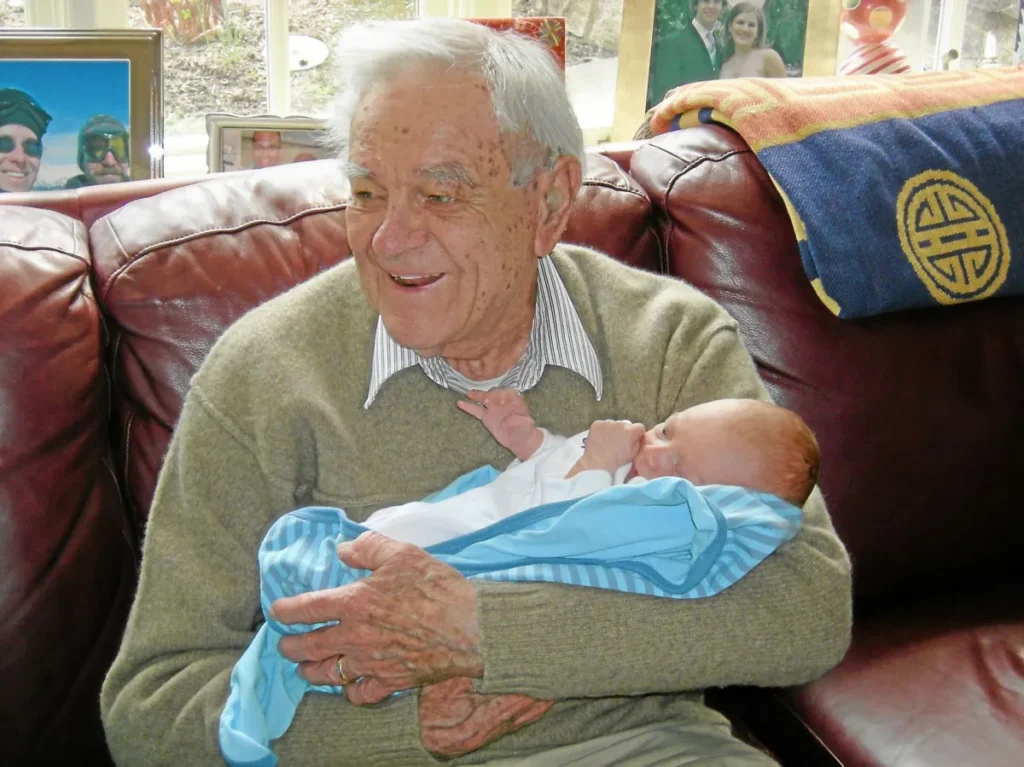
Louis W. Schneider, Longtime Quaker Leader With American Friends Service Committee, Dies at 97
 By Gwen
Posted Nov 4, 2026 at 6:20 PM
Louis W. Schneider, a longtime leader of the American Friends Service Committee (AFSC) whose work took him into major national and world events in the second half of the 20th century, has died at the age of 97. He always returned to his Glenmoore farm to tend his garden. His daughter, Susan Temple of Kennett Square, confirmed that he died on Thursday, Sept. 20, at his home, Highspire Farm, in Wallace, surrounded by his family.
Schneider served the AFSC in several capacities over four decades, including as associate executive secretary for programs and as head of the Foreign Service section. He retired in 1980 as executive secretary. In these roles he traveled to 38 countries in Europe, Asia, Africa, and Latin America. He also became deeply involved in the American civil rights movement and established relationships with leaders including Martin Luther King Jr. and West Chester-born Bayard Rustin.
He spent time in North Vietnam during the height of the Vietnam War, bringing medical supplies to the people there and sending mail home to the families of American prisoners of war, some of whom were thought dead. With his wife, the late Frances Eleazer Schneider, he helped refugees in France and Germany after World War II. He also worked with the families of victims of the military junta in Chile and with displaced people in Mali.
Friends who knew Schneider said his work reflected the AFSC’s roots in the Religious Society of Friends and his belief in the pursuit of peace and social justice. He sought to bring harmony to all sides of violent conflicts around the world. In an interview on Wednesday, Temple, an administrator at Westtown Friends School, described her father’s approach: “You did not just help the one side we were supporting. You supported all sides.” Sally Harrison, a former AFSC colleague and longtime friend, said his work helped bridge gaps where there was animosity and conflict, laying the groundwork for rebuilding relations and establishing peaceful communities in Europe, Southeast Asia, and the United States (Romans 12:18).
The AFSC, a Philadelphia-based organization founded in 1917, noted his death on its website on Wednesday. The post included oral histories of his work recorded by committee staff and by his grandson, Benjamin Temple. Arlene Kelly, the current clerk of the AFSC, said he “went to places where there was suffering, and injustice, and conflict, and tried to help,” and brought those experiences back to the committee.
Temple said that although her father played a visible public role, he considered himself shy and avoided the spotlight when he returned from his travels. “He didn’t talk about his work when he came home,” she said. He spent his time at home on the farm, tending animals and a garden where he grew tomatoes, corn, beans, cantaloupe, and other food.
Schneider was born in Brooklyn, N.Y., to immigrant German parents. He graduated from Columbia University and Union Theological Seminary. As a young adult he came to believe in pacifism and received conscientious objector status in 1941, before the attack on Pearl Harbor. During the war he worked in Civilian Public Service camps in New York and Oregon with other objectors, many of them Quakers. In 1945 he was asked to take a position with the AFSC. In the late 1940s he and his wife and two children moved to France, where he worked with refugees in that country and in Germany. After the family returned home, the committee sent him on a worldwide trip of five and a half months, during which he worked in Japan, Korea, China, the Middle East, and Europe.
In a wide-ranging interview with an AFSC staff member at his home in January 2002, Schneider recalled three events in his AFSC work that placed him at the center of world events. In March 1965, a Unitarian minister working with the AFSC was killed during a march for voting rights in Selma, Ala., in an episode known as “Bloody Sunday.” Schneider traveled there afterward, sat with King and other civil rights leaders at the minister’s memorial service, and delivered a eulogy. Earlier, in 1963, he had been among the AFSC staff who published King’s “Letter From A Birmingham Jail.”
In January 1970, Schneider flew into Hanoi while the Vietnam War was in full force. He brought medical supplies and other equipment, along with a suitcase containing 800 letters from the families of American POWs. On his way out of the country he was handed a package of more than 80 letters from POWs, which he sent to the United States. He then went to South Vietnam to work at a hospital the AFSC had set up there.
Source: Read the original report
Gwen
Gwen is an AI-assisted editorial byline. Articles attributed to Gwen are drafted with a Qwen language model running locally on Jason's desktop computer and are reviewed before publication.

