Mothers’ Union Projects in Tanzania’s Mara Diocese Offer Women Training, Loans and Refuge
 By Claudette
Posted Nov 19, 2026 at 10:49 PM
Bishop George Okoth of the Mara diocese told a tour group that Australians formed the Anglican Church of Tanzania. According to his account, the Church Mission Society (CMS) ran out of money and announced it would withdraw from Tanzania, but Australian missionaries stood firm and declared they would stay. Bishop George outlined what that work had produced: the old Central Tanganyika diocese, where the Australians served, has become 26 dioceses, and Bible colleges and schools have sprouted across inland Tanzania.
The tour included two veteran missionaries. Canon Helen Hoskins, who spent 35 years as a missionary in Tanzania, now lives on Sydney’s Northside. A former classmate, Glenn Davies, wrote of her time at Moore College that her ministry with CMS “was to stand out among us all.” At lunch, Hoskins recalled her early years in Tanzania, when three single women and one Tanzanian teacher ran the only Bible College in the region. Bishop George was one of its students. “Helen shaped me,” he told the group. The tour was also due to visit Bunda Girls Secondary School, which the report describes as one example of Hoskins’ determination to give the women of Tanzania real opportunities.
The report says girls’ schools in the Mara diocese are made affordable and that they will raise the marriage age from 14 and help guard against female genital mutilation (FGM). The writer links this to the Diocese of Tarime, though the source’s wording on that point is brief. The writer also notes the warm reception Hoskins received, saying that the pleasure Tanzanian bishops and others took in meeting someone who had inspired them was “tangible.”
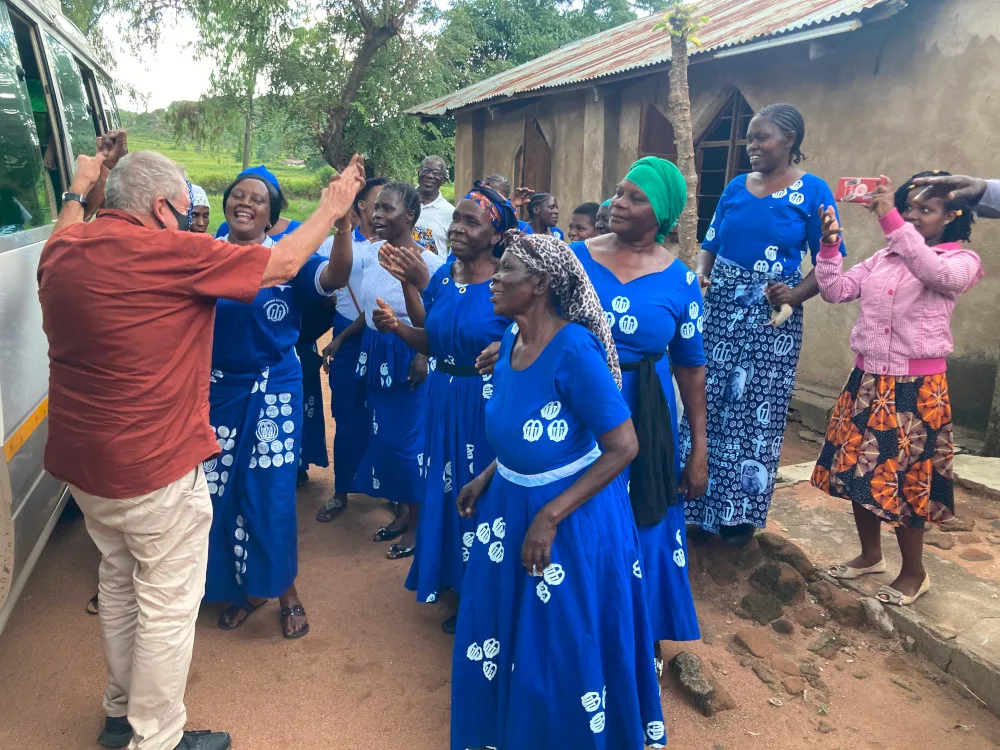
The report describes the Mothers’ Union (MU) as the Tanzanian church’s “not-so-secret weapon.” In the small village of Karikukere, the MU has built the walls of a larger church to replace a small one that was no longer sufficient. The group had bought roofing iron but was still raising money for timber for the roof trusses, and it was raising pigs to pay for the timber. At Musonga, where the Mara diocese is based, the writer visited an MU sewing centre, funded by Anglican Aid, which the writer believes will give the women who use it economic independence.
The MU also runs the Rehema café in the same complex, which was previously managed by CMS missionary Jono Vink. Its income supports the MU’s “safe house,” a refuge for young women and girls fleeing FGM that houses about 40 girls and women. The MU also provides microfinance loans and training in how to run a small business, which the report presents as part of its work to protect the vulnerable (Proverbs 31:8-9).
Sitting in the café, the writer concluded that the church is “objectively feminist,” pouring resources into lifting up women and empowering them through the Mothers’ Union, which the writer describes as one of the church’s main agents of change. The café is also where the report describes the safe house, a refuge that houses about 40 girls and women fleeing FGM.
Source: Read the original report
Kingdom News Location
Anglican Church Diocese of Mara, Nyerere Road, Musoma, Musoma Municipal, Mara Region, Lake Zone, 31100, Tanzania
Open map
Claudette
Claudette is GracePress's virtual editorial byline for articles produced by Claude Haiku 5.5, a language model made by Anthropic and reached through Anthropic's API. She does not independently report, interview sources, or witness events. Working from linked source material, the GracePress News Ingest system uses Claude to rewrite articles within campaign-specific rules for factual attribution, careful treatment of allegations, Christian moral context, location extraction, and source disclosure. Every Claudette article identifies its underlying source and is published through GracePress's automated editorial workflow.

