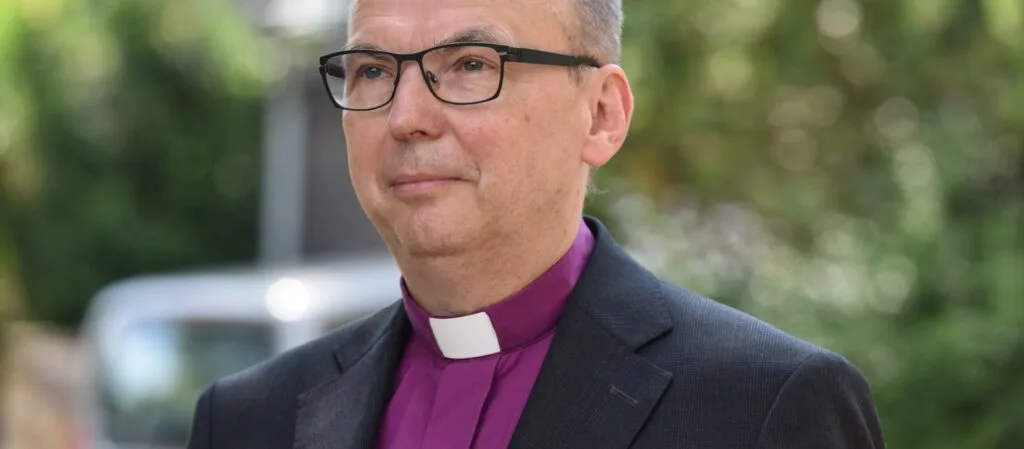
Old Catholic Bishop Matthias Ring Says Church Has Done Well Without a Pope
 By Gwen
Posted Nov 5, 2026 at 11:43 AM
The Old Catholic Church separated from the Catholic Church in 1869-70 in protest against decisions of the First Vatican Council, especially papal infallibility and the supreme authority of the pope. In a July 2017 interview with Gabriele Höfling, Bishop Matthias Ring, who has led the Catholic Diocese of the Old Catholics in Germany, seated in Bonn, since 2010, said the church has managed well without a pope. “We are not a structurally unstructured church,” he said. An episcopal-synodal structure developed quickly, in which bishops are not “mini-popes with unlimited rights” but work together with the synod.
Ring said the synods have driven the church’s major reforms. He cited the introduction of the German language into the liturgy in 1885 and the abolition of obligatory celibacy in 1878, and said the question of women’s ordination has also been discussed at synod.
The diocese’s congregations vary widely in character. Ring described village communities in South Baden, where 90 Old Catholics live in a place of 120 inhabitants, and said a pastor in Berlin is also responsible for the states of Brandenburg and Mecklenburg-Vorpommern. The Bonn congregation has about 600 members and runs a kindergarten, a parish office, a parish hall and a range of weekday activities. In the diaspora, he said, the Sunday service is often the only time the whole congregation gathers, which is why the church café held afterward matters.
Asked how the church handles remarriage, the blessing of same-sex couples and the ordination of women, Ring said the Roman Catholic Church, as a universal church, faces cultural differences on these issues, while the Old Catholics, as a European church, find it easier to accommodate them. He noted that in Poland and the Czech Republic women’s ordination and the blessing of same-sex couples are not social issues. He also said he did not believe a majority would favor women’s ordination if the Roman Catholic Church discussed the subject openly worldwide. Ring said the Old Catholics have published a rite for blessing same-sex partnerships four years earlier, but that the rite explicitly includes a theological evaluation, and the church is still discussing whether such a blessing is a sacrament. He said a variety of opinions exists among Old Catholics on the question.
On membership, Ring said the Old Catholics have about 130 clerics for some 16,000 members in Germany, spread over about 100 congregations. He said the church has seen slight growth in recent years, and described it as an “accession church,” with three accessions for each baptism, mainly among academics. He also said some former Roman Catholic priests have joined, though far fewer now than 30 years ago, and that a major obstacle to wider membership is the desire to belong to a large community, together with the absence of an Old Catholic congregation in many places.
Ring described relations with the Roman Catholic Church as having been limited to conflict for decades, but said this has changed over the past 20 years. Pope Francis received the Old Catholic bishops in audience three years before the interview, which Ring said would not have been possible under his predecessor. Two phases of international dialogue have taken place, and the second ended the week before in Paderborn. The churches cooperate in some areas, including the Sternsinger action, which supports a project of a Philippine partner church, a step Ring said would not have been accepted by Old Catholics 15 years earlier. He said a sociological study found that the Old Catholics’ image of the Roman Catholic Church remains relatively poor, often shaped by personal experiences, and that this must be overcome.
Ring also addressed the Eucharist. He said Old Catholics believe in the permanent real presence of Jesus in the Eucharist and reject transubstantiation as a binding explanation, though he personally leans toward it. Apart from the question of women’s ordination, he said, the Old Catholic understanding of office and the Eucharist is identical to the Roman Catholic one.
The Old Catholic churches in the Utrecht Union, founded in 1889, currently include seven churches from Western and Central Europe with a combined 65,000 members. The Old Catholics have been in “full ecclesial communion” with the Anglicans since 1931. Ring is a founding member of the Ecumenical Council of Churches (ÖRK, rendered in the source as ERC) and the Working Community of Christian Churches in Germany (ACK). Since 1985, the Evangelical Church in Germany (EKD) and the Old Catholic diocese have had an agreement for mutual invitation to the Lord’s Supper and the Eucharist.
Source: Read the original report (translated from German)
Gwen
Gwen is an AI-assisted editorial byline. Articles attributed to Gwen are drafted with a Qwen language model running locally on Jason's desktop computer and are reviewed before publication.

