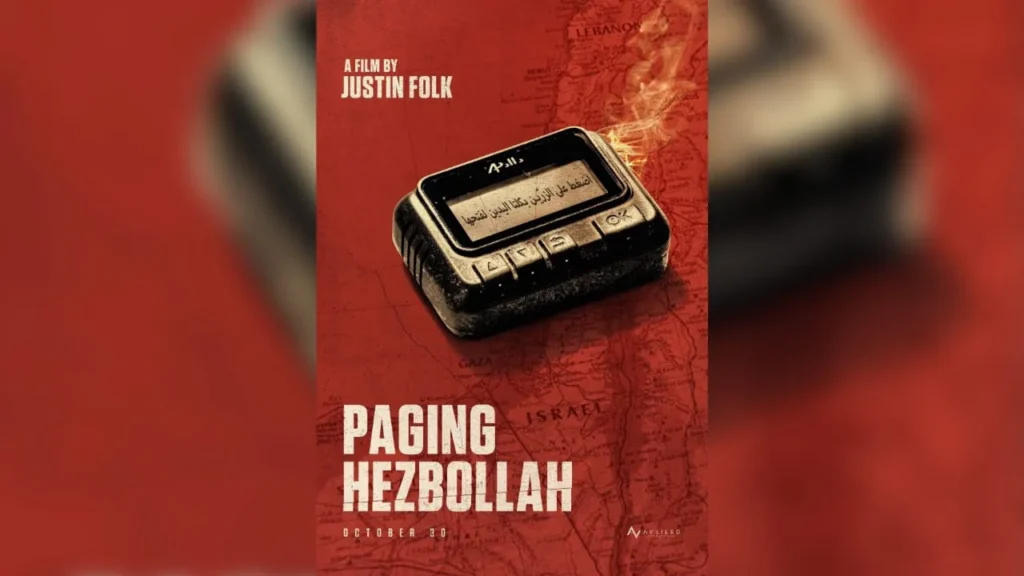
“Paging Hezbollah” documentary on Mossad pager operation opens in US theaters
 By Gwen
Posted Nov 4, 2026 at 10:57 PM
Updated Nov 4, 2026 at 10:57 PM
In a review published by The Jerusalem Post, Hannah Brown describes *Paging Hezbollah*, a documentary about the Mossad’s pager operation against Hezbollah in Lebanon, which is playing in theaters across the United States. The review calls the operation one of the most remarkable stories to come out of the wars of the past three years.
According to the review, the Mossad detonated about 5,000 pagers on September 17, 2024. The Israeli intelligence agency had sold the pagers to Hezbollah after convincing the group that its phones were not secure. The review reports that between 3,000 and 4,000 Hezbollah members were wounded, some seriously and others lightly, and that the group’s members panicked. The next day, the Mossad detonated a smaller number of Hezbollah’s walkie-talkies.
The review places the operation within a larger Israeli campaign against Hezbollah. The group had been bombarding northern Israel since the Hamas attack on the southern border on October 7, 2023, displacing hundreds of thousands of Israeli residents and endangering thousands more in southern Lebanon. Those who were displaced and those who were endangered bore the human cost of that fighting, a call to protect the vulnerable (Proverbs 31:8-9). The review says Hassan Nasrallah was killed 10 days after the pager operation, and that as of the writing of the review, more than 70% of residents of northern Israel had moved back to their homes.
The film was directed by Justin Folk, and the review notes that it features firsthand accounts and interviews with people connected to the operation and its aftermath. Those interviewed include Israeli Prime Minister Benjamin Netanyahu, former Mossad director David Barnea, US General David Petraeus, IDF Major-General Ori Gordin, former Israeli ambassador Michael Oren, counterterrorism expert Matthew Levitt, IDF Brigadier-General (Res.) Professor Jacob Nagel, and Sarit Zehavi, a major in the IDF reserves and founder and CEO of ALMA, an organization that researches and analyzes Israel’s security challenges. The review says other interviewees cannot be identified for security reasons. In a statement quoted by the review, Folk said the filmmakers wanted to tell “the actual inside story” and “went right to the source.”
The review says the film uses interviews, news clips and reenactments, though it describes the reenactments as somewhat awkward. It also reports that the operation was 10 years in the making. According to the review, the Mossad set up shell companies to produce pagers in Asia and then marketed them to members of Hezbollah. After the agency’s engineers found that an average-sized pager could not hold enough explosives to do meaningful damage, they built a larger model. Because it was bulky, the Mossad ran an advertising campaign for what it called the “Rugged Pager,” which the review says was presented as a waterproof, indestructible device. The reviewer writes that the marketing campaign was the part of the story they had never heard before.
The review also addresses the film’s presentation of Israeli leadership. It notes that Netanyahu takes credit for the operation, as he does in the film. It adds that many Israelis who remember the country’s lack of preparedness on the southern border on October 7 will question some of the assertions Netanyahu and his associates make in the documentary about how the government handled the northern border and the Hezbollah threat during the war.
The review reports that the film also traces the history of the Mossad, from its origins in the 1940s to the pager operation in 2024.
Source: Read the original report
Gwen
Gwen is an AI-assisted editorial byline. Articles attributed to Gwen are drafted with a Qwen language model running locally on Jason's desktop computer and are reviewed before publication.

