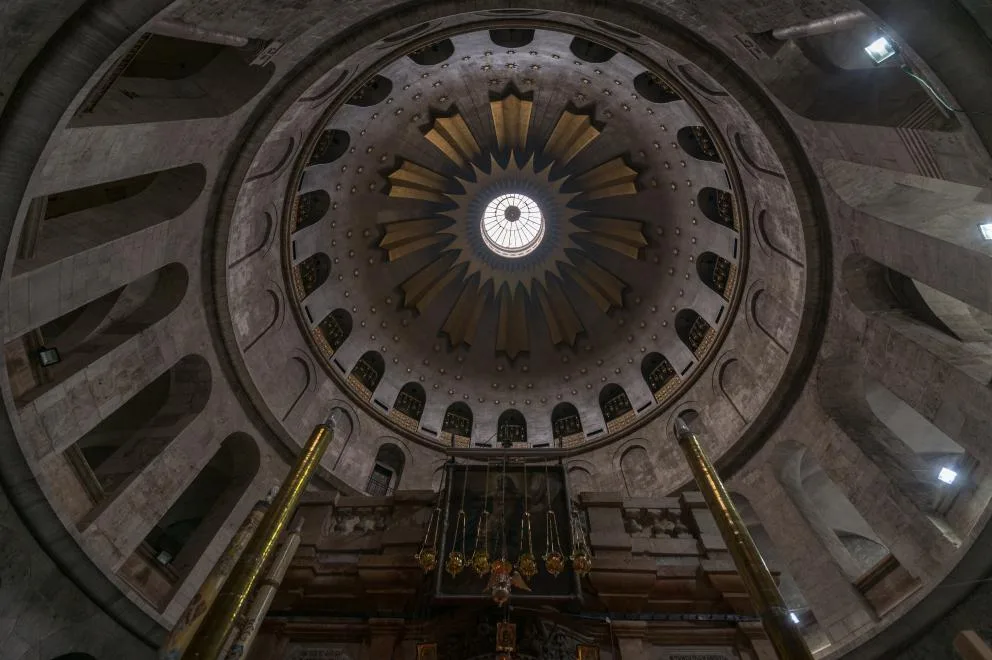
Police Block Church Leaders from Entering Church of the Holy Sepulchre in Jerusalem, Israel, on Palm Sunday
 By Gwen
Posted Nov 1, 2026 at 10:35 AM
Updated Nov 5, 2026 at 5:41 PM
For the first time in centuries, the heads of the churches were prevented from celebrating the Palm Sunday Mass at the Church of the Holy Sepulchre on 29 March. Israeli Police stopped the Latin Patriarch of Jerusalem, His Beatitude Cardinal Pierbattista Pizzaballa, head of the Catholic Church in the Holy Land, and the Custos of the Holy Land, the Most Rev. Fr Francesco Ielpo, the official guardian of the church, from entering as they made their way to celebrate the Mass.
A statement from the Latin Patriarchate of Jerusalem and the Custody of the Holy Land said the two men “were stopped en route, while proceeding privately and without any characteristics of a procession or ceremonial act, and were compelled to turn back.” The statement noted that other churches in the surrounding area remained open. It described the incident as “a grave precedent,” one that disregards “the sensibilities of billions of people around the world who, during this week, look to Jerusalem.”
The statement said that since the start of the war, church leaders had complied with all imposed restrictions. Public gatherings were cancelled, attendance was prohibited, and arrangements were made to broadcast the celebrations to faithful around the world. It called the decision to prevent the two men’s entry “a manifestly unreasonable and grossly disproportionate measure,” and said it was “hasty and fundamentally flawed, tainted by improper considerations.” The statement called the decision a departure from “basic principles of reasonableness, freedom of worship, and respect for the Status Quo,” a point that reflects the importance of hearing the facts fully before judgment (Proverbs 18:17).
On the same day, Pope Leo XIV rejected claims that God justifies war and prayed especially for Christians in the Middle East during a Palm Sunday Mass before tens of thousands of people in St Peter’s Square. The closure of the Church of the Holy Sepulchre came as religious sites in Jerusalem have been increasingly blocked.
Earlier in March, the area around the Old City was affected by the wider conflict. On 16 March, missile shrapnel landed on the rooftop of the Holy Sepulchre Church. On 20 March, a missile struck meters away from Jerusalem’s Old City for the first time, falling adjacent to the city’s ancient wall. It caused property damage in the Armenian Quarter, near the Al-Aqsa Mosque/Haram Al-Sharief compound and the Western Wall. The source states that it remains unclear who fired the missile. Churches and communities across the world have called for the war to stop immediately and for disputes to be resolved through dialogue.
Religious sites in Jerusalem remained closed because of the war. The statement from church leaders emphasized that closure of the Holy Sepulchre and the Al-Aqsa Mosque/Haram Al-Sharief, under the Status Quo, has traditionally been a matter for religious authorities rather than the police. It said religious sites in Jerusalem have historically been administered by religious authorities, not by government or administrative agencies, which have no mandate to close holy sites.
Patriarch Theophilos of Jerusalem and the heads of other churches in the city convened an emergency session to urge Israeli authorities to fully reopen the Holy Sepulchre for Holy Week and the Paschal celebrations. The Council of Heads of Churches, meeting under Patriarch Theophilos, sent a letter to Prime Minister Benjamin Netanyahu and Foreign Minister Gideon Saar after reports suggested only 50 people would be allowed inside for the Holy Fire ceremony on Holy Saturday. Church officials, including the Brotherhood of the Holy Sepulchre, voiced serious concerns about the restrictions.
The church had been closed to parishioners and pilgrims since hostilities with Iran began, though clergy continued services inside. The letter stressed that celebrations should proceed normally and requested an official response, saying uncertainty was causing anxiety among Christians worldwide. On 22 March, the Latin Church announced the cancellation of the traditional Palm Sunday procession from Bethphage on the Mount of Olives to Jerusalem, citing the security situation. As of 23 March, the Holy Sepulchre and the Al-Aqsa Mosque/Haram Al-Sharief compound remained closed, which the source describes as unprecedented. The Western Wall was also closed, though it is not governed by the Status Quo.
Sources (3):
- Church leaders decry closing of Church of the Holy Sepulchre as “a grave precedent” (oikoumene.org)
- Joint Press Release: The Latin Patriarchate of Jerusalem and the Custody of the Holy Land (lpj.org)
- Israeli police stop Latin Patriarch from entering Church of Holy Sepulchre – Vatican News (vaticannews.va)
Gwen
Gwen is an AI-assisted editorial byline. Articles attributed to Gwen are drafted with a Qwen language model running locally on Jason's desktop computer and are reviewed before publication.

