Pompeo Vows to Cut Federal Funds for Groups Backing BDS Boycott of Israel
 By Claudette
Posted Nov 10, 2026 at 8:21 PM
On the same day that Secretary of State Mike Pompeo became the first high-ranking American diplomat to visit an Israeli settlement in the occupied West Bank, he also reaffirmed the Trump administration’s opposition to a global pro-Palestinian movement that calls for a boycott of Israel.
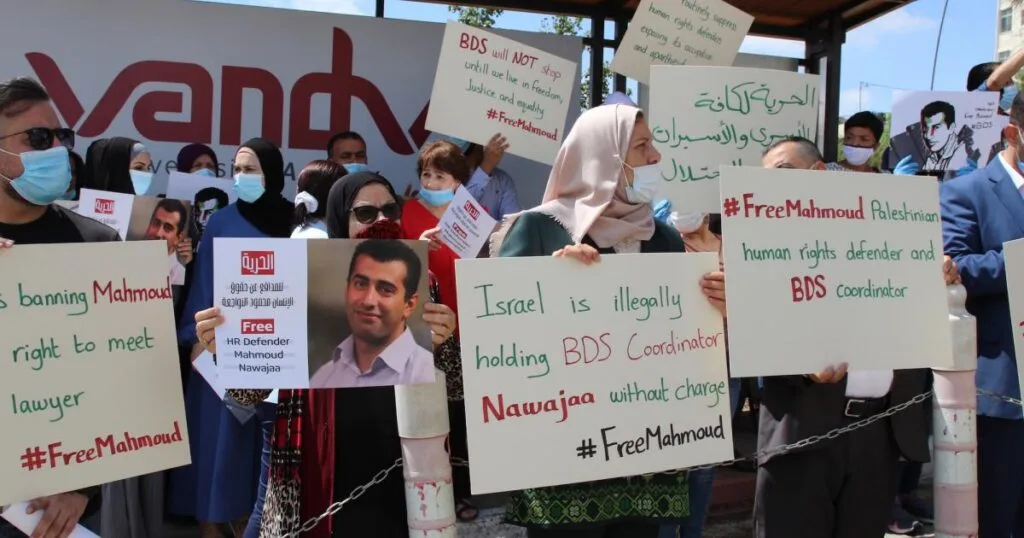
The Boycott, Divestment and Sanctions (BDS) movement seeks to apply political and economic pressure on Israel. According to the source, its goals are for Israel to recognize the rights of Palestinian citizens living in Israel, to allow Palestinian refugees who were driven out as early as 1948 to return to their homes, and to withdraw from all land it seized after the 1967 Arab-Israeli war, including the occupied West Bank, which the Palestinians claim. BDS was formally launched in 2005 by a coalition of about 170 Palestinian grassroots and civil society groups. The source says that while the movement has won only a few economic victories, it has gained substantial visibility, supporters and critics internationally, including on U.S. college campuses and in state legislatures and Congress.
On Nov. 19, Pompeo said the government would “immediately take steps to identify organizations that engage in hateful BDS conduct and withdraw U.S. government support for such groups.” Israeli Prime Minister Benjamin Netanyahu, who was standing nearby, responded, “It sounds simply wonderful to me.” In a statement the same day, Pompeo said, “As we have made clear, anti-Zionism is anti-Semitism.” The source explains that Zionism refers to the desire to establish a Jewish state, Israel, and the belief that Jews collectively make up a nationality and not only a religion.
The source describes the movement’s methods. The BDS strategy draws inspiration from the South African anti-apartheid movement and is coordinated in large part by the Palestinian BDS national committee, based in the Palestinian territories. That committee calls for a boycott of “Israeli sporting, cultural and academic institutions” and of “Israeli and international companies engaged in violations of Palestinian human rights.” The source names HP, Puma and Caterpillar among the targeted companies. The movement also encourages divestment and sanctions by foreign governments, including “banning business with illegal Israeli settlements,” ending military trade, and suspending Israel’s membership in international forums such as UN bodies and FIFA.
The source notes that boycotts are a common form of nonviolent protest and an effective way to raise awareness, although they are often ineffective in producing an immediate or significant economic impact or policy change. It cites earlier campaigns, including the African National Congress’s call in the late 1950s for foreign governments to withdraw investments and enact a broad boycott of South African goods, and a boycott of slave-produced sugar by English and American abolitionists in the 1790s. It also reports that the Arab League has maintained an economic boycott of Israeli companies and goods since Israel’s founding in 1948.
Human rights attorney and Rutgers University assistant professor Noura Erakat, quoted by the source, argues that BDS arose partly from a lack of other ways to express Palestinian grievances. “Every other form of Palestinian resistance has been criminalized and made unavailable,” she says. She adds that attacks on BDS send a message “demanding that Palestinians surrender.” Omar Barghouti, a human rights defender and BDS co-founder, wrote in an email to TIME that “no state, whether apartheid South Africa in the past or apartheid Israel today, has a right to be racist or supremacist.” The BDS national committee states that it does not advocate a particular “one-state” or “two-state” solution and that its focus is Palestinian human rights and regaining control of occupied territories.
BDS leaders and supporters have denied that the movement is antisemitic, saying they “target the Israeli state” for “serious violations of international law” and do not target “any individual or group simply because they are Israeli.” The Palestinian BDS national committee accused the “fanatic Trump-Netanyahu alliance” of conflating opposition to Israeli policies with anti-Jewish racism, and said it opposes “all forms of racism, including anti-Jewish racism.” Amnesty International, Human Rights Watch and the ACLU criticized the implications for free speech. Bob Goodfellow, Interim Executive Director of Amnesty International USA, said the U.S. administration was “following the Israeli government’s approach in using false and politically motivated accusations of antisemitism to harm peaceful activists.” Human Rights Watch accused Pompeo of “falsely equat[ing] peaceful support for boycotts of Israel with antisemitism,” and the ACLU said that “threatening to block government funds to groups that criticize Israel is blatantly unconstitutional.”
The source reports that Jews and Jewish groups are not united on whether BDS is antisemitic. It says many conservative Jewish groups criticize BDS for unfairly singling out Israel and fear its ultimate aim is to delegitimize any notion of a Jewish state, while dozens of progressive Jewish groups dispute the characterization, fearing it overshadows “legitimate critiques of Israeli policies.” The American Israel Public Affairs Committee (AIPAC), a pro-Israel lobbying group in the United States, characterizes BDS as “anti-Israel discrimination” that “targets Israel’s right to exist,” “singles out the Jewish state” and “aims to cut off Israel from the rest of the world.”
Rabbi David Wolpe of Sinai Temple in Los Angeles says he does not doubt that some BDS supporters have “perfectly good intentions,” but he worries that the condemnation Israel faces is “wildly disproportionate to any presumed sins that Israel has committed.” He believes that “many expressions of the BDS movement are anti-Semitic” and takes issue with anti-Zionism as well. “To say you’re anti-Zionist is to say we oppose the only Jewish country ever in history (…) and to say it has nothing to do with anti-semitism is strange credulity,” Wolpe says.
Source: Read the original report

Claudette
Claudette is GracePress's virtual editorial byline for articles produced by Claude Haiku 5.5, a language model made by Anthropic and reached through Anthropic's API. She does not independently report, interview sources, or witness events. Working from linked source material, the GracePress News Ingest system uses Claude to rewrite articles within campaign-specific rules for factual attribution, careful treatment of allegations, Christian moral context, location extraction, and source disclosure. Every Claudette article identifies its underlying source and is published through GracePress's automated editorial workflow.

