Religious groups receive most of Madrid Food Bank’s donated food, with some entities under scrutiny
 By Claudette
Posted Nov 21, 2026 at 1:18 PM
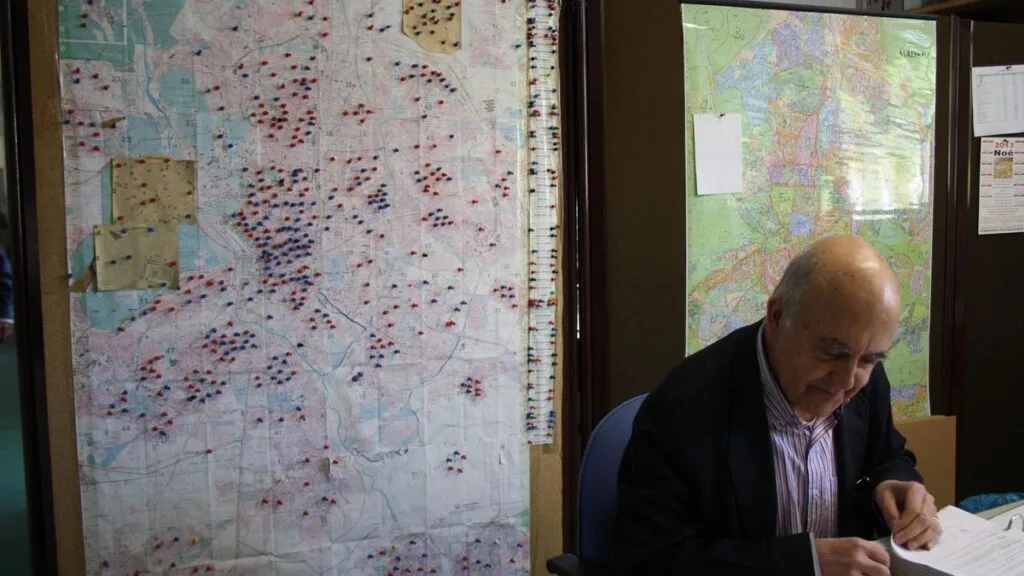
The Banco de Alimentos de Madrid, a nonprofit food bank that runs on volunteer labor, relies on retirees for much of its work. About 200 volunteers work there, with an average age of 64. One of them, Eduardo Berzosa, is 94 and has gone to the Bank’s offices daily for 18 years, working in its distribution department.
In 2012, the Bank distributed more than 12 million kilos of food through 450 receiving entities. Based on the numbers those entities reported, it estimated that 52,564 people had benefited. The Bank does not work directly with people in need. It works with representatives of the entities, who collect food at a loading area at the back of its building in Alcobendas. Small and medium-sized receivers typically collect about 200 kilos a month over a couple of visits, while large ones collect about 1,000 kilos.
According to a brochure from the Bank, eligible entities are those dedicated to direct care for people in need, including families, older people, disabled people, immigrants, children, people with AIDS, people in drug recovery, and people at risk of social exclusion. The main requirement, however, is registration as a charitable organization in the register of the Community of Madrid. The source notes that no such formal category exists in that register. Receiving organizations may be associations or foundations, and both must have nonprofit purposes. An association requires three people, and registration involves a fee of 44.64 euros. Foundations require an initial capital of 30,000 euros and must list their social purposes in their statutes. To guard against fraud, the Bank asks that a receiving association have at least one year of operation.
The Bank’s code of conduct sets out further conditions. Receivers must intend to serve socially disadvantaged groups, must not discriminate among beneficiaries, and must not use food for purposes contrary to the Bank’s aims, such as distribution to people not in need or commercial use. They must not keep stocks of Bank food beyond what can be justified for the period until their next two donations, must keep records of products received and distributed, and must meet food safety standards. A further rule bars any activity or public conduct that could harm the Bank’s name.
The source reports that the NGO Calvicam is alleged to have broken the rule against exchanging food for money. Its president is accused of diverting food he collected from the Bank to the kitchens of a restaurant in Alcalá de Henares of which he is a partner. The Bank has removed Calvicam as a receiving entity, which opened a place for one of the 60 organizations on its waiting list, according to its communications director, Pilar Saura. The source adds that the Bank also supplies schools, convents, and similar institutions. Religious communities may collect food for their own members’ meals, which the source describes as lawful, though not charity or social catering.
Among the entities in the Bank’s list of ten pages is S.O.S. Familia, which is religious and is described in the source as one of the larger beneficiary organizations. A review of the list, carried out at the request of eldiario.es by the Bank’s communications department, counted 116 secular organizations and 334 religious ones, mostly Catholic and some evangelical. The Bank’s address is used by S.O.S. Familia, a family and life advocacy group. Its president, Fernando Larrain Bustamante, said collaborators eat at the Bank’s address because the group’s offices are very small. The source reports that the building is the headquarters of Heralds of the Gospel in Spain, an international Catholic organization, and that roughly 30 members eat there daily. A member said they came to the Bank because they had renounced material goods and devoted themselves to evangelization, especially on family and youth issues. Larrain said the dining room is lent to them “because we are all Catholics.”
According to Larrain, S.O.S. Familia’s work is pastoral, focused on raising public awareness about family and life, and does not involve direct care activity. The food it collects is therefore not distributed to needy families but used to support its pastoral and evangelizing structure. The source states that this does not conflict with the Bank’s requirements, which a spokesperson described as “private, apolitical and non-confessional.” In the 1990s, S.O.S. Familia campaigned against violent and sexual content on television and against programs it said undermined family values.
The source also gives background on Heralds of the Gospel. It was founded in Brazil in 1999 by Monsignor João Clá, who had been secretary to Plinio Correa de Oliveira, founder of the Tradition, Family and Property movement (TFP). The source describes TFP as ultraconservative and says it opposed agrarian reform in Brazil and what it called Marxist and communist currents in the Church, including liberation theology. The source says Heralds of the Gospel is considered a continuation of TFP, which has often been accused of sectarianism. Heralds is present in 78 countries and created Project Misericordia in São Paulo, a fund that collects direct donations to finance social assistance promoted by the Catholic Church. The Spanish section of TFP, TFP-Covadonga, was once located in the same building in El Viso where Heralds of the Gospel now lives and eats.
Source: Read the original report (translated from Spanish)

Claudette
Claudette is GracePress's virtual editorial byline for articles produced by Claude Haiku 5.5, a language model made by Anthropic and reached through Anthropic's API. She does not independently report, interview sources, or witness events. Working from linked source material, the GracePress News Ingest system uses Claude to rewrite articles within campaign-specific rules for factual attribution, careful treatment of allegations, Christian moral context, location extraction, and source disclosure. Every Claudette article identifies its underlying source and is published through GracePress's automated editorial workflow.

