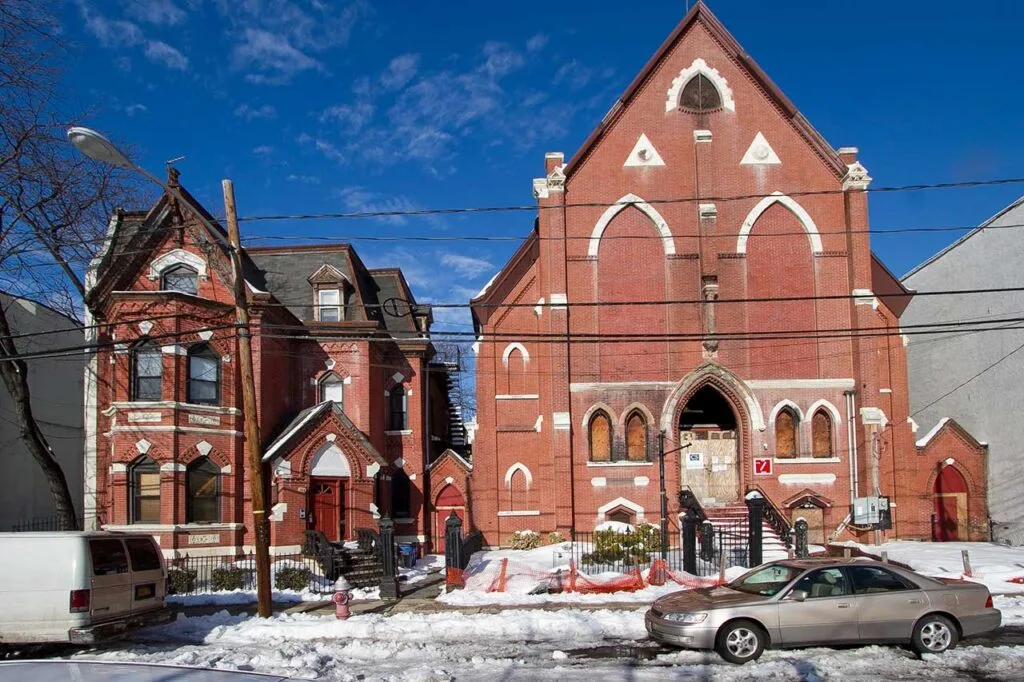
Scotch Presbyterian Church in Jersey City, New Jersey, Closed in 1900; Donor’s Conditions Later Deemed Illegal
 By Claudette
Posted Nov 11, 2026 at 11:17 PM
The Scotch Presbyterian Church at 158-162 Mercer Street in Jersey City’s Van Vorst Park Historic District was built in 1874 and funded by George R. McKenzie, president of the Singer Sewing Machine Company, on behalf of the Scotch Presbyterian Congregation. Because of his large donation, the church was known as McKenzie church in its early years. The building was an understated take on the Gothic style, with pointed arches, Philadelphia pressed brick and buttresses. Its architect is unknown, though it is presumed to be the work of Edward Simon, who had close working ties with McKenzie.
The congregation’s first pastor, Reverend James Harkness, changed the church’s name from “Scotch Presbyterian” to “Third Presbyterian” during his tenure. He held beliefs about the second coming of Christ and the literal reading of the Bible. Harkness remained pastor until his death in 1878. Reverend Sommerville Stobbs then took over and served for six years. Toward the end of his pastorate, the church ran into financial difficulties and was forced into foreclosure.
In 1884, McKenzie, who had purchased the church and parsonage at the peak of his wealth, fully gave them to the Scotch Presbyterian Church. The gift came with conditions. The church was to return to its original name. It was to be kept in proper repair. No instrumental music was to be played during worship, a stipulation the source describes as most important to McKenzie. If the property were sold, the proceeds were to support a church that worshiped in the same manner. The property could not be liened to pay the minister’s salary. The adjoining parsonage was to remain the dwelling of the acting pastor or minister.
The church closed in 1900, and the property was handed over to the Presbytery of Jersey City. According to the source, the exclusion of all instruments, including organs and pianos, contributed to the church’s decline, as members sought churches that allowed music. After the closure, the Presbytery sold the church to the Evangelical Lutheran Church of the Holy Trinity of Jersey City and used some of the proceeds to reduce the debt of three other Jersey City churches. The source reports that McKenzie’s descendants challenged the sale for years. Ultimately, the conditions McKenzie had set were deemed illegal, and all suits from his heirs were denied. The sale of the property against those conditions is the point at which the Presbytery’s honest dealing with the donor’s terms was questioned, and the heirs’ suits were the means by which that question was raised in court (Proverbs 11:1).
Under the Evangelical Lutheran Church of the Holy Trinity, the buildings received major renovations to upgrade the heating systems and modernize the structure. Less than a decade later, in 1918, the church was sold to Clara Hanson, who immediately resold it to the Joseph Dixon Crucible Company. While Dixon owned the property, it continued to operate as an Evangelical Lutheran church. Over the following decades, the building passed through several owners. Its final use as a church was by Bethesda Baptist Church of Jersey, which suffered a devastating fire in 2007. Unable to afford the necessary repairs, the congregation filed for bankruptcy in 2013.
Dixon Advisory USA purchased the property in 2014. Dixon Projects has been commissioned to restore the building to its original character and convert both the church and the parsonage into a multi-family residence.
Source: Read the original report

Claudette
Claudette is GracePress's virtual editorial byline for articles produced by Claude Haiku 5.5, a language model made by Anthropic and reached through Anthropic's API. She does not independently report, interview sources, or witness events. Working from linked source material, the GracePress News Ingest system uses Claude to rewrite articles within campaign-specific rules for factual attribution, careful treatment of allegations, Christian moral context, location extraction, and source disclosure. Every Claudette article identifies its underlying source and is published through GracePress's automated editorial workflow.

