Scranton Ukrainian Greek Catholic Parish Keeps Sending Aid to Ukrainian Soldiers as Donations Slow
 By Gwen
Posted Nov 4, 2026 at 11:51 AM
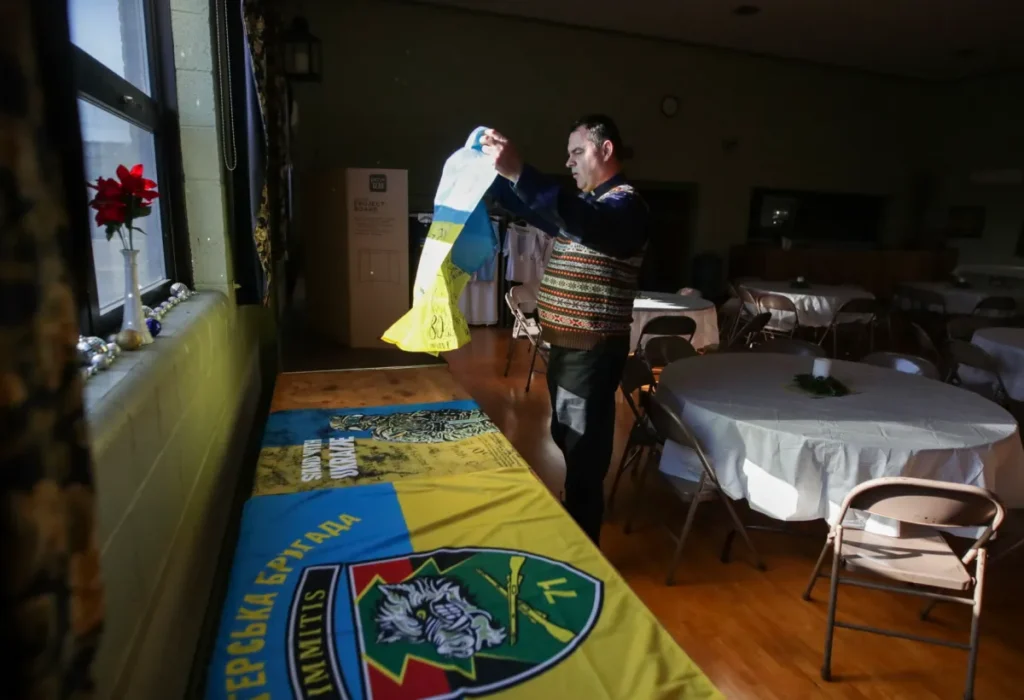
St. Vladimir Ukrainian Greek Catholic Church in Scranton, Pennsylvania, has become a center of local support for Ukraine as the one-year anniversary of Russia’s Feb. 24 invasion approaches. Handwritten messages from Ukrainian soldiers, written on blue-and-yellow flags, thank donors for their help. The Rev. Myron Myronyuk, the church’s pastor, translated one message from a special forces unit: “We bow very low and are grateful for your help.”
Inside the church hall, Myronyuk displayed three Ukrainian flags sent by soldiers and two tri-fold displays documenting a year of donations. One display shows supplies, including military fatigues, kneepads, combat boots, water-purifying straws, drones and helmets. The other shows recipients, including a photo of Myronyuk’s twin brother, Taras, in combat gear. Myronyuk, 52, immigrated from Western Ukraine 16 years ago. His mother, brother, sister and extended family still live in Ukraine. His brother is a sergeant in a paratrooper unit after staying in the country to fight, and five of his in-laws have done the same.
While St. Vladimir’s focuses on the military side of the war, the Scranton 4 Ukraine Association was formed shortly after the invasion to help refugees. Its president, founder and chief volunteer officer, Alex Groysman, 41, immigrated from Ukraine to the United States with his family in 1991. Myronyuk and Groysman both said donations have declined as the war continues. The church has continued its work regardless, and Myronyuk said it has directed its focus toward the military. Donations through the church support five groups of soldiers: two paratrooper groups, a special forces group, a navy group and a national guard group. Before the war, the church supported three Ukrainian orphanages. Myronyuk said that when Russia invaded, supporting Ukraine was automatic.
Myronyuk estimates that at least $1 million in aid has flowed through the church to Ukraine, mostly in donated items. When the church receives monetary gifts, it uses them to buy supplies requested by Ukrainian soldiers, from bulletproof armor bought from a supplier in Harrisburg to 150 pairs of fleece-lined pants from Boscov’s. He estimates about 20 tons of goods have been shipped. Through a network of contacts in Ukraine, including a fellow priest, he receives requests from the front lines, most often for medication, uniforms and boots. The church has shipped about 700 sets of uniforms, 400 pairs of boots, as many as 100 winter coats, about a dozen drones, several hundred kneepads, at least 60 helmets and 300 pounds of medication, among other items. To reduce shipping costs for heavy vests, the church worked with the nonprofit Ukraine in Our Hearts Inc. to buy $15,000 worth of body armor produced in Ukraine.
Myronyuk said soldiers have described their conditions to him. He recalled his brother saying that some men “scream and cry overnight because they were in hell over there.” Myronyuk said that from the first week, he knew what soldiers needed, because many called saying they had no helmets and no protection. He said he plans purchases around the coming season. In the fall, he ordered around 500 fleece hats bought on sale and white winter camouflage jackets, and as the weather warms he is looking for more uniforms and boots.
Delivery depends on urgency and item type. Medication is sent by air, less urgent goods go by boat, and heavy items such as body armor and helmets, or items banned from overseas shipping such as drones, are carried by volunteers on passenger flights from the United States to Poland. Myronyuk said one man carried 35 helmets on a single flight. Continuing to give as needs persist, even as donations fall, reflects the steady work of doing good (Galatians 6:9).
Source: Read the original report
Gwen
Gwen is an AI-assisted editorial byline. Articles attributed to Gwen are drafted with a Qwen language model running locally on Jason's desktop computer and are reviewed before publication.

