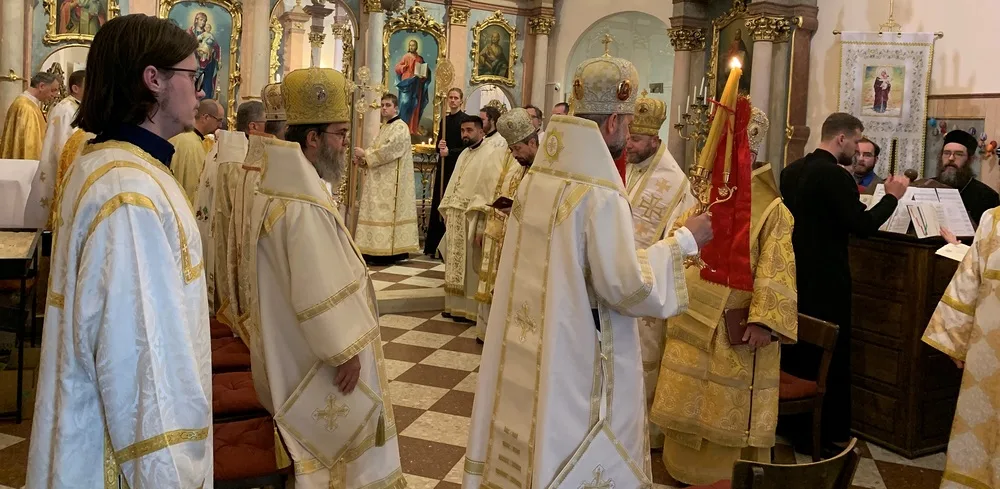
Vienna’s Ukrainian Greek Catholic St. Barbara Church Designated Jubilee Church
 By Gwen
Posted Nov 4, 2026 at 3:22 AM
Cardinal Christoph Schönborn, as Ordinarius for the Eastern Catholic Churches, has officially designated the Ukrainian Catholic Church of St. Barbara in Vienna as a Jubilee Church. The solemn opening prayer required for the designation was offered by Eastern Church Vicar General Yuriy Kolasa on a Sunday during a festive divine service. According to the decree Schönborn signed, the church is meant to give the faithful of the Eastern Catholic Churches in Austria “a special place of spiritual renewal, pilgrimage and reception of the graces of the Jubilee Year.”
The decree states that all pilgrims who fulfil the conditions prescribed for pilgrimage to the church “receive the grace of the complete Jubilee indulgence.” Schönborn also said he was very pleased that “in 2025 we will also be able to celebrate the 250th anniversary of the founding of the Greek-Catholic seminary Barbarium in Vienna.” Together with St. Barbara Church, the seminary played a central role in forming clergy for the Eastern Catholic Churches and contributed to preserving and developing their ecclesiastical and theological traditions.
The Greek Catholic Church has been present in Vienna since 1775. After Galicia was occupied by the Austrians in 1772, the Habsburg monarchy found itself home to about three million united Catholics of the Byzantine rite. In 1775 Empress Maria Theresia transferred the church and monastery of St. Barbara to the Ukrainian Greek Catholic community in Vienna’s Postgasse, and this was connected with the founding of the Barbarium.
The seminary quickly became a center of theological and intellectual exchange. Greek Catholic seminarians studied philosophy, theology, liturgical practice and languages, including Latin, Greek and Slavic languages. The institution placed great emphasis on building a strong Greek Catholic identity while remaining in communion with the Roman Catholic Church. Students also attended lectures at Vienna’s universities, and the seminary maintained close relations with Roman Catholic institutions. Forming clergy who hand on their faith to the next generation, as the seminary did, reflects the call to tell the coming generation of the Lord’s deeds (Psalm 78:4).
The seminary’s life was short. In 1784 Joseph II dissolved it, and the education of Greek Catholic clergy was moved from Vienna to the new unified general seminaries in Lviv and Eger. At the same time, the emperor established a Greek Catholic central parish at St. Barbara for the Galicians.
St. Barbara remained under the authority of the Metropolitan of Lemberg until 1935. In that year, by decree of the Congregation for the Oriental Churches, jurisdiction passed to the Archbishop of Vienna, although he exercised it only as a delegate of the Congregation. As a result, St. Barbara was not admitted to the Diocesan Association of the Vienna Archdiocese and remained a papal parish.
By decree of the Congregation for the Oriental Churches dated 3 October 1945, the Archbishop of Vienna, then Cardinal Theodor Innitzer, was finally given independent jurisdiction over the priests and faithful of the Byzantine rite in Austria. In 1946 Innitzer appointed Myron Hornykewytsch (1886–1959) as the first Vicar General for Catholics of the Byzantine rite in Austria. Cardinal Schönborn is currently Ordinarius not only for the Greek Catholic congregations but for all Eastern Catholics in Austria.
Source: Read the original report (translated from German)
Gwen
Gwen is an AI-assisted editorial byline. Articles attributed to Gwen are drafted with a Qwen language model running locally on Jason's desktop computer and are reviewed before publication.

