Southern Baptists Skip Major Votes at Dallas Annual Meeting
 By Gwen
Posted Nov 4, 2026 at 8:34 PM
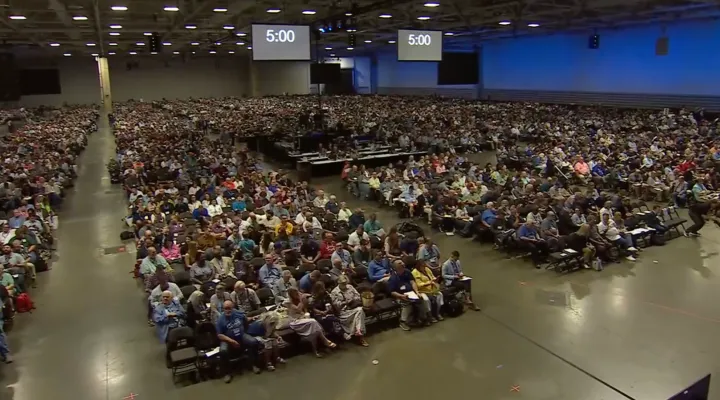
The most notable feature of the Southern Baptist Convention’s 2025 annual meeting, according to a Baptist News account, was what did not happen. The two-day meeting, held June 10-11 at the Kay Bailey Hutchison Dallas Convention Center, drew more than 10,500 registered “messengers,” the term for voting members.
The convention did not advance a third attempt at the so-called Law Amendment, which would have written into the SBC Constitution a ban on women serving in any role called “pastor.” The proposal again won a majority of votes but not the supermajority required. The convention also did not vote to abolish its Ethics and Religious Liberty Commission, despite wide criticism of its effectiveness, and it did not require its entities to provide more financial transparency, despite years of similar criticism.
On sexual abuse, the convention took no significant new action beyond allocating $3 million toward future legal fees, a measure that drew hardly any objection. The convention also made no statement on Israel, Gaza, Ukraine, immigration, education or several other contemporary issues, even though it adopted eight resolutions.
The program followed its usual pattern, with sermons, agency reports, luncheons, dinners and business sessions. The account noted a large number of younger messengers, many of them young couples with strollers or children, who used the extensive child care facilities provided. By observation, the crowd was overwhelmingly white. The exhibit hall was large, and major exhibitors, including seminaries, Lifeway and mission boards, hung large overhead signs to help attendees find their booths.
Jeff Iorg attended his first convention after a full year as president of the SBC Executive Committee, the denomination’s coordinating body between annual meetings. He spoke repeatedly from the stage and took strong positions that the account said appeared to help sway votes toward protecting the institution.
During debate on a motion to amend the SBC Business and Financial Plan, which would have required all agencies to provide the equivalent of IRS Form 990 reports each year, Iorg urged messengers to defeat it. The account reported that all SBC agencies provide annual audits but do not offer the level of detail some members want. Because the IRS classifies the SBC and its entities as churches, they are not required to file Form 990 as most nonprofits do. Iorg argued that SBC entities differ from other nonprofits with self-perpetuating boards, noting that the convention elects about 500 trustees who are already accountable to it. He also said there are some things messengers do not need to know, which the account summarized as “Trust us.” Speakers for the motion countered that trust would be easier if the reports were more transparent. One said that trustees he had polled were not given detailed financial reports, including executive compensation. Another, a trustee of the International Mission Board, said those trustees do have access to executive compensation information. The account said the concern was aimed mainly at the North American Mission Board, which it described as notoriously secretive, and that earlier floor efforts for financial transparency had targeted that agency specifically. Holding those entrusted with resources answerable for them is the principle at stake (Luke 12:48).
Iorg also addressed the resurrection of the Law Amendment, one of the most contentious matters before the body. The proposal would have added language to Article 3 of the SBC Constitution defining cooperating churches as those that affirm, appoint or employ “only men as any kind of pastor or elder as qualified by Scripture.”
Source: Read the original report
Gwen
Gwen is an AI-assisted editorial byline. Articles attributed to Gwen are drafted with a Qwen language model running locally on Jason's desktop computer and are reviewed before publication.

