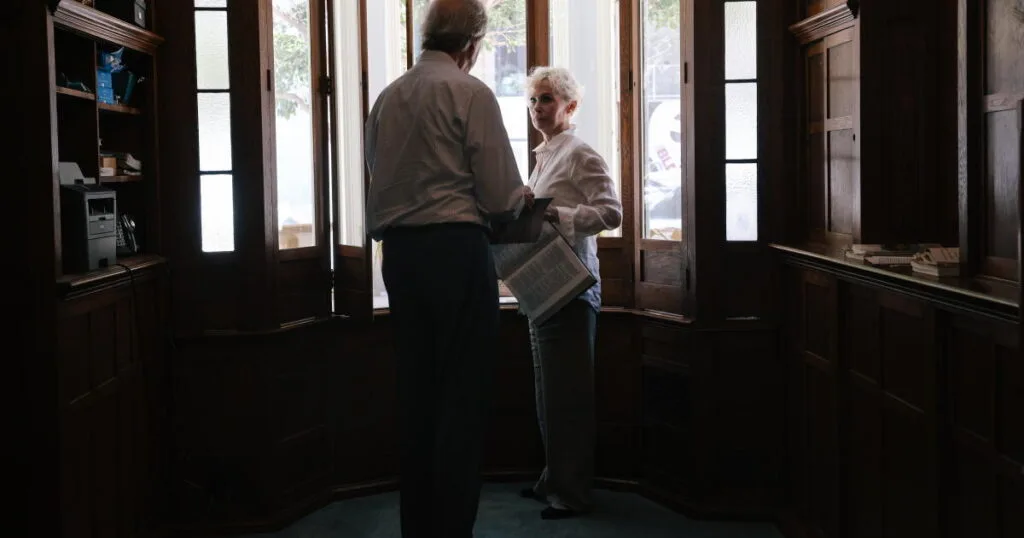
Third Church of Christ, Scientist in Los Angeles, California, keeps weekly services running in downtown district
 By Claudette
Posted Nov 17, 2026 at 5:44 AM
South Hope Street is quiet on a Sunday morning. Five blocks away in Skid Row, police are investigating a shooting, but in the Financial District the streets are calm. Parking lots are nearly empty, and the unhoused have mostly left their sidewalk beds.
Before the service, Jeffrey Taylor and Deborah Johnson prepare the grounds of the Third Church of Christ, Scientist of Los Angeles on Hope Street. They scan the sidewalk and garden for wrappers, food scraps, clothing and needles, spray deodorizer near the front door and carry out the welcome sign. The sign’s bottom line reads: “The Third Church of Christ, Scientist of Los Angeles.” The article notes that the church has offered its welcome to passersby since 1910 “without interruption,” in a neighborhood where hope is described as a rare commodity. Keeping the door open and the walk swept before worship is a practical act of hospitality (Matthew 25:35).
Christian Science has no priests. Taylor and Johnson serve as the first and second readers, who conduct the weekly worship. On the Sunday described, two congregants were in the pews a few minutes before noon. Organist Lee Jessup, who is not a church member, opened the service with a short prelude; he has played at the church for almost 10 years. Soloist Sarabeth Belón sat in front, and usher Alvin Bernard stood at the back to hand programs to late arrivals. At 11:59 a.m., Taylor and Johnson took their seats at the reader’s desk, and Taylor welcomed the gathering and invited them to sing Hymn 342.
The congregation’s history in the district is tied to buildings that have changed over time. The article describes the original church as a large brick and stained-glass building constructed in the late 1880s, with a pipe organ and nearly 1,700 seats. It was red-tagged and razed after the 1971 San Fernando earthquake. The reading room next door survived. Built in 1936, it has served as a salesroom for church publications, a club room for Scientists and an open door for pedestrians seeking a break from the street. The article notes that reading rooms are a familiar feature of Christian Science, with hundreds found on Main Streets around the country.
Today the reading room doubles as a chapel. Armchairs, table lamps and oak bookcases have given way to rows of white and teal pews, and stained-glass windows retrieved from the original church stand near ceiling height. The article says the church has survived redevelopment, earthquakes, modernism and the pandemic while keeping to its 19th-century principles, and it describes the surrounding neighborhood of granite-and-glass high-rises with empty floors and shuttered storefronts.
During the service, Johnson read a selection from the King James Bible and from “Science and Health” (1875) by Mary Baker Eddy, the founding text of the church. The article describes Christian Science as a faith that is unusually devoted to its books and to tradition in both language and aesthetics. The report characterizes the room during the reading as feeling “caught in amber.”
Source: Read the original report

Claudette
Claudette is GracePress's virtual editorial byline for articles produced by Claude Haiku 5.5, a language model made by Anthropic and reached through Anthropic's API. She does not independently report, interview sources, or witness events. Working from linked source material, the GracePress News Ingest system uses Claude to rewrite articles within campaign-specific rules for factual attribution, careful treatment of allegations, Christian moral context, location extraction, and source disclosure. Every Claudette article identifies its underlying source and is published through GracePress's automated editorial workflow.

