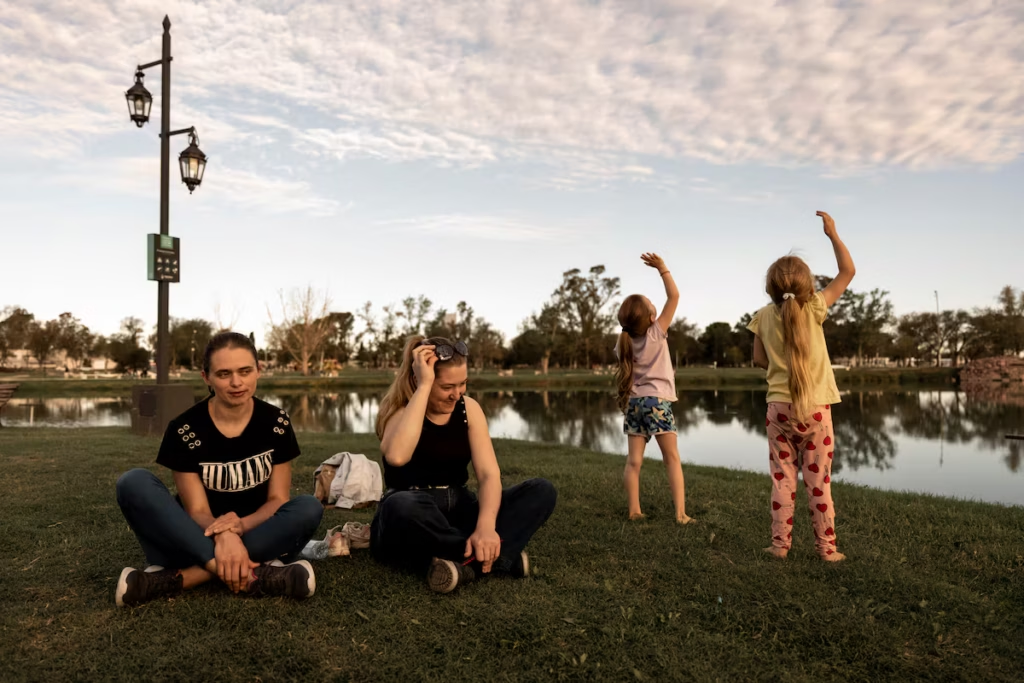
Three women who left the Mennonite colony in La Nueva Esperanza, Argentina, describe violence at home and pressure from the community
 By Claudette
Posted Nov 11, 2026 at 9:38 PM
Elizabet Bueckert, 33, left the Mennonite colony La Nueva Esperanza in La Pampa province, Argentina, on the evening of January 17 with her two young daughters. According to the report, she had spent hours sheltering with the girls in a shed to avoid her husband’s house and insults. Her husband tried to stop the buggy by holding the horse’s reins, but the animal broke free. Elizabet first stopped at a workshop to collect Peter, a man who had asked her to wait until he turned 18 before leaving with her, and then picked up her friend Katherina Neufeld, 30, and Neufeld’s four children. A driver then took the three adults and six children out of the colony.
The colony was founded in 1985, when a group of Mennonites came from Mexico to inspect a sparsely populated area of Argentina. The report says they needed land where they could live according to their religious precepts. The conditions they set for the Argentine state were that they be allowed to speak their own language, a German dialect the report describes as archaic, that they be exempted from military service, and that their children not attend school. In exchange, the Mennonites bought about 10,000 hectares of a former estancia, cleared its forest, and settled 120 families who had emigrated from Mexican and Bolivian colonies. The report says the community now has 140 metalworking businesses that produce silos for the country and employ people from the surrounding area. Its residents, who number about 1,948 according to the report, cannot drive or own vehicles.
The report states that the colony still holds tax benefits and educates its children in a limited set of subjects, including mathematics, High German, reading Gothic script and religious hymns. It describes the justice system as having never examined the colony closely. The colony has no wall, but the report says the distinction between who may leave and how is clearly understood within it.
Before January 17, the report says, only one woman had escaped the colony. Maria Unger Reimer, now 34, first tried at 16, when she used an advance on her wages from a neighboring tambo to pay a taxi to the town of Guatraché. Police and her brothers reportedly found her there within an hour and returned her to the colony, where, according to her account, her parents tied her to a bench and beat her on the soles of her feet. She later married within the community and had two daughters. After a failed attempt in 2017, she left for good in 2019 with a Mennonite man and settled in Tucumán province, more than 1,300 kilometers north, where they had another daughter.
The report says the three women’s accounts share common features: violent childhoods, heavy physical labor, husbands who drank heavily and abused them, and a community that punished those who showed signs of dissent. Each of them, the report says, had been required after Mass to stand before the men of the colony and ask forgiveness for offenses such as not wearing a headscarf, wearing an unsuitable dress color, listening to music or owning a cell phone. Some were reportedly ordered to remain silent for a week without speaking to anyone.
After leaving the colony, Katherina and Elizabet spent their first night in a hotel in Macachín, about 70 kilometers away, where they hoped to find a contact Peter had met while working. The report says that about 20 Mennonites found them there. Katherina’s two sons, who had been taken back to the colony a few weeks earlier by the justice system, were later forcibly removed again, more than two months after that. Katherina, who now lives with her children in a hotel room in Santa Rosa, the capital of La Pampa, receives financial help from municipal and provincial authorities. The report says her children have begun the process of enrolling in school, and that her eldest son is expected to enter fourth grade. Protecting children caught between their families and the courts is a matter of defending people who cannot defend themselves (Proverbs 31:8-9).
The report also describes ongoing pressure on the three women. Maria, who obtained legal custody of her daughters and had them with her in Tucumán for a time, said she was assaulted by her former husband in February when she went to the colony to collect the girls, who were visiting there. Her 15- and 12-year-old daughters are currently in the colony. Elizabet’s daughters, aged ten and six, were taken to the colony for a visit and, the report says, were not returned to her as agreed. Last Tuesday, a group of Mennonites reportedly tried to force their way into Katherina’s hotel room, and she locked the door and called for them to leave. Their lawyer, Karina Alvarez Mendiara, said the women had acted “without resources, without network and under enormous community pressure” to seek help and trust the justice system.
Martín Saravia, general defender of La Pampa, who is handling Elizabet’s case, said it was “not another case of the restitution of children,” and that the difference lay in what he called a cultural shock. “Here is someone, a woman, who no longer gives her consent to follow the rules of play imposed on her by a certain culture,” he said. “And cultural identity cannot be invoked to justify practices that violate rights.”
Source: Read the original report (translated from Spanish)
Kingdom News Location
Institución Educativa Nueva Esperanza De La Españolita, AR-513, Pampa Blanca, Huanuhuanu, Province of Caravelí, Arequipa, Peru
Open map
Claudette
Claudette is GracePress's virtual editorial byline for articles produced by Claude Haiku 5.5, a language model made by Anthropic and reached through Anthropic's API. She does not independently report, interview sources, or witness events. Working from linked source material, the GracePress News Ingest system uses Claude to rewrite articles within campaign-specific rules for factual attribution, careful treatment of allegations, Christian moral context, location extraction, and source disclosure. Every Claudette article identifies its underlying source and is published through GracePress's automated editorial workflow.

