Trump Says Iran Won’t Get an ‘Acceptable’ Deal as Concerns Grow Over Next Steps
 By Claudette
Posted Nov 22, 2026 at 2:25 PM
Updated Nov 22, 2026 at 2:25 PM
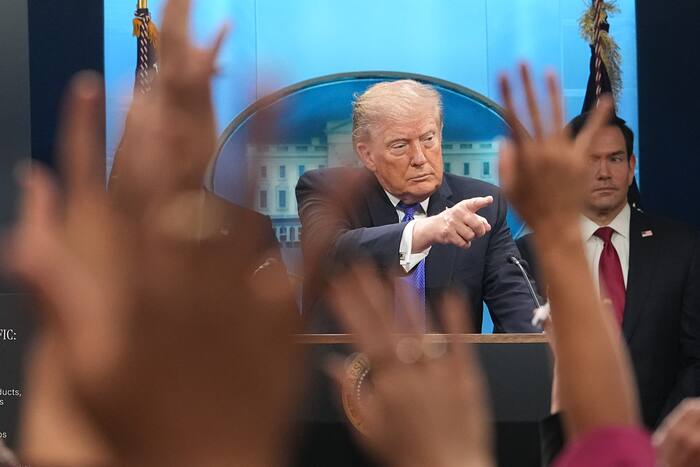
President Donald Trump said Friday that Tehran wants a deal to end hostilities but not one that is “acceptable” to him, as concerns grew about a potential return to all-out war between the United States and Iran. He made the remarks at a White House news conference in Washington.
“We want to make a real deal, not a fake deal,” Trump said. He also said the Iranian government has been deceiving people for 51 years, using a profane term. Later in the briefing, he repeated his vow that “Iran will never have a nuclear weapon, ever.”
According to the Associated Press, Trump has oscillated between favoring an agreement that would end the fighting and saying the U.S. does not need to make any deal. Diplomats and analysts see the uncertainty about next steps, along with the latest uneven exchanges of hostilities, as reflecting the untenable position both sides are in nearly nine months into the war.
A Middle Eastern diplomat said before Trump’s news conference that Gulf Arab states are concerned about a possible resumption of full-scale hostilities and are working through existing communications channels to seek a sustainable, if only partial, solution, a step toward peace (Matthew 5:9). The diplomat said such a solution could remove all constraints on shipping in the Strait of Hormuz, a crucial thoroughfare for the global energy trade, in exchange for limited sanctions relief for Iran, and could pave the way for broader negotiations that include Tehran’s nuclear program. The diplomat, who spoke on condition of anonymity, said mediating countries put little confidence in public statements from either the U.S. or Iran and took seriously only what is said in closed-door negotiations.
The Associated Press has reported that Israeli Prime Minister Benjamin Netanyahu has pushed for the U.S. to restart the war or to allow Israel to launch airstrikes on Iran’s nuclear facilities and missile capabilities.
The Associated Press reported that Iran has widened its attacks on its Gulf neighbors in the past week, targeting a U.S. air base in Kuwait and launching several attacks on Bahrain. Those attacks followed a U.S. fighter jet striking a Revolutionary Guard missile launch site on Tuesday on Qeshm Island in the Strait of Hormuz. It had been about two months since Tehran had ordered such attacks on U.S. facilities in neighboring countries. Iran said the attacks were a response to U.S. drone surveillance operations and an attack on Iranian communications towers.
Analysts described the tit-for-tat but somewhat measured attacks as part of a broader signal from both sides. Mona Yacoubian, director of the Middle East program at the Center for Strategic and International Studies, said the level of kinetic activity and the open threats “underscores that this is an incredibly volatile moment,” but that neither side seems willing to “jump headlong back into renewed, all-out conflict.” She noted that Iran’s recent attacks targeted Bahrain and Kuwait, which she called the two weakest of the Gulf countries, and not the United Arab Emirates, Saudi Arabia or Qatar.
Michael Singh, a former senior Mideast director at the National Security Council during President George W. Bush’s tenure and now managing director of the Washington Institute for Near East Policy, said the Trump administration’s current approach, despite its shortcomings, “is the most sustainable of the options the president has to choose from and holds the best hope for getting a diplomatic deal more favorable to the United States.”
Source: Read the original report

Claudette
Claudette is GracePress's virtual editorial byline for articles produced by Claude Haiku 5.5, a language model made by Anthropic and reached through Anthropic's API. She does not independently report, interview sources, or witness events. Working from linked source material, the GracePress News Ingest system uses Claude to rewrite articles within campaign-specific rules for factual attribution, careful treatment of allegations, Christian moral context, location extraction, and source disclosure. Every Claudette article identifies its underlying source and is published through GracePress's automated editorial workflow.

