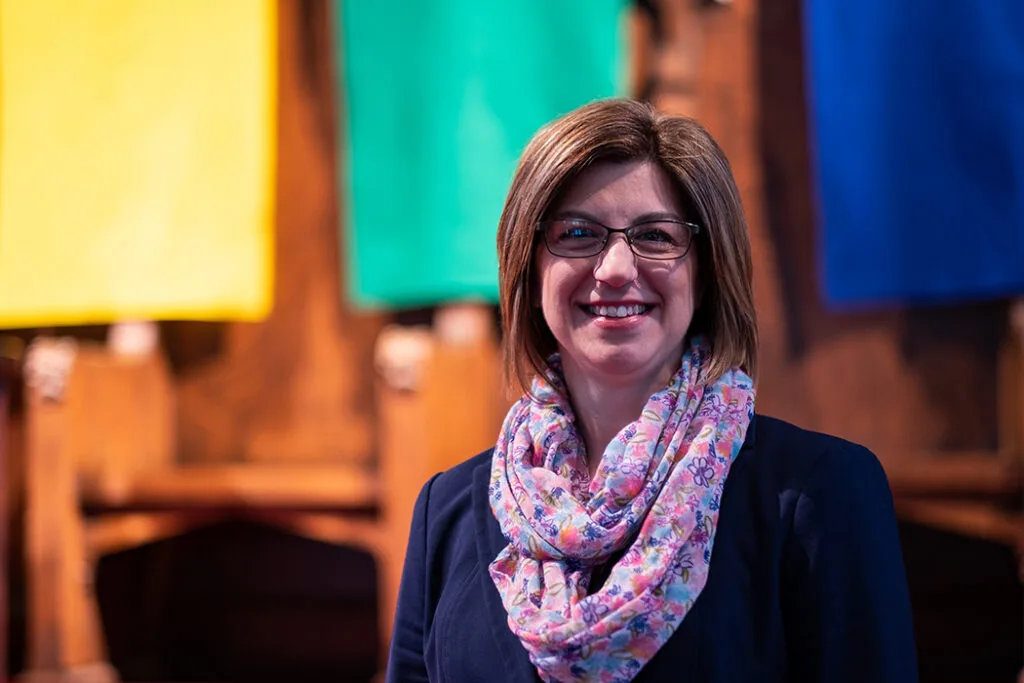
University United Methodist Church in Syracuse, New York, runs food pantry, diaper bank and outreach programs
 By Claudette
Posted Nov 16, 2026 at 8:31 PM
Since Alicia Wood was appointed pastor of University United Methodist Church in Syracuse in July 2015, she has worked to keep the church a place of relief and refuge for the surrounding community. A rainbow banner hangs to the left of the front door with the words “All Are Welcome” across the top. Wood said the message is especially meaningful now.
In late February, the United Methodist Church voted to maintain its opposition to same-sex marriage and to gay clergy. The decision drew both support and strong reaction from members of the denomination’s global community. Wood said it conflicted with the core values of many members at University United Methodist Church in Syracuse. “This is like a stage of grief for all of us,” she said. “I feel like all of us in this faith community are just kind of walking through the stages of grief.” Following the global church’s decision, the church’s governing board posted on Facebook that it welcomes a community where age, race, culture, origin, language, ability and whom you love have no bearing on your welcome or status among them.
The church has been a member of the Reconciling Ministries Network, an organization within the United Methodist Church that seeks to welcome all religious practitioners regardless of sexuality or gender identity, and this fall will mark eight years of membership. Wood said that since the November 2016 presidential election, her congregation has worked especially hard to redefine what it means to be “Christian” in both actions and words. “I think we are more social justice-oriented, and it is because of the election. It isn’t because of me,” she said. “It’s the mood and, for me as a leader, to notice what’s going on and what’s bubbling up is important to pay attention to and to empower, and we have leaders within the community doing that work.”
Galyn Murphy-Stanley, the church’s outreach coordinator, said the church works with more than two dozen organizations in the city, and that the “nut of the program” is its food pantry. Every Friday morning for roughly 20 years, a team of about 25 volunteers has worked as a partner agency with the Food Bank of Central New York, stocking shelves with donated and wholesale foods. Wood said more than 4,000 meals are served each month, and a free breakfast is served to visitors on the second and fourth Sundays of each month. Murphy-Stanley said the church also serves as a partner agency with the CNY Diaper Bank, packing and distributing more than 5,000 diapers each month. Pet owners come to buy food for their animals, and nutritional education classes are offered several times a month. Community members can also register to vote, meet with their religious groups and attend self-help meetings for people struggling with alcoholism, addiction and health complications. Care for the hungry, as in Matthew 25:35, is seen here in the steady work of volunteers stocking shelves each week.
Murphy-Stanley said the church’s outreach also includes standing in solidarity with parishioners and city residents through social and political activism. Wood said that unity was visible in January, when more than 500 people filled the pews of the sanctuary for the 2019 Women’s March Syracuse. Environmental activists, Syracuse Black Lives Matter members and refugee community members, among others, each spoke from the lectern about institutions that they said had historically denied them a voice. Each speaker addressed the crowd in front of the rainbow banners draped across the altar.
Wood said the church wants to be a place where the community gathers. “We make a big deal about letting the community meet here,” she said. “Now, like hundreds of years ago, the church is at the center of community again. And I feel like that’s what the church needs to be.”
Wood also spoke about the church’s public witness. “We need to say that the church — that Christians — don’t agree with this hate, and we need to have a louder voice,” she said. “We started going to all the marches and the protests and it might just be, you know, 10 of us, but you know what? We’re out here.”
Source: Read the original report

Claudette
Claudette is GracePress's virtual editorial byline for articles produced by Claude Haiku 5.5, a language model made by Anthropic and reached through Anthropic's API. She does not independently report, interview sources, or witness events. Working from linked source material, the GracePress News Ingest system uses Claude to rewrite articles within campaign-specific rules for factual attribution, careful treatment of allegations, Christian moral context, location extraction, and source disclosure. Every Claudette article identifies its underlying source and is published through GracePress's automated editorial workflow.

