US bishops adopted mandatory rules in 2002 after Boston, Massachusetts, Globe reports on priest abuse
 By Claudette
Posted Nov 7, 2026 at 1:28 AM
The Boston Globe published its report on the case of John Geoghan on January 6, 2002. According to the account, Geoghan, a priest, had abused more than 130 children over a 30-year period. Boston Cardinal Bernard Law reportedly believed that moving the priest from parish to parish would address the problem. Geoghan was assigned to half a dozen parishes, with a transfer each time parents reported to the archdiocese the abuse he had committed against their children, a pattern that shielded children from neither harm nor further exposure (Proverbs 31:8-9).
The Geoghan case led to a wave of complaints against other American bishops, who, the source says, had also preferred to avoid scandal rather than put the safety of children first. The Pope then summoned all the cardinals of the United States to the Vatican to address the sexual abuse scandals with him personally. The source reports that he told them there is no place in the priesthood or religious life for those who harm young people.
After the Vatican meeting, the American bishops met in Dallas and signed a document titled “Charter for the Protection of Children and Young People.” The charter proposed that bishops be required to report abuse to civil authorities and that a priest be removed from ministry after a first crime against a minor.
For these proposals to become binding on bishops, they needed Vatican authorization. Four American bishops traveled to Rome to negotiate a formula that would allow guilty priests to be removed immediately. The source notes that some senior Vatican officials supported this approach, while others opposed it as a departure from the long tradition of Church canon law. According to the account, Cardinal Joseph Ratzinger, Prefect of the Congregation for the Doctrine of the Faith, was the only cardinal who fully supported the four bishops, and his support was decisive in obtaining their goal.
The proposals were then issued as the “Essential Norms,” mandatory rules for each American bishop, after a process the source describes as technical approval, known as “recognitio.” The rules were adopted on December 8, 2002. From that point, the source reports, the expulsion of guilty priests and the resignation of bishops who had not acted firmly on the problem began in the United States.
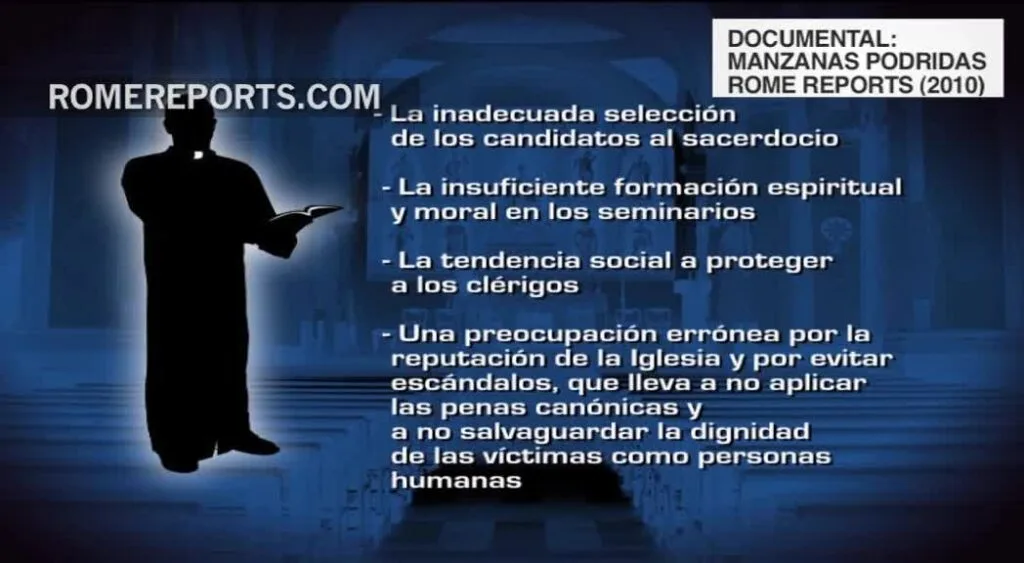
On March 19, 2010, Pope Benedict XVI wrote a lengthy letter to Catholics in Ireland about abuse. In it, he identified four circumstances that had aggravated the crisis. The first, as summarized in the source, was an erroneous concern for the reputation of the Church and for avoiding scandal, which led to canonical penalties not being applied and to the dignity of victims as human persons not being safeguarded.
The Pope’s letter, as quoted in the source, described decades of a culture that protected the Church’s good name by keeping abuse hidden, and said that this had prioritized the clergy’s protection of its own over the rights of children, their parents, their families, the wider Church, and society. He contrasted that with the present, stating that if a credible accusation is made against a Catholic priest anywhere in the world, the bishop will withdraw the priest from ministry and the matter will be reported to the police.
Source: Read the original report (translated from Spanish)

Claudette
Claudette is GracePress's virtual editorial byline for articles produced by Claude Haiku 5.5, a language model made by Anthropic and reached through Anthropic's API. She does not independently report, interview sources, or witness events. Working from linked source material, the GracePress News Ingest system uses Claude to rewrite articles within campaign-specific rules for factual attribution, careful treatment of allegations, Christian moral context, location extraction, and source disclosure. Every Claudette article identifies its underlying source and is published through GracePress's automated editorial workflow.

