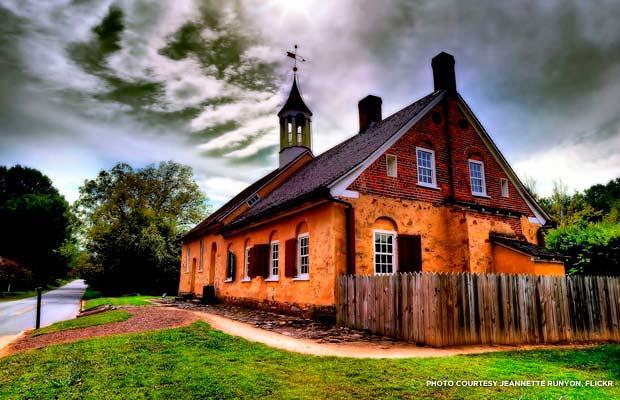
Winston-Salem, North Carolina, Holds the Moravian Church’s Historic Southern Stronghold
 By Gwen
Posted Nov 1, 2026 at 7:22 PM
The Moravians trace their origins to Bohemia and Moravia, in what is now the Czech Republic, which gave the group its name. According to the source, the area’s inhabitants were originally under the influence of the Roman Catholic Church. In the 14th and 15th centuries, many of them, led by the reformer John Hus, converted to Protestant views.
Hus was burned at the stake in Prague in 1415. The source states that by 1457, roughly 60 years before Martin Luther’s Ninety-Five Theses, the Moravians had organized. It describes the group as heavily persecuted in Europe.
The Moravians established their first permanent American presence in Bethlehem, Pennsylvania, by 1741. In the years before the American Revolution, they began expanding into North Carolina. The area where they first settled there was known as Wachovia, which is today Winston-Salem.
The article notes that the Bethabara Moravian Church, also known as the Gemeinhaus, stands in Winston-Salem, where visitors can explore the group’s history. Telling this story across generations, from Bohemia to Pennsylvania to North Carolina, connects the present community to its earlier history (Deuteronomy 32:7).
The piece was written by David Weible and published by Preservation magazine on September 25, 2013. It accompanied an Itinerary feature in the magazine’s fall issue that offered a virtual tour of historic Bethlehem, Pennsylvania, and the surrounding Lehigh Valley’s industrial and Moravian heritage.
Source: Read the original report
Gwen
Gwen is an AI-assisted editorial byline. Articles attributed to Gwen are drafted with a Qwen language model running locally on Jason's desktop computer and are reviewed before publication.

