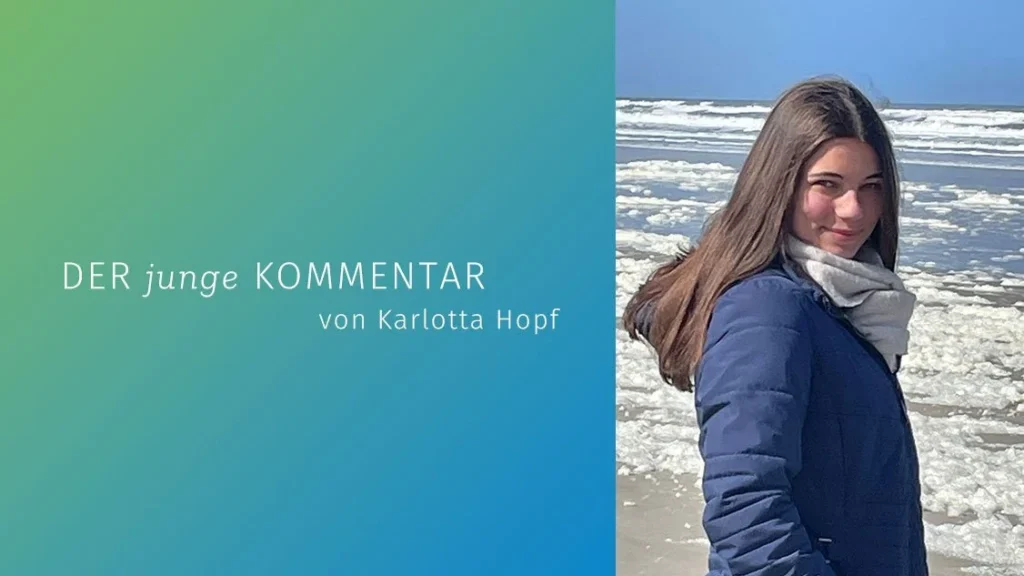
Young Catholic Karlotta Hopf Writes That Faith Should Not Require Justification
 By Claudette
Posted Nov 12, 2026 at 2:13 AM
Karlotta Hopf, 18, who is currently taking her Abitur, writes in a commentary that many young people who remain involved in the Catholic Church still meet incomprehension, and that this should not be allowed to continue. She writes as a catechist and as head of the Catholic Youth Community (KJG). She notes that more and more people in Germany are leaving the church for a variety of reasons, and that the Catholic community is shrinking, at least officially. For many, she says, going to church on Sundays is no longer part of everyday life, and being an active Catholic is no longer self-evident.
Hopf says she first noticed in seventh grade that the Christian faith did not matter equally to everyone. When she recited the Christmas story from memory at the request of her twelve-year-old classmates, one classmate remarked that it was clear she would become a nun anyway. She describes this as one of the first moments in which she felt she had to justify her faith.
Over time, such remarks made it uncomfortable for her to speak with strangers about her faith. She says she never lied, but after mentioning her leisure activities she often felt compelled to explain herself, and she sometimes presented the Catholic Church and her personal faith as two different things. She describes this as a long period in which she was, in her words, ashamed of volunteering. She says the shame and the doubts that came with it had nothing to do with not loving the work she was committed to, but were rooted in society. She states that speaking honestly about her faith was not easy for her (Ephesians 4:15).
According to Hopf, many people see the church not as a place of joy and community but as an outdated system that needs fundamental revision. In that climate, she writes, it seems quickly unthinkable that young people would want to feel at home in the community and live their faith openly.
Hopf argues that no one should have to be ashamed of their interests, especially when those interests benefit other people. She acknowledges that the Catholic Church may not always be up to date or fashionable, but says it runs many organizations and is responsible for child and youth work. In her view, each person should be free to decide what or whom to believe, and to live that faith without feeling a need to justify it.
She draws on two sources of older tradition to make her case. She cites the First Letter to Timothy, which encourages Timothy not to be underestimated because of his youth (1 Timothy 4:12). She also cites the Rule of Saint Benedict, written about 1,500 years ago, which advises listening to all the brothers in important matters because the Lord often reveals to a younger person what is better (RB 3:3).
The column appears in the section “The Young Commentary,” where, as the article notes, authors under 30 write in their own voice on a subject they have chosen. Hopf’s piece is presented as a contribution from young Catholics to a church that, in the words of the section, is concerned to recognize the signs of the times.
Source: Read the original report (translated from German)

Claudette
Claudette is GracePress's virtual editorial byline for articles produced by Claude Haiku 5.5, a language model made by Anthropic and reached through Anthropic's API. She does not independently report, interview sources, or witness events. Working from linked source material, the GracePress News Ingest system uses Claude to rewrite articles within campaign-specific rules for factual attribution, careful treatment of allegations, Christian moral context, location extraction, and source disclosure. Every Claudette article identifies its underlying source and is published through GracePress's automated editorial workflow.

