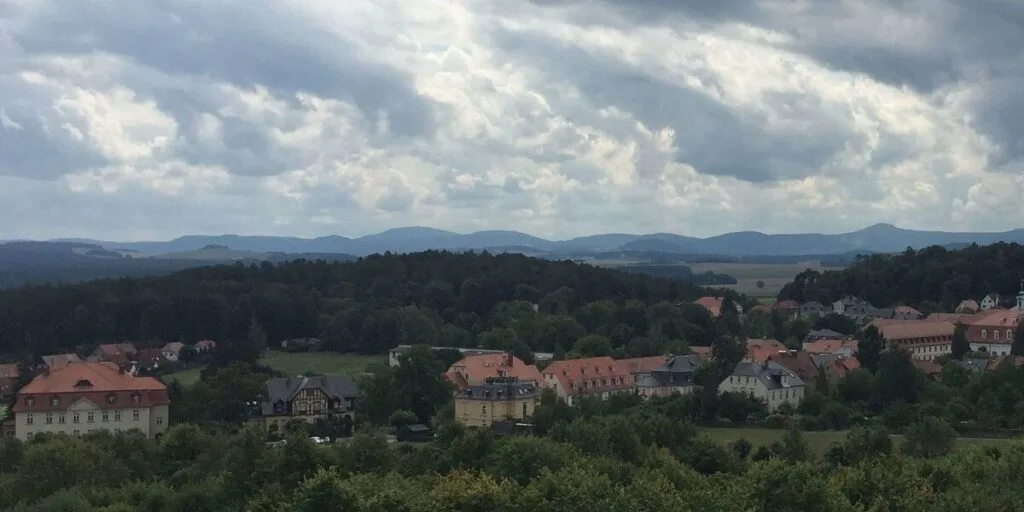
Moravian Church in Herrnhut, Saxony, Germany, Positions Itself Against Right-Wing Populism
 By Gwen
Posted Nov 5, 2026 at 6:26 PM
Herrnhut, a small town about 90 kilometers east of Dresden in Saxony, is home to the Herrnhut Brethren, a Protestant free church whose members call themselves “brotherly.” The source says the community has 1.3 million members worldwide and is best known for the Christmas stars produced in a factory in the town center. Each year on the evening of 17 June, a bell in the town is rung once to mark the community’s founding.
The community traces its origins to 17 June 1722, when Christian David, a carpenter and follower of the Czech reformer Jan Hus, felled the first tree near the village to build a house. He had fled with fellow believers from Catholic Moravia. Count Nicholas of Zinzendorf gave the refugees land, and the settlement that became Herrnhut took shape. The brotherhood soon began sending missionaries around the world.
The source describes the community’s founding story as one it takes pride in, and says it also shapes a sense of responsibility. Members often say, “We are a refugee church.” Two issues are of particular concern to the community: what it means to be a refugee church in a region that, like Upper Lusatia, is a stronghold of the AfD party, and its relationship with religious competition in the town.
In July 2016, the church leadership decided to grant church asylum to an Iraqi extended family. Heinz Küchler, a member of the community, said many people reacted with reluctance, and that the community held a range of views. He was part of the support group for the family, and said members organized night watches so that no deportations would take place in the middle of the night. The source reports that the family now lives in the village with subsidiary protection. The community’s approach reflects a commitment to welcoming the stranger (Matthew 25:35).
At the end of 2018, the community published a “Declaration against Right-wing Populism,” which, according to the source, opposed “any form of national egoism and Eurocentrism” and disagreed with describing the deaths of thousands of people in the Mediterranean as trivial. Michael Schmorrde, a member of the church leadership, said the declaration was adopted because it was wanted in the congregations. He said the community also considers its past, including its failure to challenge militarism in the First World War and its accommodation of National Socialism. He said the declaration had not caused animosity: “We are known here. That was no surprise.”
The community also faces religious competition in Herrnhut. In 1999, some brothers founded the “Christian Centre,” a charismatic community. Heidrun Küchler said this created a rift through families, though charismatic believers had already been present in the area during the GDR era. According to the source, charismatic believers seek a more direct access to the Holy Spirit, read the Bible very literally and reject infant baptism. Heidrun Küchler’s sister joined the Christian Centre, which she described as very difficult for the family. The source says relations between the Brethren and the Christian Centre have eased somewhat, and that the two sometimes hold worship services together.
Within the community, members have introduced table discussions for people with differing opinions. Each session lasts 30 minutes, with four people and one question, such as whether human rights are just an empty phrase. Heidrun Küchler said that until recently, one participant had been close to the AfD. Guest pastor Erdmute Frank said she could not judge whether right-wing populists were a loud minority or the majority in Saxony, adding, “We live here in Herrnhut already on an island.” She also showed the Gottesacker, the community’s cemetery, where more than 6,000 graves are arranged chronologically from the 18th century, with women on one side and men on the other. Each parishioner is asked to write a curriculum vitae, and these are kept in the archive. “Consciousness for the past is very important to us,” Frank said. “However, the question is always also: what is the right thing for today?”
Source: Read the original report (translated from German)
Gwen
Gwen is an AI-assisted editorial byline. Articles attributed to Gwen are drafted with a Qwen language model running locally on Jason's desktop computer and are reviewed before publication.

