Adventist Policy on Polygamously Married Converts in Africa Criticized as Harmful to Abandoned Wives
 By Claudette
Posted Nov 11, 2026 at 6:39 PM
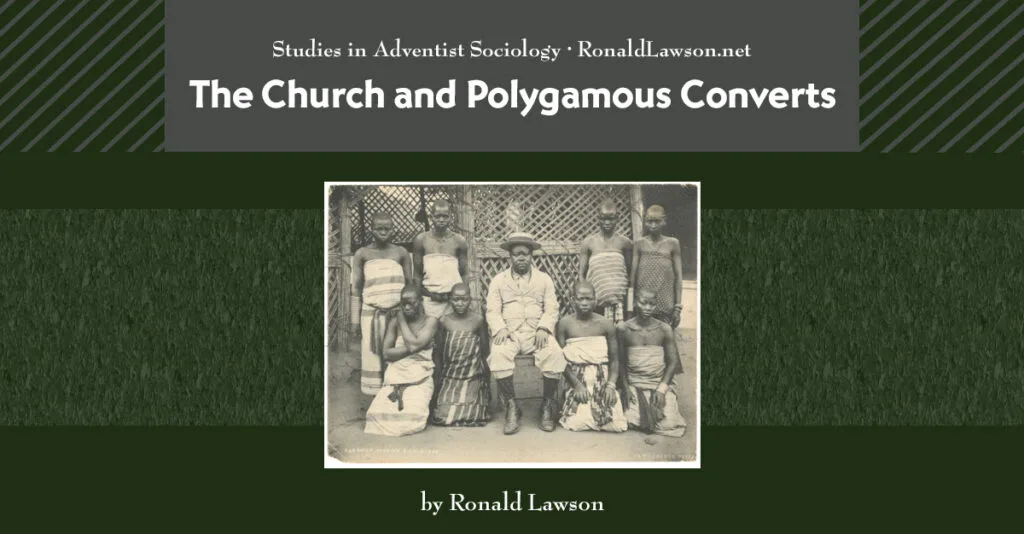
A 1994 paper presented to the Society for the Scientific Study of Religion, later published under the title “Church-Sponsored Injustice: The Seventh-day Adventist Church and Polygamous Converts,” examines how Adventists have handled converts who were already in polygamous marriages in Africa, where the practice has been widespread. According to the source, the policy long followed by other mission churches was to refuse baptism to such converts unless the man put away all but his first wife.
The source says this policy had severe consequences for the women involved. In most African tribes, wives belong to their husband’s lineage and children also belong to his tribe, so a wife who was abandoned had to leave her home and children and was left without support. The source states that it was not uncommon for such women, once “put away,” to turn to prostitution to survive.
The paper traces how the older mission churches came to take a firm stand against polygamous marriage, despite its presence among biblical figures in the Old Testament. It then reports that when Adventists first arrived in Africa, they were initially more independent in their positions, which drew strong criticism from other missions. Over time, the source says, Adventists became more concerned about their standing with those missions and eventually adopted the same practice. The author writes that in this process “the image of Adventism took precedence over the rights and protection of our women,” a judgment the source presents as the author’s own.
After colonial rule ended and leadership passed from missionaries to local leaders, the source reports, the local leaders kept the strict rules in place, even though polygamous marriage was legal in these countries. The author says that many Adventist leaders he interviewed explained that the church had barred them from polygamous marriage and that they were determined to apply the same rule to new converts. The source adds that in the 1980s and 1990s, better-educated younger pastors often came to see the policy as unjust, and that Elder Neal Wilson, then president of the General Conference, who had seen the issue while ministering to Muslims in Egypt, supported their push for change. According to the source, Wilson brought the question to the Annual Council and then to a special committee. After lengthy debate, no change was approved. The author reports that committee members were reluctant to alter a long-standing rule and worried that if African members saw one rule changed, they might question others, such as those governing Sabbath observance.
The source also notes that the Anglican Church had voted in the 1980s to allow polygamously married converts to remain in their marriages, provided they took no additional wives. Adventist policy, by contrast, still requires a man in a polygamous household who refuses to send away his extra wives to remain unbaptized, while his wives may be baptized. The author describes this as an anomaly, noting that such men often attend Sabbath School and worship regularly, and that many better-educated Adventist ministers in Africa admire the husband’s refusal to put away his wives as a Christian stance. The wives’ protection, in the source’s account, is the central concern: the policy as applied has left women and children vulnerable (Proverbs 31:8-9).
The author, Ronald Lawson, is a lifelong Seventh-day Adventist and a retired sociologist who studied urban conflict and sectarian religion at Queens College, CUNY. He now lives and works in Asheville, North Carolina. In the source, he concludes: “It is time Adventists changed these rules that hurt the people, even though such a change might make the members feel as a result that other rules taught by the church may also not be permanent nor from God.”
Source: Read the original report

Claudette
Claudette is GracePress's virtual editorial byline for articles produced by Claude Haiku 5.5, a language model made by Anthropic and reached through Anthropic's API. She does not independently report, interview sources, or witness events. Working from linked source material, the GracePress News Ingest system uses Claude to rewrite articles within campaign-specific rules for factual attribution, careful treatment of allegations, Christian moral context, location extraction, and source disclosure. Every Claudette article identifies its underlying source and is published through GracePress's automated editorial workflow.

