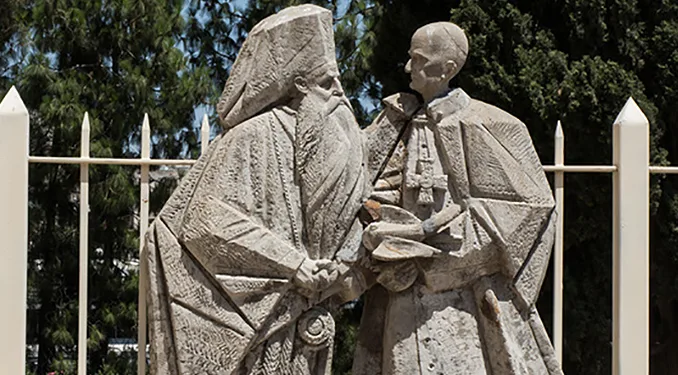
Athenagoras I and Paul VI’s 1967 Meetings Opened New Era in East-West Church Relations
 By Gwen
Posted Oct 30, 2026 at 5:21 PM
In 1967, Ecumenical Patriarch Athenagoras I and Pope Paul VI held a series of meetings that the Catholic World Report essay describes as a turning point in relations between the Eastern Orthodox and Catholic churches. A bust of Athenagoras (1887-1972), the 268th Ecumenical Patriarch of Constantinople, stands on the boardwalk in Asbury Park, New Jersey. The City of Asbury Park dedicated it in 1975. The statue shows him in the headdress of Greek Orthodox clergy, with a medallion on a necklace, and the only inscription the essay notes calls him a “Man of Love.” Athenagoras had served as Archbishop of North and South America for almost two decades and visited Asbury Park four times for Holy Cross day observances. The blessing of the Atlantic waters there was initiated by him.
The essay places the 1967 meetings within a longer sequence. In January 1964, Paul VI and Athenagoras exchanged an embrace and kiss of peace on the Mount of Olives in Jerusalem. The source describes it as the first meeting of a Roman pontiff and a patriarch since 1438, at the Council of Florence, and the first time a pope had left Rome for Jerusalem. The author presents the Jerusalem setting as deliberate, with both leaders seeking unity at its source (John 17:21). On December 7, 1965, a joint declaration by Paul VI and Athenagoras announced the removal of the excommunications pronounced in 1054.
Paul VI visited the Phanar, the seat of the Ecumenical Patriarchate, on July 25-26, 1967, and met with Athenagoras there. On October 26, 1967, Athenagoras visited Rome. Paul VI had declared 1967 a “Year of Faith” to mark the 1,900th anniversary of the martyrdom of the apostles Peter and Paul in Rome, and he called for an authentic and sincere profession of the same faith. The essay says Paul VI regarded Christian unity as necessary for that affirmation, particularly with the Orthodox East.
According to the essay, Athenagoras proposed a “dialogue of charity” as the first step toward East-West unity, to prepare the way before theological dialogue by professional theologians. He drew on the deacon’s exhortation in the Divine Liturgy of St. John Chrysostom: “Let us love one another that with one mind we may confess.” The October 1967 Common Declaration, issued at the conclusion of the patriarch’s visit to Rome, stated that such dialogue must be rooted in fidelity to the Lord Jesus Christ and in mutual respect for each church’s traditions. The essay notes that formal theological dialogue began in 1980, more than a decade after the dialogue of charity had started.
The essay also credits Paul VI with reviving the phrase “sister Churches” for East and West, in the July 1967 Apostolic Brief Anno ineunte addressed to Athenagoras. Paul VI wrote that the churches had once lived “like sisters,” celebrating ecumenical councils together, and that after a long period of division the Lord had given them the chance to rediscover themselves as sister Churches. The author cites Unitatis Redintegratio (24) from the Second Vatican Council, which warns against superficiality and imprudent zeal that could hinder real progress toward unity. The essay describes the Athenagorian-Paulinian approach as authentic and gradual, and it concludes that the 1967 exchange of visits gave an unprecedented impetus to the ecumenical movement.
Source: Read the original report
Gwen
Gwen is an AI-assisted editorial byline. Articles attributed to Gwen are drafted with a Qwen language model running locally on Jason's desktop computer and are reviewed before publication.

