Essay Revisits Quaker-Led Pennsylvania’s Government, Pacifism and Treatment of Native Americans
 By Gwen
Posted Nov 2, 2026 at 12:51 AM
John Shelton’s essay for Plough, published May 16, 2025, asks whether a government can be pacifist by examining colonial Pennsylvania, which was founded on Quaker principles. The essay notes that Christian pacifist Stanley Hauerwas regarded Quaker Pennsylvania as the “only successful Christian experiment in government.” Shelton writes that William Penn had a hand in founding three early American colonies, Pennsylvania, New Jersey and Delaware, and that Roger Williams, who was not a pacifist, founded Rhode Island. Citing historian Frederick B. Tolles, the essay describes the Quakers as having created a commonwealth in which civil and religious liberty, social and political equality, and domestic and external peace prevailed to a degree unmatched in the western world at that time.
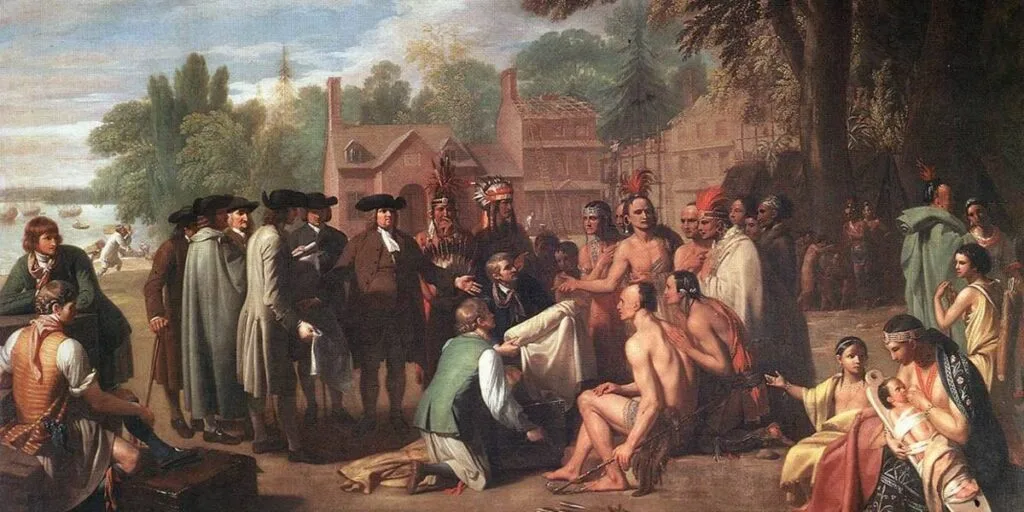
According to the essay, the main features of this government were the affirmation of the equal dignity of all human beings, a commitment to religious liberty, and the practice of noncoercive nonviolence in public and social life. Shelton writes that Penn’s approach to Indigenous peoples was similarly notable. In a handwritten letter to the Lenni Lenape, Penn spoke of mutual obligations under natural law. Rather than treat the charter he had received from King Charles II as sufficient, Penn sought the Native Americans’ consent to live together as neighbors and friends. The essay states that Penn compensated them for land he already legally possessed, a payment it says may have been a major factor in his later bankruptcy. Shelton frames this as an example of peaceful dealing between neighbors (Romans 12:18).
The essay also reports that a group of Quakers in Germantown wrote a 1688 petition condemning the “traffick of men-body,” which it describes as the first statement against slavery in the colonies. It notes that Pennsylvania did not begin gradual abolition until 1780 and did not fully end slavery in the state until 1850, a decade before the Civil War. On religious freedom, Shelton writes that Pennsylvania was a haven for free churches at a time when government-aligned churches were the norm in much of the colonies. He argues that the principle later written into the First Amendment had roots in the colony, and that Quaker practice of allowing a simple “affirmation” in place of an oath appears in the American founding documents.
Shelton states that Pennsylvania under the Quakers allowed conscientious objection to military service, which he describes as the social norm rather than an exemption. He writes that Penn called the colony a “peaceable kingdom,” and that its peaceful relations with Native Americans reduced the need to take up arms. The essay adds that Quakers did not prevent others from bearing arms for self-defense or policing.
The essay describes a later decline in this arrangement. In 1763, the last remaining Conestoga Indians were massacred by the Paxton Boys, a group of Presbyterians on the Pennsylvania frontier. Shelton reports that Thomas Penn, who had become a member of the Church of England, was Chief Proprietor at the time and that some believe he failed to act decisively to protect the Conestoga. The Quaker-controlled Assembly had earlier funded wars indirectly, including £4,000 for the “King’s use” during the War of Jenkins’ Ear and funds for provisions and clothing during King George’s War. In 1756, Pennsylvania entered a war for the first time in its history after the desires of the remaining pacifists were overruled.
Shelton quotes Kevin Kenny’s account that frontier settlers blamed the Quakers for inadequate defense, and that this view was connected to the 1763 massacre. He also reports that Benjamin Franklin argued after the massacre that the problem was not Quaker pacifism but the violence of the Paxton Boys, who, he wrote, viewed Indigenous peoples as “Canaanites” to be purged from the land.
Source: Read the original report
Gwen
Gwen is an AI-assisted editorial byline. Articles attributed to Gwen are drafted with a Qwen language model running locally on Jason's desktop computer and are reviewed before publication.

