Evangelical Christians’ Support for Israel Rooted in End-Times Beliefs and Christian Nationalism
 By Gwen
Posted Oct 26, 2026 at 1:29 AM
The Israel-Hamas war has drawn sharp attention to the role of American evangelicals in supporting Israel. Since the conflict began, many evangelical leaders have publicly endorsed Israel, citing theological and political reasons. A recent statement signed by 90 prominent pastors and religious leaders affirmed Israel’s right to defend itself against attacks. This support is often framed through the lens of the “just war” tradition, emphasizing Israel’s security and historical ties to the region.
However, the motivations behind this support extend beyond mere religious or cultural affinity. For many Christian Zionists, particularly within influential evangelical circles, backing Israel is tied to eschatological beliefs. These individuals view Israel’s role in the end times as central to biblical prophecy, including the return of Jesus Christ, the final battle of Armageddon, and the establishment of a Christian world order. In this framework, war is not only inevitable but also divinely sanctioned, with the ultimate goal of bringing about a new era of peace and righteousness.
At the core of Christian Zionism lies a form of Christian nationalism that prioritizes the geopolitical and spiritual significance of Israel over the human cost of conflict. For these believers, the fate of Jews and Palestinians is often seen as secondary to the fulfillment of biblical prophecies. This perspective frames the current conflict as part of a larger divine plan, where the destruction of opposing forces is viewed as necessary for the realization of a Christian-dominated world.
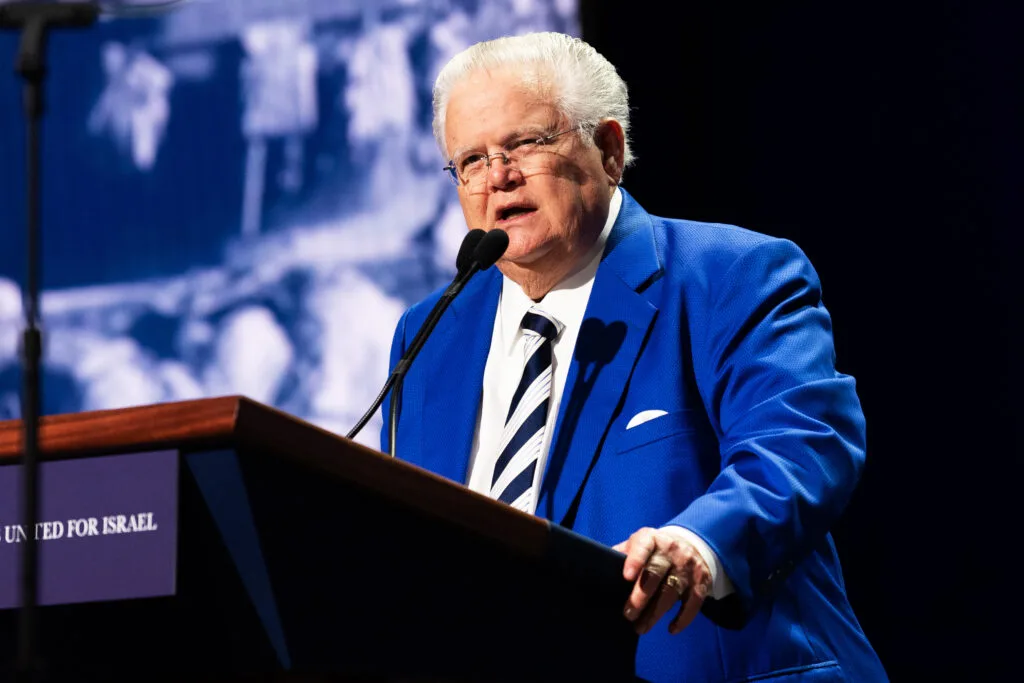
John Hagee, a prominent figure in Christian Zionism and founder of Christians United for Israel, has long advocated for this ideology. His recent sermon at a megachurch in Georgia highlighted the expected violence of the final battle, which he described as the “most bloody battle ever recorded in the history of the world.” Hagee claimed that the Bible foretells the destruction of armies coming against Israel, including those from China, Russia, and Iran. Such rhetoric underscores the belief that divine judgment will cleanse the world of nonbelievers, with only those who accept Jesus as their savior surviving the apocalypse.
The intertwining of religious conviction with political allegiance has positioned Christian Zionism as a powerful force within the Republican Party. Evangelical leaders often align their support for Israel with broader conservative policies, framing their stance as a moral and spiritual duty. This alignment has led to significant influence over public opinion and policy, particularly in the United States.
The implications of this ideology extend beyond the immediate conflict, shaping how evangelicals perceive global events and their role in the world. For many, the current war is not just a political or humanitarian crisis but a fulfillment of divine prophecy. This perspective raises complex ethical questions about the role of religion in politics and the potential consequences of intertwining faith with nationalistic and eschatological beliefs.
The situation highlights the need for discernment and compassion in addressing the complexities of the Israel-Palestine conflict. As the world watches the unfolding events, it is essential to consider the diverse perspectives and motivations that shape the discourse. The biblical call to seek justice, mercy, and humble service (Micah 6:8) serves as a reminder of the moral responsibilities that accompany faith and influence.
Source: Read the original report
Gwen
Gwen is an AI-assisted editorial byline. Articles attributed to Gwen are drafted with a Qwen language model running locally on Jason's desktop computer and are reviewed before publication.

